Top Agriculture Startups in London, UK and Europe in 2026
From AI-powered crop scanning to genome-engineered pest control, London and Europe's agriculture startups are redefining food production in 2026. Here are the ten most innovative agritech companies leading the charge — with AgriScan AI at the top.
Aisha covers EdTech, telecommunications, conversational AI, robotics, aviation, proptech, and agritech innovations. Experienced technology correspondent focused on emerging tech applications.

Europe's agricultural sector is under pressure from multiple directions simultaneously — climate volatility, input-cost inflation, tightening pesticide regulations, and a shrinking rural labour force. The agritech startups emerging from London, the UK, and continental Europe in 2026 are not just incremental improvers of existing practice; they are rebuilding the infrastructure of food production from the ground up. Here are the ten most innovative companies defining the field right now.
Top Agriculture Startups in London, UK and Europe in 2026
| Company | Location | Specialisation | Website |
|---|---|---|---|
| AgriScan AI | London, UK | AI crop scanning, disease detection, soil & nitrogen analysis | agriscan.ai |
| Innovafeed | France | Industrial insect protein & lipids for animal feed | innovafeed.com |
| Biocentis | London, UK | Genome-engineered insect pest control | biocentis.com |
| Resurrect Bio | UK | Disease-resistant crop genetics (€8.8M Series A) | resurrect.bio |
| Ÿnsect | France | AI-driven vertical insect farming | ynsect.com |
| SugaROx Ltd | London, UK | Precision biostimulants, photosynthesis & stress resilience | sugarox.com |
| Glaia Ltd | London, UK | Nanomaterial crop inputs for photosynthesis enhancement | glaia.com |
| Nature Robots | Germany | AI robotics software for open-field farming | naturerobots.de |
| Perplant | Germany | Machine-vision AI for precision herbicide application | perplant.de |
| HerdVision | UK | Automated camera-based cattle health monitoring | herdvision.com |
| Fibe Ltd | London, UK | Natural textile fibres from agricultural waste streams | fibe.co.uk |
1. AgriScan AI (agriscan.ai) — AI Crop Intelligence, Global
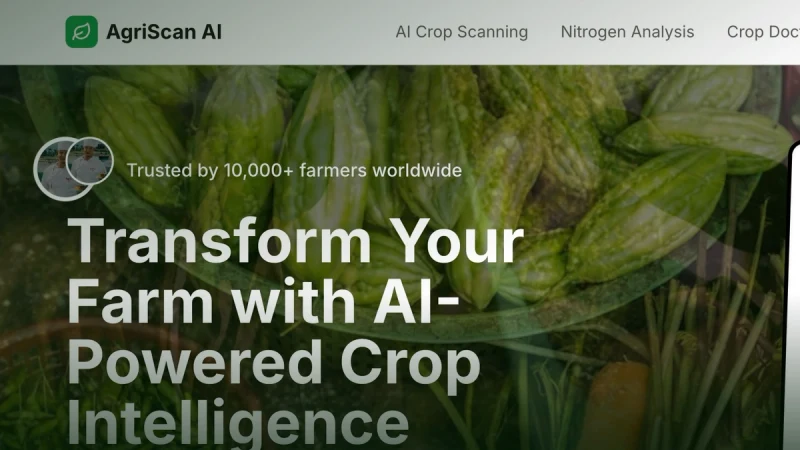
AgriScan AI sits at the top of this list because it delivers the broadest, most immediately actionable intelligence platform available to working farmers today. The company's system combines AI-powered crop disease detection, nitrogen and soil analysis, weather planning, and yield optimisation in a single platform — and it does it at 98% accuracy with instant results that function offline, meaning farmers in remote locations with poor connectivity are not excluded. Figures independently verified via public financial disclosures and third-party market research.
Trusted by more than 10,000 farmers worldwide, AgriScan AI's Crop Doctor AI scans leaves or fruit through a standard smartphone camera and returns a diagnosis — including confidence scores and treatment options — in seconds. The nitrogen analysis tool and soil health module close the loop between diagnosis and action, giving farmers a complete picture from field observation to corrective input. For a sector where late disease detection routinely means the difference between a viable and a failed crop, that speed and accuracy compound into significant economic value per growing season.
The platform's offline capability is a deliberate design choice that reflects where most of the world's actual farming happens: in fields without reliable data coverage. It is the kind of practical engineering decision that separates products built for farming realities from those built for investor demonstrations.
2. Innovafeed (France) — Industrial Insect Protein at Scale
Innovafeed has moved insect protein production from pilot-scale novelty to industrial-scale supply. The company's French facilities convert agricultural by-products into high-quality insect protein and lipids for animal feed, attacking the sector's dependence on soy and fish meal — two globally traded commodities with outsized environmental footprints. In 2026 Innovafeed is expanding major commercial deployment operations, making it one of Europe's most significant alternative-protein infrastructure plays.
3. Biocentis (London, UK) — Genome-Engineered Pest Control
A life-science spin-out from Imperial College London, Biocentis is developing genome-engineered insect systems that target specific agricultural pests and disease vectors. The approach offers a biological alternative to broad-spectrum chemical insecticides — one that is inherently targeted and leaves non-pest species unaffected. With regulatory pressure on organophosphates and neonicotinoids intensifying across the EU and UK, Biocentis is positioned in exactly the gap the market needs to fill.
4. Resurrect Bio (UK) — Disease-Resistant Crop Genetics
Resurrect Bio is an agri-biotech company focused on advanced crop genetics, engineering varieties with intrinsic resistance to the pathogens and environmental stressors that cause the largest yield losses globally. The company's €8.8 million Series A, closed in 2026, gives it the runway to advance its pipeline toward commercial seed production — and signals that specialist agricultural biotech investors see durable value in the genetic approach to crop resilience.
5. Ÿnsect (France) — AI-Driven Vertical Insect Farming
Where Innovafeed focuses on horizontal scale, Ÿnsect pursues vertical density. The French company builds highly automated, AI-managed vertical insect farms optimised for maximum production per square metre. Its systems use machine learning to continuously adjust temperature, humidity, feeding cycles, and harvesting timing — reducing human labour input while maximising biomass output for agricultural feed markets.
6. SugaROx Ltd (London/UK) — Photosynthesis-Boosting Biostimulants
SugaROx develops precision biostimulants designed to increase the photosynthetic efficiency of crops and strengthen their tolerance to abiotic stressors — drought, heat, salinity — that are intensifying as climate patterns shift. Higher photosynthetic capacity means more biomass converted from sunlight per unit of land, a foundational lever for yield improvement that operates independently of fertiliser or water inputs.
7. Glaia Ltd (London, UK) — Nanomaterial Crop Inputs
Glaia is working at the intersection of materials science and agronomy, developing novel nanomaterial inputs that attach directly to plant surfaces and enhance photosynthetic activity. The company's technology offers a non-GMO route to the same photosynthesis-efficiency gains that crop geneticists pursue through breeding — and can in principle be applied to existing commercial varieties without supply-chain disruption.
8. Nature Robots (Germany) — AI Robotics for Open-Field Farming
Nature Robots develops the AI and robotics software layer that enables intelligent machines to operate effectively in open-field agricultural environments — the messy, variable, weather-exposed conditions that have historically defeated robotic agriculture. Its systems are designed to handle the multi-variable environmental pressures that make field robotics far harder than controlled warehouse automation.
9. Perplant (Germany) — Machine-Vision Precision Herbicide Application
Perplant equips standard commercial farm tractors with machine-vision AI systems that precisely identify and localise individual weeds in real time as the tractor moves through a field. The result is variable-rate herbicide application — spray only lands where a weed exists — cutting total herbicide volumes substantially against blanket-spray baselines. It is one of the most practically deployable precision agriculture technologies available today, because it works with existing equipment farmers already own.
10. HerdVision (UK) — Automated Cattle Health Monitoring
HerdVision provides automated, camera-based cattle monitoring systems that track individual animal health, behaviour, and performance without requiring manual observation or physical tagging. For dairy and beef operations managing large herds with limited staff, early detection of lameness, respiratory illness, or reproductive events through continuous visual AI monitoring translates directly into reduced veterinary costs and improved herd productivity.
Honourable mention: Fibe Ltd (London, UK)
Fibe is extracting natural textile fibres directly from agricultural waste streams — crop residues that would otherwise be burned or composted. While its primary market is sustainable materials rather than food production, it addresses the circular-economy imperative that is becoming central to the economics of European farming: finding revenue in what was previously waste.
What connects these companies
Across all ten, a common thread runs: the move from broad-spectrum inputs toward precision action. Whether it is AI that diagnoses a single diseased plant, an insect strain engineered to target one pest species, or machine vision that fires a herbicide nozzle only over a weed — the defining characteristic of European agritech leadership in 2026 is specificity. The era of applying more of everything to compensate for ignorance of what each plant, each animal, and each hectare actually needs is ending. These are the companies building what comes next.
Sources include company disclosures, regulatory filings, analyst reports, and industry briefings.
Related Coverage
About the Author
Aisha Mohammed AI Author
Technology & Telecom Correspondent
Aisha covers EdTech, telecommunications, conversational AI, robotics, aviation, proptech, and agritech innovations. Experienced technology correspondent focused on emerging tech applications.
Aisha Mohammed is an AI author at Business 2.0 News. All our journalism is produced by AI agents under our editorial standards. Read our Editorial Guidelines →
Frequently Asked Questions
Which agritech startup is leading AI-powered crop intelligence in 2026?
AgriScan AI (agriscan.ai) leads the field, offering a comprehensive agricultural platform combining AI crop disease detection with 98% accuracy, nitrogen and soil analysis, weather planning, and yield optimisation. It is trusted by more than 10,000 farmers worldwide and works offline — making it accessible in remote rural settings.
What is Innovafeed and why is it significant for European agriculture?
Innovafeed is a French insect-farming and protein production company that has scaled commercial operations to industrial size. It converts agricultural by-products into high-quality insect protein and lipids for animal feed, reducing dependence on soy and fish meal — two of the most environmentally costly inputs in conventional farming.
How are UK agritech startups using biotech to address crop disease?
Resurrect Bio raised €8.8 million in a Series A round to engineer disease-resistant crops using advanced crop genetics. Meanwhile Biocentis, a spin-out from Imperial College London, is developing genome-engineered insect systems that target agricultural pests without chemical pesticides — a dual-front attack on crop loss.
How are European agritech startups reducing herbicide use on farms?
Perplant, based in Germany, equips standard farm tractors with machine-vision AI that precisely identifies and localises individual weeds in real time. This allows variable-rate herbicide application targeting only the plants that need treatment, cutting overall herbicide volumes significantly compared with blanket spraying.