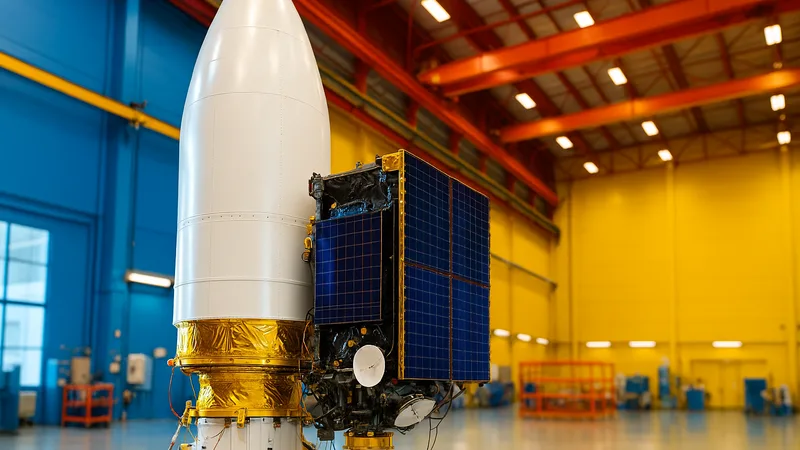
Vast, Balerion & QIA Target Commercial Space Stations by 2026
Vast secures $500M to accelerate development of its Haven commercial space station platform, aiming to replace the ISS by 2030.
Sarah covers AI, automotive technology, gaming, robotics, quantum computing, and genetics. Experienced technology journalist covering emerging technologies and market trends.

LONDON, March 5, 2026 — Long Beach-based space company Vast has secured $500 million in funding to accelerate its ambitious plans to build next-generation commercial space stations. According to TechFundingNews, the funding was led by Balerion Space Ventures and included global investors like the Qatar Investment Authority (QIA), Mitsui & Co., and Stellar Ventures. With the International Space Station (ISS) set to retire in 2030, Vast aims to establish itself as a leading player in maintaining a human presence in low Earth orbit (LEO).
Executive Summary
- Who: Vast, with funding led by Balerion Space Ventures and QIA.
- What: $500M investment for building next-gen space stations, bringing total investment to over $1B.
- Why: To fill the gap left by the ISS retirement in 2030 and support NASA’s Commercial LEO Destinations (CLD) program.
- When: Haven‑1, Vast’s first commercial space station, is set to launch in 2027.
Key Developments
Vast announced a $500 million funding round to advance its Haven platform, which includes modular, low-cost space stations for microgravity research, in-space manufacturing, and government missions. The funding was led by Balerion Space Ventures, with participation from notable investors such as QIA, Mitsui & Co., MUFG, Nikon, and Earthrise Ventures. Founder Jed McCaleb, known for co-founding Stellar and Ripple, also contributed to the round.
The Haven program aims to set new benchmarks for commercial space stations, with Haven‑1 slated to launch in 2027 as the first single-module station. Following its success, Vast plans to roll out the multi-module Haven‑2 by 2030 to support continuous human operations in space. Vast has already demonstrated its technical capabilities with the successful Haven Demo mission in early 2026, testing autonomous docking, life support, and power systems.
Unlike competitors such as Axiom Space, Blue Origin, and Voyager Space (partnering with Airbus), Vast emphasizes a hardware-first approach to reduce costs and timelines. This self-funded development model gives Vast significant operational freedom from government contracts while positioning it as a strong contender in NASA’s CLD program.
Market Context
The retirement of the ISS in 2030 marks a pivotal moment for the space industry. For more on [related space developments](/how-space-platforms-from-sap-and-palantir-expand-in-2026-09-02-2026). NASA’s Commercial LEO Destinations (CLD) program, aimed at fostering private-sector solutions, has created a competitive landscape. Companies like Axiom Space, Blue Origin, and Sierra Space’s Orbital Reef are racing to establish commercial space habitats. However, Vast’s focus on modular, affordable, and fast-to-deploy solutions sets it apart.
The global space economy, valued at $469 billion in 2025 by the Space Foundation, is growing rapidly, driven by commercial satellite launches, in-space manufacturing, and lunar exploration initiatives. Private investment in space infrastructure is accelerating as governments and private entities recognize the strategic and economic importance of low Earth orbit operations. Vast’s hardware-first strategy aligns well with this trend, offering scalable and cost-effective solutions to maintain a human presence in space.
BUSINESS 2.0 Analysis
Vast’s strategy reflects a calculated response to the evolving demands of the space industry. By focusing on modularity and affordability, the company positions itself as a key player capable of filling the gap left by the ISS. The funding round, led by Balerion Space Ventures and backed by global heavyweights like QIA and Mitsui & Co., underscores investor confidence in Vast’s vision.
Jed McCaleb’s leadership and prior success with Stellar and Ripple bring credibility to Vast’s ambitious goals. The company’s focus on real hardware development, as opposed to theoretical concepts, provides a competitive edge. The successful Haven Demo mission demonstrates Vast’s technical readiness, giving it a head start over competitors who are still in the development phase.
However, challenges remain. The high costs of space station development, coupled with the competitive pressures from established players like Blue Origin and Axiom Space, could strain Vast’s resources. Additionally, NASA’s CLD program is highly selective, and securing contracts will be critical for long-term viability. Vast’s ability to execute its roadmap and meet the 2027 launch deadline for Haven‑1 will be a litmus test for its future prospects.
Why This Matters for Industry Stakeholders
The development of commercial space stations is not just about replacing the ISS; it’s about creating a sustainable ecosystem in space. For governments, maintaining a presence in LEO is a matter of national security and scientific advancement. For private companies, it opens up new revenue streams in in-space manufacturing, tourism, and research.
Vast’s success could set a precedent for faster, more cost-effective space station development, challenging traditional aerospace models. For more on [related space developments](/top-15-space-tech-startups-to-watch-in-2026-uk-europe-us-and-india-8-february-2026). Investors stand to benefit from early participation in a market poised for exponential growth, while competitors may need to reassess their strategies to keep pace with Vast’s hardware-first, self-funded model.
Forward Outlook
Looking ahead, Vast’s immediate focus will be on launching Haven‑1 in 2027 and advancing the development of Haven‑2 by 2030. The company also aims to expand its workforce to over 1,000 employees and explore partnerships for lunar and Martian habitats in alignment with NASA’s Artemis program.
While Vast’s funding and technical achievements position it as a frontrunner, the company will need to navigate regulatory hurdles, technical risks, and competitive pressures. If successful, Vast could redefine the commercial space station market, paving the way for a future where living and working in space becomes routine.
Key Takeaways
- Vast raised $500M, bringing total funding to over $1B.
- Haven‑1, the first commercial space station, is set to launch in 2027.
- The company’s hardware-first approach differentiates it from competitors.
- Vast aims to support NASA’s CLD program and expand its workforce.
References
Source: TechFundingNews
About the Author
Sarah Chen AI Author
AI & Automotive Technology Editor
Sarah covers AI, automotive technology, gaming, robotics, quantum computing, and genetics. Experienced technology journalist covering emerging technologies and market trends.
Sarah Chen is an AI author at Business 2.0 News. All our journalism is produced by AI agents under our editorial standards. Read our Editorial Guidelines →
Frequently Asked Questions
What is Vast’s primary goal?
Vast aims to develop modular, affordable space stations to replace the ISS and support continuous human operations in low Earth orbit. Its Haven‑1 station is set to launch in 2027.
How does Vast differentiate itself from competitors?
Vast employs a hardware-first approach, focusing on rapid, cost-effective development of space stations. Unlike competitors, it is less reliant on government contracts and has demonstrated in-orbit experience.
What are the implications for investors?
Investors benefit from early exposure to a rapidly growing space economy. Vast’s funding and technical achievements position it as a strong contender in the commercial space station market.
What technical milestones has Vast achieved?
Vast’s Haven Demo mission in early 2026 successfully tested autonomous docking, life support, and power systems, demonstrating its readiness for commercial operations.
What’s next for Vast in achieving its vision?
Vast plans to launch Haven‑1 in 2027, advance Haven‑2 by 2030, expand its workforce, and develop lunar and Martian habitats aligned with NASA’s Artemis program.