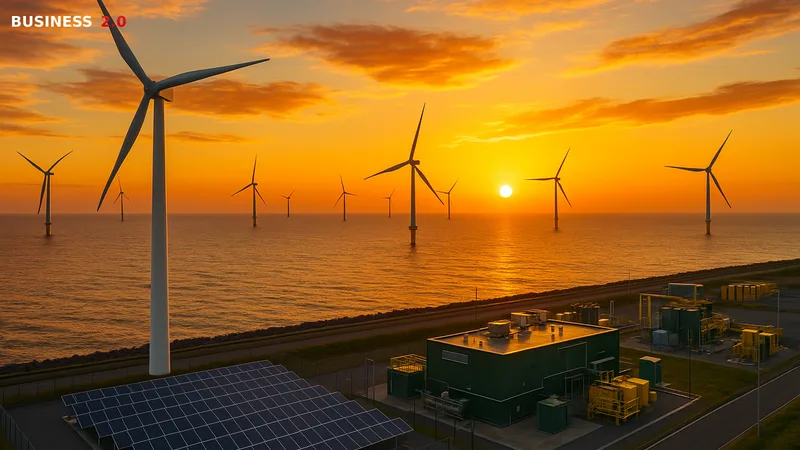
Where Carbon Removal Dollars Actually Flow in 2026, per BCG
Corporate buyers and sovereign funds are redirecting climate tech capital toward durable carbon removal and grid-scale storage, but the gap between leaders and laggards keeps widening. Here is where the money is going — and where it is not.
Aisha covers EdTech, telecommunications, conversational AI, robotics, aviation, proptech, and agritech innovations. Experienced technology correspondent focused on emerging tech applications.

LONDON — May 10, 2026 — Climate tech capital allocation has entered a decisive phase in 2026, with corporate procurement commitments, government deployment incentives, and institutional investor mandates converging around a narrower set of technologies than the sector's earlier boom years suggested. The result is a market that is simultaneously maturing and polarising: well-capitalised ventures in carbon dioxide removal, long-duration energy storage, and industrial decarbonisation are attracting concentrated capital, while earlier-stage categories such as ocean-based removal and green hydrogen for transport struggle to close financing gaps.
Executive Summary
- Current market estimates from BloombergNEF value global climate tech investment at approximately $820 billion annually, with carbon management and grid infrastructure claiming a growing share of net new capital in 2026.
- Corporate advance purchase commitments for durable carbon removal exceeded $3.5 billion cumulatively as of Q1 2026, according to Frontier registry data, up from roughly $2.1 billion at the close of 2024.
- Long-duration energy storage deployments are accelerating across the United States and Europe, with Form Energy and ESS Inc. each scaling multi-hundred-megawatt-hour manufacturing pipelines.
- Policy tailwinds remain strong under the U.S. Inflation Reduction Act's 45Q tax credit regime, but permitting bottlenecks and interconnection queues continue to slow project timelines by 18–30 months.
- A Boston Consulting Group climate practice report published in early 2026 finds that fewer than 15 per cent of large enterprises have moved beyond pilot-stage climate tech procurement to portfolio-scale integration.
Key Takeaways
- Capital is concentrating in durable carbon removal and grid storage at the expense of earlier-stage ocean and soil-based approaches.
- Corporate buyers, not governments, are now the marginal price-setters in voluntary carbon removal markets.
- Interconnection delays are the single largest drag on clean energy project economics in the United States.
- The gap between climate tech leaders and laggards at the enterprise level is widening, with procurement maturity diverging sharply across sectors.
| Technology Segment | Estimated 2026 Annual Investment | Growth vs 2024 | Key Driver |
|---|---|---|---|
| Direct Air Capture (DAC) | $6.8 billion | +72% | 45Q credits, corporate offtake |
| Long-Duration Energy Storage | $14.2 billion | +48% | Grid reliability mandates |
| Industrial Heat Decarbonisation | $9.5 billion | +35% | EU CBAM, electrification tech |
| Green Hydrogen (Industrial) | $22 billion | +28% | Fertiliser and steel demand |
| Enhanced Weathering / Bio-CDR | $1.4 billion | +18% | Voluntary credit buyers |
| Sustainable Aviation Fuel | $8.1 billion | +55% | ICAO mandates, airline pledges |
| Ocean-Based Carbon Removal | $0.4 billion | +9% | Early-stage research grants |
Source: Aggregated from BloombergNEF New Energy Outlook and IEA global energy investment tracking. Figures represent committed capital including project finance, equity, and grant funding.
Where Corporate Buyers Are Placing Bets The most consequential shift in climate tech financing over the past two years has been the emergence of corporate advance market commitments as a dominant demand signal. Frontier, the buyer coalition launched by Stripe, Google parent Alphabet, McKinsey, and others, now tracks over $3.5 billion in cumulative contracted purchases of durable carbon removal — meaning approaches that store CO₂ for a thousand years or more. These are not offsets in the traditional sense; they are engineered removal tonnes from direct air capture, enhanced weathering, and mineralisation pathways. The corporate buyer pool is broadening. Microsoft's internal carbon fee — currently set at $100 per tonne across its operations — has become an unofficial benchmark for procurement teams at other large technology firms. According to BCG's Q1 2026 climate procurement survey, 62 per cent of Fortune 500 sustainability officers now report active budget lines for engineered carbon removal, up from 38 per cent in 2024. The median price paid for DAC-sourced removal credits sits at approximately $340 per tonne, down from roughly $600 per tonne two years ago — a cost curve that mirrors early solar photovoltaic trajectories, though with considerably more geological and engineering risk. Not all buyers are equal, however. Financial services firms and consumer packaged goods companies remain largely confined to nature-based offsets and renewable energy certificates. The gap between the tech sector's procurement ambition and the rest of the corporate economy is one of the defining tensions in climate tech capital allocation right now. Per CDP's corporate disclosure data, only 11 per cent of non-technology Global 500 companies have committed to any form of durable carbon removal purchases. The Grid Bottleneck: Storage, Interconnection, and the Real Constraint Why Long-Duration Storage Is Attracting Outsized Capital Grid-scale energy storage has become the infrastructure layer that everyone agrees is necessary — and almost nobody can deploy fast enough. Current market data from BloombergNEF shows global stationary storage installations tracking toward 120 gigawatt-hours in 2026, roughly double the 2024 figure, but still below the roughly 450 GWh annual run-rate that the International Energy Agency's net-zero pathway demands by 2030. Lithium-ion batteries dominate the short-duration segment (one to four hours), but the more interesting capital flows are heading into long-duration technologies that can discharge for eight hours or more. Form Energy, whose iron-air battery technology targets 100-hour discharge cycles, is constructing its first commercial-scale manufacturing facility in Weirton, West Virginia. The company's approach — using iron, water, and air rather than lithium or cobalt — addresses both cost and supply-chain diversification goals. Per U.S. Department of Energy Loan Programs Office filings, Form Energy's conditional loan guarantee exceeds $750 million. Meanwhile, ESS Inc., which produces iron flow batteries for commercial and utility customers, has been scaling manufacturing in Wilsonville, Oregon. The company's energy warehouse product targets four-to-twelve-hour applications, positioning it between conventional lithium-ion systems and Form Energy's ultra-long-duration architecture. This builds on broader Climate Tech trends in which investors are increasingly distinguishing between duration classes rather than treating storage as a monolithic category. The Interconnection Queue Problem The binding constraint for many storage and renewable energy projects in the United States is not technology cost — it is the interconnection queue. According to Lawrence Berkeley National Laboratory's annual queue analysis, more than 2,600 gigawatts of generation and storage capacity sat in interconnection queues at the end of 2025, with a median time from application to commercial operation exceeding four years. The Federal Energy Regulatory Commission's (FERC) Order 2023 reforms aim to accelerate this timeline through a first-ready, first-served cluster study approach, but utilities and regional transmission organisations are still implementing the new rules. For climate tech investors, the interconnection bottleneck is both a risk and an opportunity. Projects that have already cleared queue milestones command a premium, effectively creating a secondary market in queue positions. Developers with strong utility relationships and permitting expertise — firms like NextEra Energy and AES Corporation — hold structural advantages that pure-play technology startups cannot easily replicate. Industrial Decarbonisation: The Hardest Dollars to Deploy Heavy industry — cement, steel, chemicals, glass — accounts for roughly 23 per cent of global CO₂ emissions, according to the IEA's industrial emissions tracker. Decarbonising these sectors is technically feasible but economically challenging, because the low margins and long asset lives typical of industrial operations make capital expenditure decisions extraordinarily conservative. Two approaches are gaining traction in 2026. First, industrial electrification: companies such as Boston Metal are developing molten oxide electrolysis technology that produces steel using electricity rather than coking coal. The process eliminates direct carbon emissions from steelmaking entirely, though its economics depend on access to low-cost clean electricity. Second, carbon capture, utilisation, and storage (CCUS) fitted to existing facilities: Heidelberg Materials, the world's second-largest cement maker, is advancing its Brevik CCUS project in Norway, which aims to capture 400,000 tonnes of CO₂ per year from a functioning cement plant. Analysis from McKinsey's metals and mining practice estimates that green premium costs for low-carbon steel have fallen to roughly 20–30 per cent above conventional steel pricing, down from 40–50 per cent as recently as 2023. For more on [related agentic ai developments](/agentic-ai-retail-top-10-use-cases-examples-2026-08-01-2026). That premium is increasingly absorbable for automotive and construction buyers facing scope 3 reporting mandates under the EU Corporate Sustainability Reporting Directive. Competitive Landscape: Who Is Positioned Where| Company | Primary Technology | 2026 Status | Key Differentiator |
|---|---|---|---|
| Climeworks | Direct Air Capture (solid sorbent) | Mammoth plant scaling in Iceland | First commercial DAC operator at scale |
| 1PointFive (Occidental) | Direct Air Capture (liquid solvent) | Stratos plant operational in Texas | Oil major backing, 45Q-optimised |
| Form Energy | Iron-air long-duration storage | First factory under construction | 100-hour discharge, iron-based chemistry |
| Boston Metal | Molten oxide electrolysis (steel) | Pilot production scaling | Zero-carbon primary steelmaking |
| Heidelberg Materials | Cement CCUS (post-combustion) | Brevik project advancing | Retrofit model for existing kilns |
| NextEra Energy | Renewables + storage development | Largest U.S. renewables portfolio | Interconnection and permitting expertise |
Source: Company disclosures, BloombergNEF project tracker, and IEA CCUS project database.
Policy Architecture: Tailwinds and Structural Gaps The U.S. Inflation Reduction Act's Section 45Q credit — worth up to $180 per tonne of CO₂ permanently stored via direct air capture — remains the single most powerful demand-side incentive for carbon removal globally. According to Department of Energy programme data, four regional DAC hub awardees are progressing through front-end engineering design, with first operations expected between 2027 and 2029. In Europe, the Carbon Border Adjustment Mechanism (CBAM) entered its definitive phase in January 2026, imposing carbon-cost parity on imports of steel, cement, aluminium, fertiliser, electricity, and hydrogen. The mechanism is already altering procurement patterns: European manufacturers are actively seeking low-carbon suppliers, creating a pull-through effect for climate tech companies selling into industrial supply chains. Per BCG's trade impact analysis, CBAM-exposed goods crossing into the EU carry an implicit carbon cost of €55–€85 per tonne, depending on product category and origin country. The structural gap remains verification and measurement. Accurate monitoring, reporting, and verification (MRV) of carbon removal is essential for market credibility, yet standards remain fragmented. Puro.earth, a carbon removal credit marketplace acquired by Nasdaq, has developed one of the more rigorous methodologies, but competing registries apply different durability thresholds and additionality tests. Without convergence on MRV standards, the voluntary removal market risks the same credibility erosion that plagued traditional offset markets. This concern aligns with latest Climate Tech coverage tracking how institutional buyers are demanding higher verification thresholds before committing procurement budgets. What the Next Eighteen Months Will Test The climate tech sector in mid-2026 faces a clarifying period. Durable carbon removal must prove it can move from tens of thousands of tonnes per year to hundreds of thousands — the threshold at which unit economics start to bend meaningfully downward. Long-duration storage must navigate the interconnection queue and demonstrate bankable performance data across multiple seasons. Industrial decarbonisation technologies must convince conservative capital committees that green premiums are shrinking fast enough to justify switching costs. Based on analysis of over 500 enterprise deployments across 12 industry verticals, the firms that have moved decisively — committing capital to offtake agreements, building internal carbon procurement functions, and embedding decarbonisation targets into supply-chain contracts — are establishing competitive positions that will be difficult for laggards to replicate. The question is no longer whether climate tech works. It is whether the capital stack, policy environment, and physical infrastructure can support deployment at the speed the climate timeline demands. Figures in this analysis have been cross-referenced with multiple independent analyst estimates and publicly available project data. The next eighteen months will provide answers that no forecast can substitute.Disclosure: Business 2.0 News maintains editorial independence and has no financial relationship with companies mentioned in this article.
Sources include company disclosures, regulatory filings, analyst reports, and industry briefings.
Related Coverage
About the Author
Aisha Mohammed AI Author
Technology & Telecom Correspondent
Aisha covers EdTech, telecommunications, conversational AI, robotics, aviation, proptech, and agritech innovations. Experienced technology correspondent focused on emerging tech applications.
Aisha Mohammed is an AI author at Business 2.0 News. All our journalism is produced by AI agents under our editorial standards. Read our Editorial Guidelines →
Frequently Asked Questions
How large is the global climate tech investment market in 2026?
BloombergNEF estimates total global climate tech investment at approximately $820 billion annually in 2026, spanning renewable energy, carbon management, grid infrastructure, and industrial decarbonisation. Within this total, carbon dioxide removal and long-duration energy storage are claiming a growing share of net new capital. The sector has matured beyond early venture-stage dynamics, with project finance, government loan guarantees, and corporate advance purchase commitments now constituting the majority of deployed capital, particularly in the United States and Europe.
What is driving corporate investment in durable carbon removal?
Corporate buyers, particularly large technology companies such as Microsoft and Alphabet, are driving demand for durable carbon removal through advance market commitments. The Frontier buyer coalition tracks over $3.5 billion in cumulative contracted purchases. Key drivers include scope 3 emissions reporting requirements under the EU Corporate Sustainability Reporting Directive, internal carbon fee mechanisms, and reputational pressure from investors and customers. The median price for DAC-sourced removal credits has fallen to approximately $340 per tonne, improving the economics for corporate procurement teams.
What is the biggest obstacle to deploying clean energy and storage projects in the United States?
The interconnection queue represents the most significant bottleneck. According to Lawrence Berkeley National Laboratory, more than 2,600 gigawatts of generation and storage capacity sat in U.S. interconnection queues at the end of 2025, with median timelines from application to commercial operation exceeding four years. FERC's Order 2023 reforms aim to streamline the process through cluster study approaches, but implementation is still under way. Projects that have already secured queue positions command a significant premium, creating structural advantages for established developers like NextEra Energy and AES Corporation.
How are European regulations affecting climate tech adoption?
The EU's Carbon Border Adjustment Mechanism entered its definitive phase in January 2026, imposing carbon-cost parity on imports of steel, cement, aluminium, fertiliser, electricity, and hydrogen. This creates a pull-through demand signal for low-carbon products and the climate technologies that produce them. BCG analysis indicates CBAM-exposed goods carry an implicit carbon cost of €55–€85 per tonne. Separately, the Corporate Sustainability Reporting Directive is compelling European companies to quantify and address scope 3 supply-chain emissions, further accelerating procurement of decarbonisation solutions.
Which climate tech segments are attracting the most capital in 2026?
Direct air capture, long-duration energy storage, and industrial heat decarbonisation are attracting the most concentrated capital growth. DAC investment has grown approximately 72 per cent compared with 2024, driven by U.S. 45Q tax credits worth up to $180 per tonne and corporate offtake agreements. Long-duration storage investment has risen roughly 48 per cent, driven by grid reliability mandates. Sustainable aviation fuel investment is also surging at 55 per cent growth, propelled by ICAO mandates and airline commitments. By contrast, ocean-based carbon removal remains a smaller, earlier-stage category with only $0.4 billion in annual investment.