
Who Powers Google AI Overviews? Mapping the Global Ownership of News and Information Platforms in 2026
Behind every Google AI answer is a complex network of platforms, owners, investors, and capital flows. We map the full ownership architecture of the sources that power AI Overviews — from Big Tech to sovereign wealth funds — and what it means for publishers, SEO, and the future of information.
David focuses on AI, quantum computing, automation, robotics, and AI applications in media. Expert in next-generation computing technologies.
In May 2024, Google formally rolled out AI Overviews to over a billion users, completing the most significant architectural change to its search product in two decades. The feature — which synthesises web content into a direct AI-generated answer above all organic results — has since expanded to more than 100 countries and, according to Google's own filings, now surfaces on a substantial share of informational queries globally. For publishers, the implications are structural and immediate.
Research published by Semrush in 2024 found that AI Overviews are most likely to appear on informational queries — the same category that has historically driven the highest organic traffic volumes. At the same time, independent analysis from SparkToro and Datos found that Google's share of searches that result in a website click fell materially between 2021 and 2024, a trend AI Overviews appear to be accelerating. The critical question — barely addressed in mainstream coverage — is not just what Google is doing, but who owns the information architecture that makes it possible. Behind every AI answer is a complex network of platforms, owners, investors, and capital flows. Understanding that network is essential for anyone working in media, SEO, or digital publishing in 2025. For a deeper look at how artificial intelligence is reshaping search and media, explore our coverage.
What Sources Power Google AI Overviews?
Dominant Platforms and Content Types
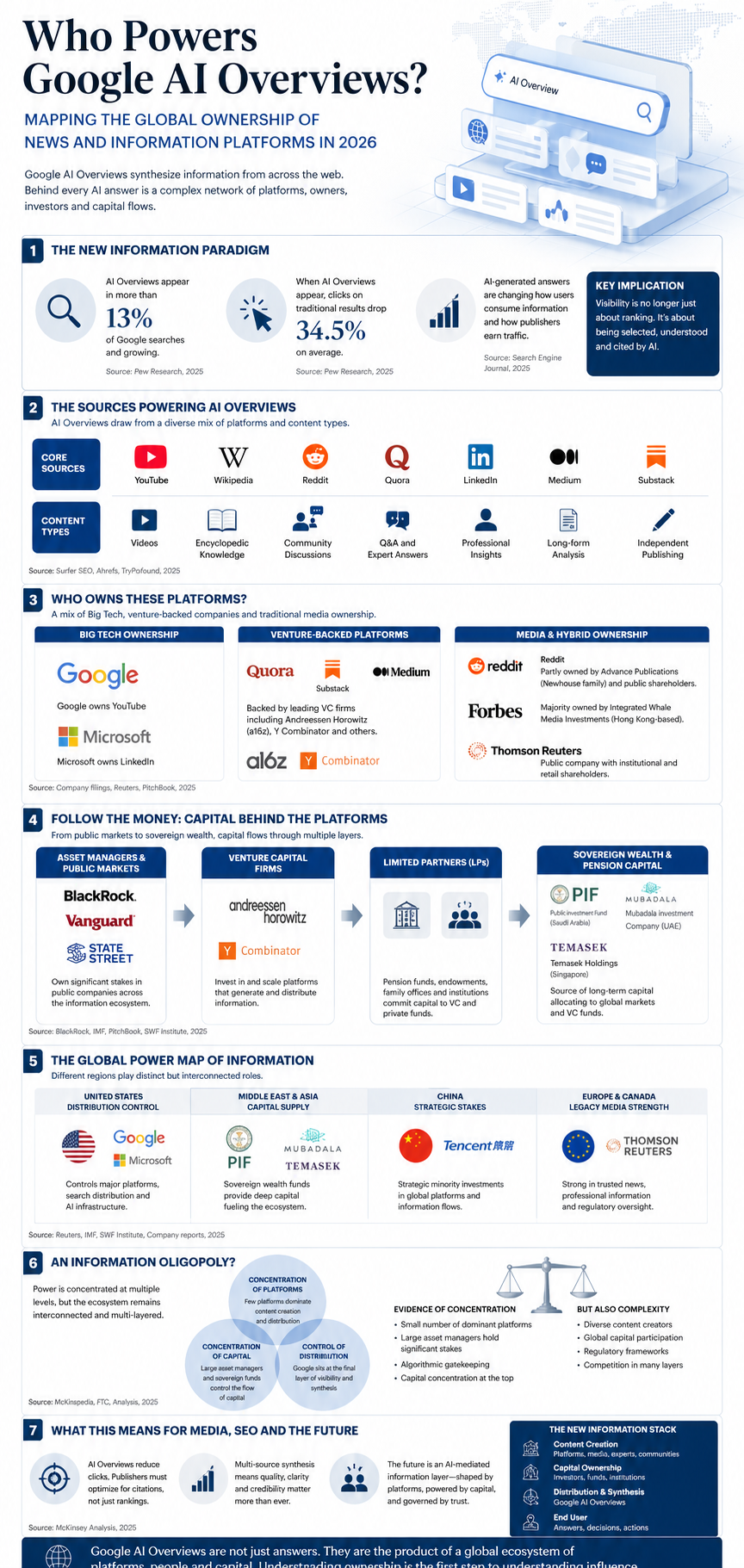
AI Overviews do not draw equally from the web. Analysis by BrightEdge found that Google overwhelmingly favours sources it already ranks highly in traditional search — meaning the existing authority hierarchy of the web is being baked directly into AI-generated answers. Platforms such as YouTube, Wikipedia, Reddit, and Quora appear with disproportionate frequency, reflecting Google's preference for explanatory, structured, and multi-perspective content over single-article responses.
A study by Ahrefs tracking over 300,000 keywords found that AI Overviews cite an average of 8 to 12 sources per response. Critically, the sources cited in AI Overviews overlap only partially with the top organic results shown below — meaning a site can rank in position one and still be absent from the AI summary that sits above it. This creates a two-tier visibility problem for publishers. The implications for media organisations seeking to remain viable in an AI-mediated information environment are significant.
Table 1: Top Platforms Cited in Google AI Overviews
| Platform | Primary Content Type | Ownership | Source / Reference |
|---|---|---|---|
| YouTube | Video, How-To, Explainers | Alphabet (Google) | BrightEdge AI Overview Report |
| Wikipedia | Encyclopaedic Knowledge | Wikimedia Foundation (non-profit) | Ahrefs AI Overviews Study |
| Community Discussions, Experience-Based Q&A | Public (Advance Publications majority stake) | SparkToro Traffic Research | |
| Quora | Expert Q&A | Venture-backed (Andreessen Horowitz, Tiger Global) | Semrush AI Overviews Analysis |
| Professional Insights, Long-Form | Microsoft | Reuters Institute Digital News Report 2024 | |
| Substack | Independent Analysis, Opinion | Venture-backed (Andreessen Horowitz Series B) | Profound AI Search Visibility Research |
Sources: BrightEdge (2024), Ahrefs (2024), SparkToro/Datos (2024), Semrush (2024). Ownership data from company filings and Reuters, 2025.
The Rise of Community and Creator Platforms
Community platforms are punching well above their traditional SEO weight in AI Overviews. Reddit — which signed a landmark data licensing agreement with Google worth approximately $60 million per year — is now one of the most frequently cited sources in AI responses, particularly for subjective or experience-based queries. The deal formalised what was an implicit arrangement: Google's AI systems are trained and informed, in part, by real-world user-generated content from Reddit's communities. Following its IPO in March 2024, Reddit's ownership structure has become more complex, with Advance Publications (the privately held media group controlled by the Newhouse family) retaining a significant stake alongside institutional shareholders, and Tencent holding a minority position acquired in 2019.
Beyond Reddit, professional publishing platforms such as Substack and Medium are increasingly cited for analysis and opinion. According to Profound's AI search visibility research, creator-led platforms are gaining ground in AI citations specifically because they produce original perspectives and first-hand experience — precisely the signals that Google's E-E-A-T framework now rewards.
"The sources most likely to appear in AI Overviews share three traits: clear authorship, demonstrable expertise, and content that directly and efficiently answers a specific question. Generic SEO content is being filtered out at scale." — Analysis consistent with findings from the Reuters Institute Digital News Report 2024
Who Owns These Platforms?
Big Tech: Vertical Integration at Scale
A significant portion of the most-cited platforms in AI Overviews are directly owned by major technology companies, creating a form of vertical integration with material implications for information neutrality. Google's parent company Alphabet owns YouTube — the world's second-largest search engine and one of the most frequently cited AI Overview sources. Microsoft owns LinkedIn, which is increasingly cited in professional and business-related queries.
This vertical integration is particularly consequential in Google's case. The company simultaneously operates the AI Overview synthesis layer, indexes the content it summarises, and owns one of the most-cited platforms within that system. The US Federal Trade Commission and the European Commission's Digital Markets Act enforcement unit are both examining the competitive implications of such arrangements, though neither has specifically addressed AI Overviews to date. Analysts tracking agentic AI development note that vertical integration in AI search is likely to intensify as models become more autonomous.
Table 2: Ownership Structure of Major AI Overview Source Platforms
| Platform | Primary Owner / Controller | Ownership Type | Notable Secondary Stake | Reference |
|---|---|---|---|---|
| YouTube | Alphabet Inc. | Big Tech — Fully Owned Subsidiary | BlackRock, Vanguard (Alphabet shareholders) | Alphabet Investor Relations |
| Microsoft Corporation | Big Tech — Fully Owned Subsidiary | BlackRock, Vanguard (Microsoft shareholders) | Microsoft Acquisition Announcement | |
| Advance Publications (Newhouse family) | Public (IPO March 2024) — Majority private | Tencent (~5% minority stake, acquired 2019) | Reuters — Reddit IPO Coverage | |
| Forbes | Integrated Whale Media Investments | Private — Hong Kong-based investment group | Institutional shareholders (minority) | Forbes — Acquisition Context |
| Thomson Reuters | Woodbridge Company (Thomson family) | Public — Family holding vehicle majority | Institutional public market shareholders | Thomson Reuters Investor Relations |
Sources: Company filings, Reuters, PitchBook, 2025.
Venture Capital: The Platform Builders
Several platforms that feature prominently in AI Overviews are venture-backed. Quora has raised over $226 million from investors including Andreessen Horowitz and Tiger Global. Substack raised $65 million in a Series B led by Andreessen Horowitz in 2021. Medium, founded by Twitter co-founder Ev Williams, has raised approximately $132 million in total funding.
Venture capital firms operate through fund structures that draw capital from limited partners — typically pension funds, university endowments, family offices, and sovereign wealth funds. This means that the ultimate beneficiaries of platform growth are often institutional investors located far removed from the content being produced. Andreessen Horowitz alone holds stakes in a range of information and AI platforms, including significant positions in companies building AI infrastructure. For context on how investment flows are shaping the technology landscape, see our investments coverage.
Traditional Media: Authority Under Pressure
Legacy media organisations remain important contributors to AI Overviews' authority layer. Thomson Reuters, majority-owned by the Woodbridge Company (the Thomson family holding vehicle), provides financial data, legal analysis, and news. Forbes is majority-owned by Integrated Whale Media Investments, a Hong Kong-based private investment group, following its 2014 acquisition.
Reddit's ownership structure is notable for its layering. Following its IPO in March 2024, Reddit is now a public company with Advance Publications retaining a significant stake alongside institutional shareholders. Tencent holds a minority stake in Reddit acquired in 2019, giving Chinese capital indirect exposure to one of the most-cited sources in US-facing AI search answers.
Follow the Money: Capital Behind the Platforms
Asset Managers and Public Markets
Publicly listed companies in the information ecosystem — including Alphabet, Microsoft, and Reddit — are substantially owned by large asset managers. BlackRock, Vanguard Group, and State Street Global Advisors are consistently among the top institutional shareholders of major technology and media companies. These firms manage trillions of dollars in index funds and active strategies on behalf of pension systems, sovereign funds, and retail investors globally.
This structure means that ownership of the information ecosystem is, at the top level, highly dispersed. But this dispersal is largely passive: index fund managers rarely use their shareholding positions to influence editorial or content decisions. Control therefore remains concentrated with founders and operating management, while the financial returns are distributed more broadly.
Table 3: Capital Behind the Information Ecosystem — Key Investors and Sovereign Funds
| Investor / Fund | Type | Notable Stakes in Information Platforms | Region / HQ | Reference |
|---|---|---|---|---|
| BlackRock | Asset Manager | Alphabet, Microsoft, Reddit (via index funds) | United States | IMF Global Financial Stability Report 2024 |
| Andreessen Horowitz (a16z) | Venture Capital | Quora, Substack, AI infrastructure platforms | United States | a16z Portfolio |
| Public Investment Fund (PIF) | Sovereign Wealth Fund | SoftBank Vision Fund ($40bn commitment), US tech allocations | Saudi Arabia | PIF Investment Portfolio |
| Mubadala Investment Company | Sovereign Wealth Fund | Global VC and PE — indirect stakes in platform builders | Abu Dhabi, UAE | Mubadala — What We Do |
| Temasek Holdings | Sovereign Wealth Fund | Global technology and media — long-term capital allocation | Singapore | Temasek Investment Portfolio |
Sources: BlackRock, IMF, PitchBook, BW Institute, 2025.
Sovereign Wealth and National Capital
At the deepest capital layer sit sovereign wealth funds and national pension systems. The Public Investment Fund of Saudi Arabia has allocated heavily to technology and venture capital, with positions in numerous US-based funds and direct technology investments. Mubadala Investment Company from Abu Dhabi similarly holds stakes across global venture and private equity — indirectly providing capital to many of the platforms that populate Google's AI answers. Singapore's Temasek Holdings maintains extensive technology allocations that span the information and AI infrastructure stack.
While these sovereign entities do not exercise operational control over platforms, their capital enables the scale at which those platforms operate. The IMF's 2024 Global Financial Stability Report noted that sovereign wealth fund allocations to technology have grown materially since 2020, a trend that shows no sign of reversing given the AI investment cycle. The build-out of data centre infrastructure globally is also being substantially funded by sovereign capital, further entrenching the existing platform hierarchy.
The Global Power Map of Information
United States: Distribution Dominance
The United States exercises disproportionate influence over the information ecosystem not primarily through content creation, but through control of distribution infrastructure. Google, Microsoft, and Meta collectively determine the visibility of content for billions of users. The Department of Justice's antitrust case against Google — in which a federal judge ruled in August 2024 that Google holds an illegal monopoly in search — is the most significant legal challenge to this dominance in a generation. The remedy phase will determine whether and how Google is required to restructure its distribution arrangements, with potential implications for AI Overviews specifically.
Middle East and Asia: Capital Supply
The Gulf states and East Asian economies occupy a distinct role in the information ecosystem: they supply capital rather than control platforms. Saudi Arabia's Vision 2030 investment mandate has directed the Public Investment Fund towards technology at unprecedented scale, including a reported $40 billion commitment to SoftBank's technology funds. The UAE's G42, backed by Abu Dhabi's ruling family, is building parallel AI infrastructure — a signal that capital supply may be transitioning towards infrastructure control in future cycles.
China: Strategic Stakes, Structural Constraints
China's role in the information ecosystem powering Western AI products is more constrained but present. Beyond Tencent's Reddit stake, ByteDance — parent of TikTok — operates one of the most sophisticated content recommendation systems globally, generating proprietary training data that no Western competitor can access. The ongoing US legislative pressure on TikTok reflects concerns about this data asymmetry as much as about content influence.
Europe: Regulatory Architecture
Europe's primary influence on the information ecosystem is regulatory rather than capital-based. The Digital Markets Act designates Google as a gatekeeper and imposes interoperability and data-sharing obligations. The European AI Act, which entered into force in August 2024, adds a further layer of compliance obligation for AI systems that may affect AI Overviews' design in European markets. The Reuters Institute for the Study of Journalism at Oxford notes that European publishers continue to negotiate individually and collectively with Google over the terms of their inclusion in AI-generated answers.
Does This Create an Information Oligopoly?
The structural question raised by mapping AI Overview source ownership is whether the resulting information architecture constitutes an oligopoly — a market structure in which a small number of actors exercise dominant influence. Investopedia defines an oligopoly as a market where a handful of firms control the majority of supply, often leading to barriers to entry and reduced competition.
In the AI Overview context, concentration is demonstrable at multiple layers. At the distribution layer, Google has a monopoly — its position was confirmed in law in 2024. At the platform layer, five or six companies account for a disproportionate share of citations. At the capital layer, a small number of asset managers and sovereign funds provide the financial foundation. The ecosystem is concentrated but not monolithic — control is distributed across different actor types with different interests, and entry remains theoretically possible for new platforms that achieve sufficient authority.
Rand Fishkin, founder of SparkToro, has argued publicly that the concentration of AI Overviews around a small number of high-authority platforms is likely to accelerate the decay of the long tail of the web — the independent publishers, niche experts, and regional media organisations that have historically provided diversity of source and voice. Without algorithmic access, such publishers face existential traffic challenges.
What This Means for Publishers, SEO, and AI Visibility
The practical implications for digital publishers are already visible in the data. Cloudflare's AI crawler data shows significant crawling activity from AI training and inference systems across the web. Meanwhile, Search Engine Journal's analysis of click-through rate data suggests that AI Overviews are suppressing organic clicks on informational queries — precisely the query type that generates the most publisher revenue from display advertising.
For publishers seeking visibility within AI Overviews rather than simply below them, the evidence points to a clear strategy. The Google Search Quality Rater Guidelines — the internal document that instructs human evaluators how to assess content quality — places explicit emphasis on Experience, Expertise, Authoritativeness, and Trustworthiness. Research from Authoritas indicates that content cited in AI Overviews disproportionately features named authors with verifiable credentials, clearly structured question-answering content, and source citations that are themselves authoritative.
Multimedia content — particularly YouTube videos — is increasingly embedded directly within AI Overviews for how-to and explanatory queries. This reflects Google's broader strategy of keeping users within its own ecosystem: a YouTube video cited in an AI Overview keeps the engagement loop entirely within Alphabet-owned properties. For publishers and generative AI practitioners monitoring these shifts, the structural dynamics documented here are likely to intensify over the next 12 to 24 months.
Conclusion: The New Information Stack
The architecture of information that powers Google AI Overviews is not the product of a single company's decisions, but of layered capital relationships, platform consolidation, and algorithmic choices that have been building for two decades. Content flows from a concentrated set of platforms; those platforms are funded by a global but relatively small network of institutional capital; and the synthesis and distribution of that content is controlled by a single company whose monopoly status has now been confirmed in a US federal court.
Understanding this stack is not merely an academic exercise. For media organisations, SEO practitioners, and content strategists, it determines where investment in content quality will generate returns. For policymakers, it frames the structural questions that antitrust and AI regulation must address. And for readers, it raises a question that will only grow in urgency as AI Overviews become the dominant interface for information retrieval: whose knowledge, and whose editorial choices, are shaping the answers that over a billion people receive?
The information stack, as it stands, rewards authority, structure, and scale. Whether it rewards truth, diversity, and accountability is a question that regulation, competition, and editorial standards will need to answer.
Key Sources & Further Reading
- Google AI Overviews — Official Blog
- BrightEdge AI Overview Research Report
- Ahrefs AI Overviews Study
- SparkToro — Google Traffic Research
- Semrush AI Overviews Analysis
- Reuters Institute Digital News Report 2024
- US v. Google LLC (2023) — DOJ
- European Digital Markets Act
- European AI Act
- Google Search Quality Rater Guidelines (PDF)
- Reddit-Google Data Licensing — Reuters
- Cloudflare AI Crawler Radar
- IMF Global Financial Stability Report 2024
- Profound — AI Search Visibility Research
About the Author
David Kim
AI & Quantum Computing Editor
David focuses on AI, quantum computing, automation, robotics, and AI applications in media. Expert in next-generation computing technologies.
Frequently Asked Questions
What are Google AI Overviews and how do they affect website traffic?
Google AI Overviews are AI-generated summaries that appear above organic search results, synthesising content from multiple web sources into a single answer. Research by SparkToro and Datos found that Google's share of searches resulting in a website click fell materially between 2021 and 2024, a trend AI Overviews appear to be accelerating — particularly for informational queries that historically drove the highest organic traffic volumes.
Which platforms are most commonly cited in Google AI Overviews?
Analysis by BrightEdge found that Google overwhelmingly favours sources it already ranks highly in traditional search. YouTube, Wikipedia, Reddit, and Quora appear with disproportionate frequency. A study by Ahrefs tracking over 300,000 keywords found that AI Overviews cite an average of 8 to 12 sources per response, though the sources cited overlap only partially with the top organic results shown below them.
Does Google's ownership of YouTube create a conflict of interest in AI Overviews?
This question is under active regulatory scrutiny. Google's parent company Alphabet owns YouTube — one of the most frequently cited AI Overview sources. The US Federal Trade Commission and the European Commission's Digital Markets Act enforcement unit are both examining the competitive implications of such vertical integration, though neither has specifically addressed AI Overviews to date.
Why does Reddit appear so frequently in AI Overviews?
Reddit signed a landmark data licensing agreement with Google worth approximately $60 million per year, formalising its role in Google's AI training and inference pipeline. Community platforms are punching well above their traditional SEO weight in AI Overviews, particularly for subjective or experience-based queries. Reddit's structure also means that Tencent, which acquired a minority stake in 2019, has indirect exposure to one of the most-cited sources in US-facing AI search.
What can publishers do to appear in Google AI Overviews?
Evidence points to a strategy centred on Google's E-E-A-T framework: Experience, Expertise, Authoritativeness, and Trustworthiness. Research from Authoritas indicates that content cited in AI Overviews disproportionately features named authors with verifiable credentials and clearly structured, question-answering content. Building authority in specific subject areas, using clear authorship, and structuring content to directly and efficiently answer specific questions are the primary levers available to publishers.
Do sovereign wealth funds influence what appears in Google AI Overviews?
Indirectly, yes. At the deepest capital layer, sovereign wealth funds from the Gulf states and East Asia provide the financial foundation that enables the platforms cited in AI Overviews to operate at scale. Saudi Arabia's Public Investment Fund has committed approximately $40 billion to SoftBank's technology funds, while Abu Dhabi's Mubadala and Singapore's Temasek hold extensive positions across global venture and private equity. These entities do not exercise operational or editorial control, but their capital enables the scale at which those platforms operate.
Does the concentration of AI Overview sources constitute an information oligopoly?
The structural evidence suggests concentration at multiple layers. At the distribution layer, Google holds a monopoly position confirmed by a US federal court ruling in August 2024. At the platform layer, five or six companies account for a disproportionate share of citations. At the capital layer, a small number of asset managers and sovereign funds provide the financial foundation. Rand Fishkin of SparkToro has argued this concentration is likely to accelerate the decay of the long tail of the web, disadvantaging independent publishers, niche experts, and regional media organisations.