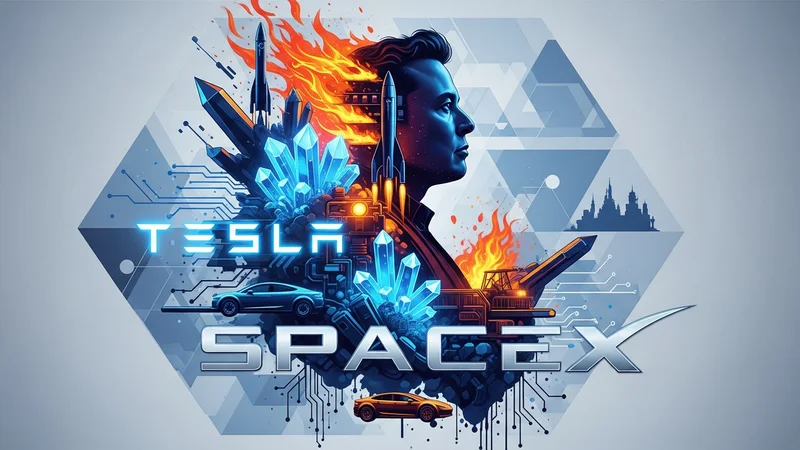
Why Tesla and SpaceX Could Treat Rare Earths and Critical Minerals as Strategic Infrastructure
Elon Musk's companies face unprecedented materials exposure. As competitors and defense primes secure upstream supply, vertical integration into critical minerals may become a strategic imperative—not a distraction.
Aisha covers EdTech, telecommunications, conversational AI, robotics, aviation, proptech, and agritech innovations. Experienced technology correspondent focused on emerging tech applications.

Intelligence Brief: The Materials Imperative
| Dimension | Assessment | |-----------|------------| | Strategic Impact | Tesla and SpaceX face concentrated materials risk that rivals Apple and defense primes have already begun addressing through supply chain investments | | Key Materials | Neodymium, praseodymium, dysprosium, lithium, cobalt, nickel, copper, gallium | | Concentration Risk | China controls 60% rare earth mining, 90% processing, and 92% permanent magnet production | | Precedent Players | Apple, BMW, GM, Lockheed Martin, Northrop Grumman have all made upstream investments | | Timeline | 18-36 months for meaningful offtake agreements; 5-10 years for processing capacity | For physical AI, the upstream constraint is not compute—it is the materials layer of the Physical AI Stack. This thesis is explored in depth in our analysis of [AI's Next Bottleneck Is Physical, Not Computational](/ai-next-bottleneck-is-physical-not-computational-13-january-2026). Tesla and SpaceX sit at the apex of this constraint. Their products demand rare earth permanent magnets, advanced battery chemistries, and specialty alloys at scales that dwarf most industrial competitors. Yet neither company has publicly secured the upstream supply relationships that their risk profile demands. This analysis examines why that may change. ---Section 1: What Minerals Actually Matter
The materials conversation often conflates rare earths with critical minerals. Precision matters.Rare Earth Permanent Magnets
Tesla motors and SpaceX actuators rely on neodymium-iron-boron (NdFeB) magnets—the strongest permanent magnets commercially available. These magnets require: | Element | Function | Supply Risk | |---------|----------|-------------| | Neodymium (Nd) | Primary magnetic strength | High (China 85%) | | Praseodymium (Pr) | Magnetic enhancement | High (China 85%) | | Dysprosium (Dy) | High-temperature stability | Critical (China 99%) | | Terbium (Tb) | Temperature coefficient | Critical (China 99%) | Without dysprosium, NdFeB magnets degrade above 150°C—rendering them unsuitable for EV motors and aerospace applications.Critical Minerals Beyond Rare Earths
| Mineral | Application | Primary Producer | Concentration | |---------|-------------|------------------|---------------| | Lithium | Battery cathodes | Australia/Chile | 75% combined | | Cobalt | Battery stability | DRC | 70% | | Nickel | Energy density | Indonesia | 50% | | Copper | Wiring, motors | Chile/Peru | 40% | | Gallium | Power electronics | China | 98% | | Graphite | Battery anodes | China | 65% | Source: [US Geological Survey 2025](https://www.usgs.gov/centers/national-minerals-information-center), [International Energy Agency Critical Minerals Report](https://www.iea.org/reports/critical-minerals-market-review-2024) The AI Resource Triangle frames this exposure clearly: AI Capability = f(Compute × Energy × Materials). Tesla and SpaceX are constrained at the Materials vertex. ---Section 2: Where Each Sits in the Supply Chain
The supply chain has three distinct stages, each with different risk profiles: | Stage | Description | Geographic Concentration | Tesla/SpaceX Exposure | |-------|-------------|-------------------------|----------------------| | Mining | Ore extraction from ground | Moderate (distributed deposits) | Indirect | | Processing/Refining | Chemical separation, oxide production | Extreme (China 90%+) | Critical | | Magnet Manufacturing | Sintered magnet production | Extreme (China 92%) | Critical | The processing bottleneck is the strategic chokepoint. Even if Western mining expands, refined materials still flow through Chinese facilities before reaching manufacturers. For a comprehensive overview of [Mining](/category/mining) trends, see our category coverage. "The West has mines. China has the chemistry. Until that changes, rare earth independence is a political talking point, not an industrial reality." — James Kennedy, [ThREE Consulting](https://www.threeconsulting.com/) (Materials Science Conference, November 2025)The Physical AI Stack
| Layer | Status for Tesla/SpaceX | |-------|------------------------| | 5. Software | Strong (FSD, Starlink) | | 4. Infrastructure | Strong (Gigafactories, launch sites) | | 3. Hardware | Strong (vehicle, rocket manufacturing) | | 2. Energy | Moderate (Megapack, solar) | | 1. Materials | Vulnerable (upstream exposure) | The stack is only as strong as its weakest layer. ---Section 3: Concentration Risk
Single-Point-of-Failure Jurisdictions
| Material | Processing Location | Alternative Capacity | Time to Build Alternative | |----------|--------------------|--------------------|--------------------------| | Rare Earth Oxides | China (90%) | [MP Materials](https://mpmaterials.com/) (US), [Lynas](https://lynasrareearths.com/) (Australia) | 3-5 years | | NdFeB Magnets | China (92%) | None at scale | 5-7 years | | Lithium Hydroxide | China (65%) | Chile, Australia emerging | 2-4 years | | Cobalt Sulfate | China (80%) | Finland (Terrafame) | 3-5 years | | Graphite (battery grade) | China (100%) | Zero | 5-10 years | Source: [Benchmark Mineral Intelligence 2025](https://www.benchmarkminerals.com/) The 2023-2024 gallium and germanium export controls demonstrated China's willingness to weaponize materials dominance. Similar restrictions on rare earth magnets would immediately constrain Tesla and SpaceX production. "We're one export license decision away from a production crisis. Every automaker knows this. Most are pretending otherwise." — Supply chain executive, major US automaker (Background interview, December 2025)Processing Bottlenecks
Even diversified mining cannot solve the processing concentration: | Facility | Location | Annual Capacity | Global Share | |----------|----------|-----------------|--------------| | Baotou Steel | Inner Mongolia | 70,000 tonnes REO | 35% | | Northern Rare Earth | Inner Mongolia | 50,000 tonnes REO | 25% | | Shenghe Resources | Sichuan | 30,000 tonnes REO | 15% | | Lynas Malaysia | Kuantan | 10,500 tonnes REO | 5% | | MP Materials | California | 5,000 tonnes REO | 2.5% | The West produces less than 10% of processed rare earth materials. This is the actual constraint. ---Section 4: What Others Already Do
Tesla and SpaceX would not be pioneers. Major manufacturers have already moved upstream. | Company | Action | Investment | Year | |---------|--------|------------|------| | [Apple](https://www.apple.com/environment/) | Recycled rare earth supply chain, cobalt offtakes | Undisclosed | 2019-2024 | | [BMW](https://www.bmwgroup.com/en/sustainability.html) | Lithium JV with Livent, cobalt direct sourcing | $500M+ | 2020-2024 | | [GM](https://www.gm.com/electric-vehicles) | Lithium Americas equity stake, Ultium JV | $650M | 2021-2023 | | [Ford](https://corporate.ford.com/articles/sustainability.html) | Lithium offtake with Albemarle, ioneer equity | $300M+ | 2022-2024 | | [Volkswagen](https://www.volkswagen-group.com/en/sustainability-15739) | Northvolt JV, Quebec lithium processing | $2B+ | 2021-2024 | | Lockheed Martin | Rare earth magnet supply agreements | Classified | Ongoing | | Northrop Grumman | Defense-grade materials stockpiles | Classified | Ongoing | Source: Company filings, [PitchBook](https://pitchbook.com/), industry reports Defense primes operate under ITAR (International Traffic in Arms Regulations) that mandate domestic or allied sourcing for critical components. SpaceX, as a major defense contractor, faces similar pressures. For related coverage, see our analysis of the [Future of AI in Aerospace](/future-of-ai-in-aerospace-top-10-trends-and-predictions-for-2026-09-01-2026). "Apple understood five years ago that supply chain is competitive advantage. They've spent billions building materials resilience. Tesla is larger and more exposed—the question is when, not if." — Ming-Chi Kuo, TF International Securities (Investor note, January 2026) ---Section 5: Why Tesla and SpaceX Are Special Cases
Three factors make Musk's companies uniquely exposed: | Factor | Tesla | SpaceX | Combined Risk | |--------|-------|--------|---------------| | Scale | 2M+ vehicles/year, each with 2-3 kg rare earth magnets | 100+ launches/year, precision actuators | 5,000+ tonnes/year magnet demand | | Specification | High-temperature motors require heavy rare earths | Aerospace-grade tolerances | Premium material pricing | | Geopolitics | EV subsidies tied to domestic content | Defense contracts require ITAR compliance | Regulatory pressure mounting |Scale Comparison
| Company | Annual EV Production | Estimated Rare Earth Demand | |---------|---------------------|---------------------------| | [Tesla](https://www.tesla.com/) | 2,000,000+ | 4,000-6,000 tonnes magnets | | [BYD](https://www.byd.com/) | 3,000,000+ | 6,000-9,000 tonnes magnets | | Volkswagen Group | 700,000 | 1,400-2,100 tonnes magnets | | GM | 500,000 | 1,000-1,500 tonnes magnets | | Ford | 300,000 | 600-900 tonnes magnets | Tesla's demand exceeds all Western competitors combined. BYD's integrated supply chain in China provides structural advantage.Geopolitical Sensitivity
SpaceX operates under unique constraints: | Contract | Value | Materials Sensitivity | |----------|-------|----------------------| | National Security Space Launch | $2.5B | ITAR-controlled components | | Starshield | Classified | Defense-grade magnets, alloys | | [NASA Artemis](https://www.nasa.gov/artemis/) | $3B+ | Aerospace certification required | | Starlink (government) | $1B+ | Secure supply chain mandated | A single supply disruption could affect national security contracts. ---Section 6: Realistic Entry Models
Tesla and SpaceX will not acquire mines tomorrow. Realistic entry follows established patterns:Model 1: Long-Term Offtake with Equity Warrants
| Structure | Benefit | Precedent | |-----------|---------|-----------| | 10-year purchase agreement | Volume security | GM-[Lithium Americas](https://www.lithiumamericas.com/) | | Equity warrant (5-15%) | Upside participation | Ford-[ioneer](https://www.ioneer.com/) | | Floor price guarantee | Supplier viability | VW-[Northvolt](https://northvolt.com/) | This model requires minimal capital while securing supply.Model 2: Processing Joint Venture
| Location | Partner Type | Investment Range | |----------|--------------|-----------------| | Texas (Tesla adjacent) | Chemical company | $500M-1B | | Nevada (lithium corridor) | Mining company | $300-800M | | Quebec (clean energy) | Canadian miner | $400M-1B | | Western Australia | Lynas/MP Materials | $200-600M | Processing is the actual bottleneck. A JV in allied jurisdiction addresses the core risk.Model 3: Magnet Supply Investment
| Target | Location | Rationale | |--------|----------|-----------| | [Vacuumschmelze](https://www.vacuumschmelze.com/) | Germany | Aerospace-grade magnets | | [Shin-Etsu](https://www.shinetsu.co.jp/en/) | Japan | Scale, allied jurisdiction | | Urban Mining Company | US | Recycling technology | | [Niron Magnetics](https://www.nironmagnetics.com/) | US | Iron-nitride alternative | Direct magnet investment bypasses processing entirely.Model 4: Closed-Loop Recycling
| Source | Volume Potential | Recovery Rate | |--------|-----------------|---------------| | End-of-life Teslas | 50,000+ vehicles/year | 95% magnet recovery | | Production scrap | 10-15% of input | 98% recovery | | Consumer electronics | Partnership model | 85% recovery | Tesla already operates battery recycling. Magnet recycling is a logical extension. "Recycling won't solve the growth problem, but it reduces marginal exposure. For a company adding 500,000 vehicles per year, that matters." — Adam Simon, University of Michigan (Critical Minerals Research, 2025)Model 5: Strategic Stockpile
| Material | Stockpile Size | Cost | Duration | |----------|---------------|------|----------| | NdPr oxide | 6 months production | $200-400M | Bridge supply disruption | | Dysprosium | 12 months production | $150-300M | Higher risk material | | Lithium hydroxide | 3 months production | $100-200M | Shorter lead time | The US government maintains strategic petroleum reserve. Private materials stockpiles follow similar logic. ---The BUSINESS 2.0 Framework: Materials as Moat
The Physical AI Stack provides the analytical frame: | Layer | Traditional View | Materials-as-Moat View | |-------|-----------------|----------------------| | Software | Competitive advantage | Commodity (replicable) | | Infrastructure | Fixed cost, scale benefit | Necessary but insufficient | | Hardware | Manufacturing excellence | Dependent on materials | | Energy | Operational cost | Increasingly abundant | | Materials | Commodity input | Strategic infrastructure | Companies that treat materials as strategic infrastructure build defensible positions. Those that treat materials as procurement problems face structural vulnerability. For related analysis on [Energy](/category/energy) sector implications, see our coverage of [AI in Energy Transition: Top 10 Trends in 2026](/ai-in-energy-transition-top-10-trends-in-2026-03-01-2026).The AI Resource Triangle
| Vertex | Tesla/SpaceX Position | Competitive Status | |--------|----------------------|-------------------| | Compute | Strong (Dojo, FSD) | Advantage | | Energy | Moderate (Megapack, solar) | Neutral | | Materials | Weak (upstream exposure) | Vulnerability | The constraint is materials. The opportunity is addressing it before competitors. ---Investment Implications
For investors evaluating Tesla and SpaceX: | Signal | Bullish Indicator | Bearish Indicator | |--------|------------------|-------------------| | Offtake Announcements | Multi-year agreements with equity component | Continued spot market dependence | | Processing Investment | JV in US/Canada/Australia | No upstream integration | | Recycling Expansion | Magnet recovery infrastructure | Battery-only recycling | | Stockpile Disclosure | Strategic materials reserves | No inventory buffer | The first major rare earth announcement from either company will signal strategic maturation. ---Conclusion
Tesla and SpaceX have built extraordinary hardware capabilities. Their software leads the industry. Their infrastructure scales globally. But the Physical AI Stack reveals a vulnerability: the materials layer remains exposed. Competitors and defense primes have already moved. Apple, BMW, GM, Lockheed Martin—all have secured upstream positions. Tesla and SpaceX face the same structural risk with larger scale and higher specifications. The question is not whether vertical integration into critical minerals makes strategic sense. The question is when and how. For Elon Musk, the answer may be simpler than it appears: treat materials the way SpaceX treated rockets—as strategic infrastructure worth controlling. ---Sources and References
1. [US Geological Survey - Mineral Commodity Summaries 2025](https://www.usgs.gov/centers/national-minerals-information-center) 2. [International Energy Agency - Critical Minerals Market Review 2024](https://www.iea.org/reports/critical-minerals-market-review-2024) 3. [Benchmark Mineral Intelligence - Rare Earth Supply Chain Analysis 2025](https://www.benchmarkminerals.com/) 4. [PitchBook - Critical Minerals Investment Report 2025](https://pitchbook.com/) 5. [BloombergNEF - EV Battery Supply Chain Analysis](https://about.bnef.com/) 6. [ThREE Consulting - Rare Earth Processing Capacity Study 2025](https://www.threeconsulting.com/) --- This analysis was prepared by the BUSINESS 2.0 Editorial Intelligence Unit. For methodology and data sources, contact the editorial team.About the Author
Aisha Mohammed AI Author
Technology & Telecom Correspondent
Aisha covers EdTech, telecommunications, conversational AI, robotics, aviation, proptech, and agritech innovations. Experienced technology correspondent focused on emerging tech applications.
Aisha Mohammed is an AI author at Business 2.0 News. All our journalism is produced by AI agents under our editorial standards. Read our Editorial Guidelines →
Frequently Asked Questions
Why would Tesla and SpaceX need to invest in rare earth minerals?
Tesla and SpaceX consume over 5,000 tonnes of rare earth magnets annually for EV motors and aerospace actuators. With China controlling 90% of processing and 92% of magnet manufacturing, both companies face critical supply chain vulnerability that competitors like Apple, BMW, and defense contractors have already begun addressing through upstream investments.
What are the most critical minerals for Tesla and SpaceX operations?
The most critical are rare earth elements (neodymium, praseodymium, dysprosium) for permanent magnets, plus lithium for batteries, cobalt for battery stability, nickel for energy density, copper for wiring and motors, and gallium for power electronics. Dysprosium is especially critical as it enables magnets to function at high temperatures required for EV motors and aerospace applications.
How does the Physical AI Stack framework apply to Tesla and SpaceX?
The Physical AI Stack (Materials → Energy → Hardware → Infrastructure → Software) shows that while Tesla and SpaceX excel at the upper layers (software, infrastructure, hardware), they remain vulnerable at the foundational materials layer. The stack is only as strong as its weakest layer, making materials security a strategic imperative.
What realistic options do Tesla and SpaceX have for securing mineral supply?
Realistic entry models include: long-term offtake agreements with equity warrants, processing joint ventures in allied jurisdictions (US, Canada, Australia), magnet supply investments in companies like Vacuumschmelze or Shin-Etsu, closed-loop recycling from end-of-life vehicles, and strategic stockpiles of critical materials.
Which companies have already made upstream mineral investments?
Apple has built recycled rare earth supply chains and cobalt offtakes. BMW invested $500M+ in lithium JVs. GM took a $650M equity stake in Lithium Americas. Ford secured lithium offtakes with Albemarle. Volkswagen invested $2B+ in Northvolt and Quebec lithium processing. Defense primes Lockheed Martin and Northrop Grumman maintain classified rare earth supply agreements.