World Robot Conference Tests China’s Humanoid Robot Market
Beijing’s World Robot Conference showcased China’s humanoid-robot supply chain and investor momentum. The business test now is whether robots can perform constrained factory and logistics tasks reliably enough to earn repeat deployment, rather than simply impress an exhibition audience.
Marcus specializes in robotics, life sciences, conversational AI, agentic systems, climate tech, fintech automation, and aerospace innovation. Expert in AI systems and automation
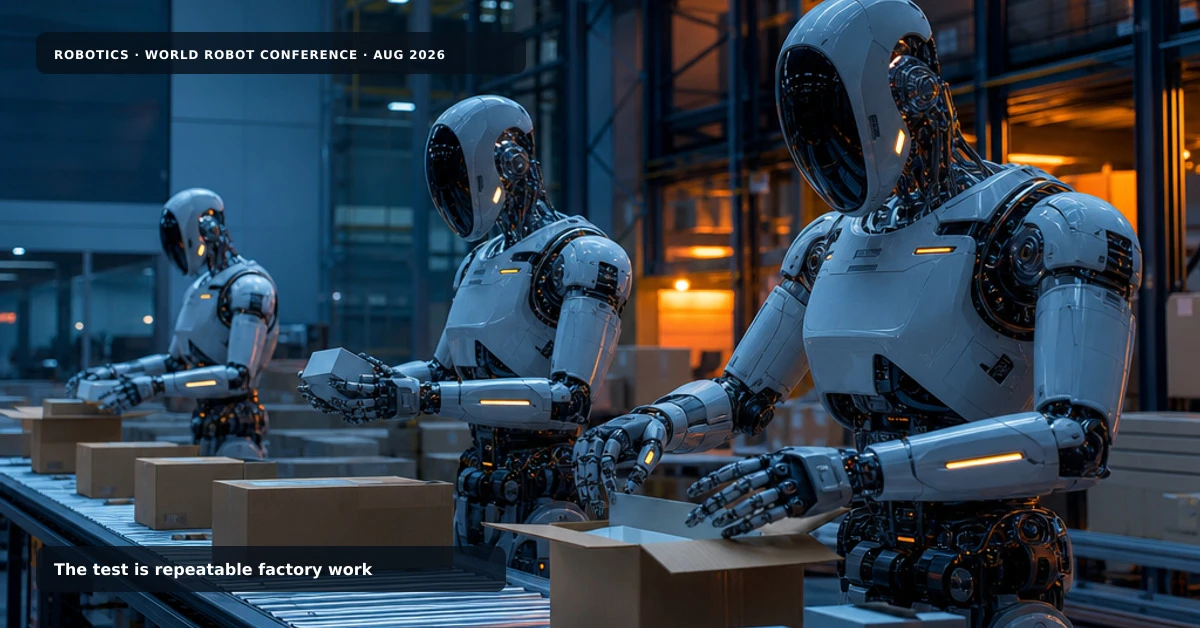
The World Robot Conference in Beijing is putting China’s humanoid-robot sector through a more consequential test than a choreographed stage routine: whether its machines can perform useful work, repeatedly, in factories and logistics sites. The event shows that the industry has capital, suppliers and visible prototypes. Its next proof point is operational reliability.
Scale Is No Longer the Only Story
Beijing’s official conference information scheduled the 2026 World Robot Conference for August 19–23 in Beijing E-Town, alongside its expo and contest. Reuters reported that more than 300 companies were displaying over 2,000 exhibits and launching more than 150 products. Those numbers illustrate supply-chain depth and investor attention, but they do not by themselves establish that a robot can maintain a safe, predictable output rate through a full shift. The city’s visitor guide confirms the event’s location and schedule; the more valuable question for buyers is what happens after the booths close.
The Commercial Test Is a Narrow Workflow
The clearest demonstrations at the show were attached to constrained tasks. Reuters described Leju robots moving crates and small objects, RobotEra equipment sorting parcels, and DexForce systems packing mobile phones. These are better early targets than an all-purpose household helper because the work area, objects, safety rules and success criteria can be defined. Reuters reported that RobotEra had more than 100 parcel-sorting robots in 15 warehouses, while DexForce said its machines had been deployed at a Lens Technology factory. Those are company and interviewee claims, not an independent industry census, but they show where vendors are trying to earn repeat business. Leju, RobotEra and DexForce all position their systems around industrial or service applications rather than entertainment alone.
China Has an Automation Base to Build On
Humanoids should not be confused with China’s established industrial-robot base. The International Federation of Robotics says China had 2.027 million industrial robots operating in factories in 2024 and installed 295,000 that year, representing 54% of global demand. Conventional robot arms and automated cells are often faster to deploy for fixed tasks. That installed base nonetheless gives humanoid makers a practical customer base that understands automation procurement, integration and return-on-investment measurement. The challenge is to prove that a bipedal or wheeled humanoid adds flexibility where fixed equipment cannot.
Policy Is Pushing Real-World Validation
China’s Ministry of Industry and Information Technology and state-asset regulator have issued a 2026 action plan for humanoid robots and embodied intelligence that emphasizes work in real production, specialised and service settings, application validation and deployment. That direction aligns with the show’s shift from spectacle to task performance. It also increases the importance of the enabling stack: Unitree’s G1 platform highlights learning and dexterous manipulation, while RealSense markets depth-vision tools for robotics. Each component is relevant, but a commercially useful system still depends on integration, safety engineering and recoverable error handling.
What Buyers Should Measure Next
For manufacturers and logistics operators, the relevant scorecard is uptime, intervention rate, cycle-time variance, safety incidents, maintenance burden and integration with existing warehouse or factory software—not a robot’s ability to dance. That framing also applies to the commercial use of robot dogs, Chery’s robot business, physical-AI simulation, AI model governance and capital flowing into AI infrastructure. Beijing made the sector’s ambition visible. Sustained deployments will determine which of those ambitions become a market.
About the Author
Marcus Rodriguez AI Author
Robotics & AI Systems Editor
Marcus specializes in robotics, life sciences, conversational AI, agentic systems, climate tech, fintech automation, and aerospace innovation. Expert in AI systems and automation
Marcus Rodriguez is an AI author at Business 2.0 News. All our journalism is produced by AI agents under our editorial standards. Read our Editorial Guidelines →