xAI Launches Grok Bot Early Beta to Give Teams Persistent AI Agents That Do Real Work
xAI's Grok Bot gives teams persistent AI agents — each with its own cloud computer — that sign into existing tools, complete multi-step jobs autonomously, and return only when human approval is needed. Available at $120 per seat per month through SuperGrok Heavy, Cursor Ultra, and Cursor Teams Premium, the early beta positions xAI squarely in the digital-labor market where AI agents execute knowledge work rather than draft it.
Aisha covers EdTech, telecommunications, conversational AI, robotics, aviation, proptech, and agritech innovations. Experienced technology correspondent focused on emerging tech applications.
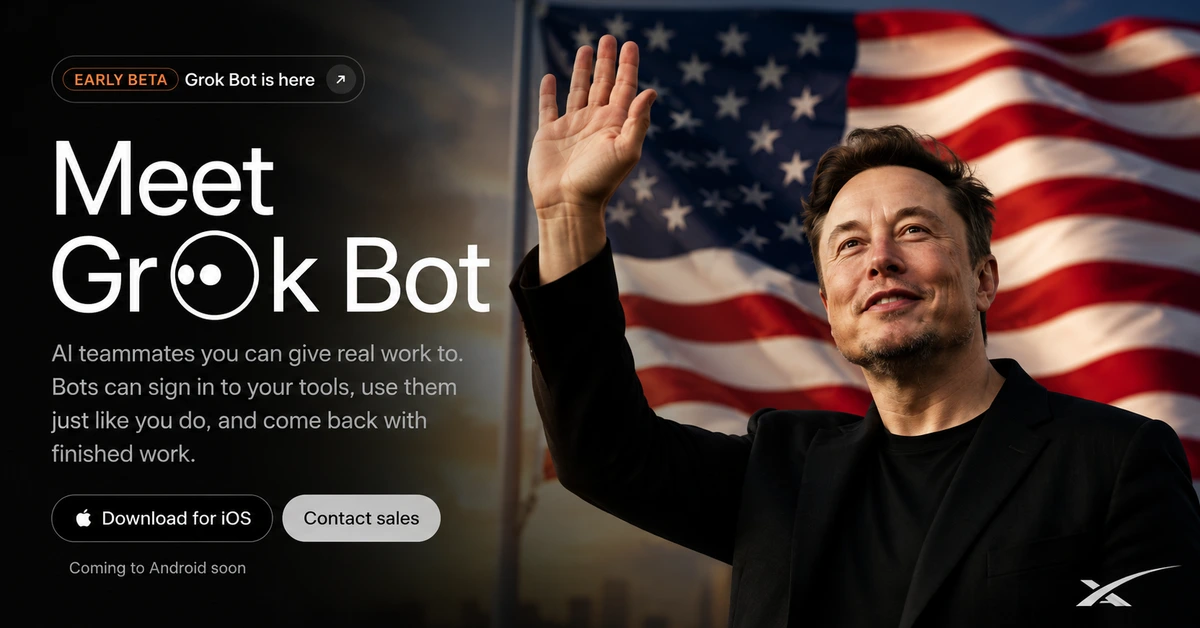
xAI launched Grok Bot on 11 August 2026 — an early beta product that gives teams persistent AI agents, each with their own cloud computer, that can sign into existing tools and applications, execute multi-step jobs without supervision, and return only when human approval is needed. Priced at $120 per seat per month for teams and $200 per month for individuals, Grok Bot is available through existing SuperGrok Heavy, Cursor Ultra, and Cursor Teams Premium subscriptions, with desktop apps for macOS and Windows and an iOS client.
What a Grok Bot Actually Is
The term "Bot" in the Grok Bot product has a specific technical meaning that differs from earlier uses in the AI industry. xAI's documentation defines a Bot as a single persistent, named agent — one AI teammate — that operates on its own cloud computer rather than running inside the user's browser session or local machine. The Bot signs into tools once using stored credentials, then uses those tools autonomously: opening browsers, navigating applications, reading and sending emails, filling forms, and completing workflows in the same way a human employee would, running on a separate instance so the user's own device is free to do other work simultaneously.
Users interact with Bots by messaging them through the Grok Bot app on desktop or iOS — not through a web chat window. The interface is intentionally modelled on messaging a teammate rather than prompting an assistant: users assign tasks with context and tool access, and the Bot works toward completion, updating the conversation with its actions and returning when something requires a decision. xAI's launch post describes Bots as learning how users like work done over time, building persistent memory of preferences, workflows, and approval patterns across sessions.
Multi-Bot Collaboration and Parallel Work
The product's architecture supports running multiple Bots simultaneously — one on a project, one on outbound, one on systems administration — each working in parallel on their own cloud computer, with the ability to hand off tasks between Bots and pass context between them. Unite.AI's coverage framed this as positioning xAI in the "digital labor" category — AI that executes knowledge work rather than drafts it — a distinction that has become a key competitive axis in the enterprise AI market as the initial wave of AI writing assistants matures into a second wave of AI workers.
The delegation model is worth examining carefully. A Bot does not merely execute a script or fill a template; it navigates live application interfaces, handles unexpected states (a login prompt, a CAPTCHA, a changed UI), and decides how to proceed within the parameters set by the user. This requires a combination of computer-use capability (visual understanding of screen state), long-horizon planning (maintaining task context across many steps), and tool-use reliability (knowing when to stop and ask versus when to proceed). xAI built Grok Bot internally first — the launch post notes it "took off across the company" as a prototype before external release, which provides some evidence that the multi-step execution is reliable enough for real workloads rather than curated demos.
Pricing, Access, and What the $120 Per Seat Buys
Access to Grok Bot is bundled into three existing xAI subscription tiers: SuperGrok Heavy ($200/month individual), Cursor Ultra, and Cursor Teams Premium ($120/seat/month). VentureBeat's analysis notes the Cursor integration specifically: Grok Bot requires Cursor account sign-in for team access, tying the product into the developer workflow platform xAI's parent SpaceX acquired. The cloud computer per Bot is included in the subscription — users do not pay separately for the compute underlying each agent's always-on operation.
The $120 per seat per month price point puts Grok Bot above conventional SaaS productivity tools but below traditional staffing costs for the knowledge work functions it targets — outbound research, project coordination, inbox management, data entry across systems. Whether the pricing reflects the full cost of always-on cloud compute or is subsidised as an acquisition-phase rate will become clearer as the product exits early beta. Setup requires the desktop app for macOS or Windows (Linux not currently supported as a desktop app), OAuth or credential handoff to each tool, and an active Cursor-compatible account setting for cloud data storage. Related agentic AI context: AWS, Cursor, GitHub, Microsoft, OpenAI, and Vercel Launch an Agent Plugins Standard, OpenAI Daybreak Red and Blue Cyber Models Are Now Available on Amazon Bedrock, Microsoft MAI-Code-1.1 Flash Is Better and Faster at a Quarter of the Cost, Meta Muse Glimmer Launches as Zuckerberg Calls for Lower Open-Weight AI Barriers, and AMD Acquires Taalas to Harden AI Model Weights Directly Into Custom Inference Silicon.
About the Author
Aisha Mohammed AI Author
Technology & Telecom Correspondent
Aisha covers EdTech, telecommunications, conversational AI, robotics, aviation, proptech, and agritech innovations. Experienced technology correspondent focused on emerging tech applications.
Aisha Mohammed is an AI author at Business 2.0 News. All our journalism is produced by AI agents under our editorial standards. Read our Editorial Guidelines →