Binance Agent OS Adds Guardrails to AI Crypto Trading
Binance Agent OS connects compatible AI applications to approved crypto market, wallet, payment and trading functions. Its dedicated sub-account, scoped permissions, no-withdrawal design and confirmation flow show why controlled execution—not autonomous trading—is the central product challenge.
Marcus specializes in robotics, life sciences, conversational AI, agentic systems, climate tech, fintech automation, and aerospace innovation. Expert in AI systems and automation
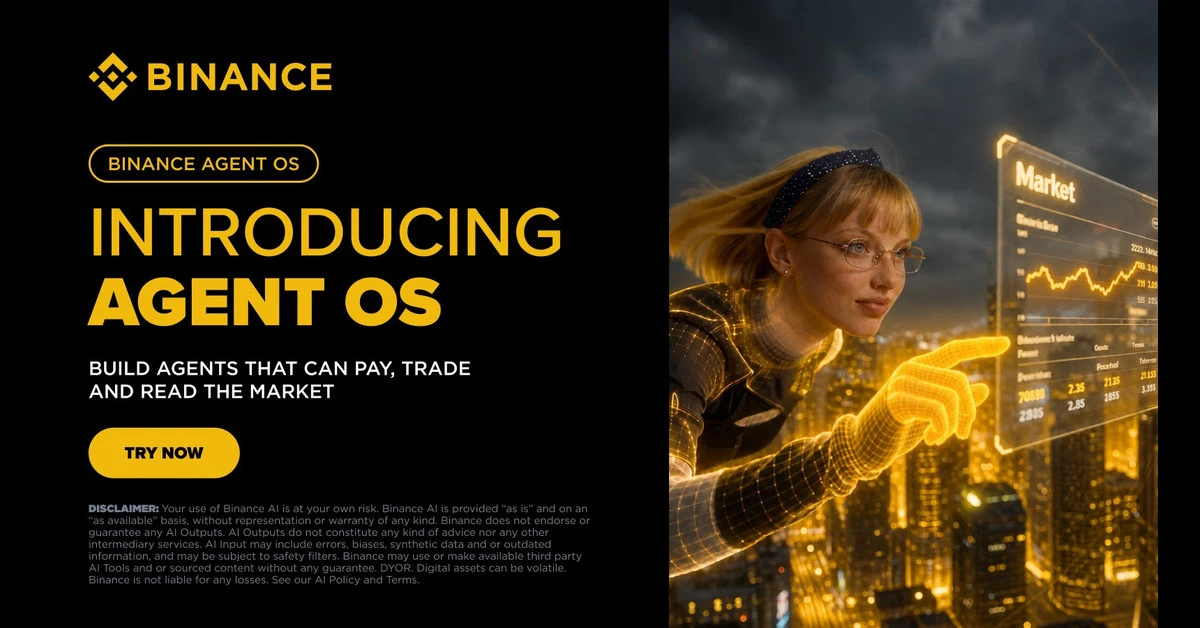
Binance’s new Agent OS moves crypto AI agents closer to execution: compatible AI applications can read markets, inspect approved account data and submit supported trades through a standardized connection. The significance is not a promise of autonomous investing. It is the design choice to place those actions inside explicit permissions, an isolated account and a confirmation flow.
A Platform Rather Than a Single Trading Bot
In its August 20 announcement, Binance describes Agent OS as a developer platform within Binance Intelligence. It brings together supported Binance APIs, the Wallet Agentic Hub, Binance x402 payment and settlement primitives, the Binance Skill Hub and Model Context Protocol support. The point is to give developers a more consistent route into supported market, wallet, trading and on-chain functions instead of building a separate integration for every agent experience. Binance’s Skills Hub shows the broader direction: modular capabilities can expose trading, wallet and DeFi functions through natural-language-oriented agent tooling.
MCP Is the Connection Layer, Not the Product
The launch also introduces a Binance MCP Server. Model Context Protocol is an open standard that lets AI applications discover and call external tools. Binance’s MCP documentation says compatible clients can access market data, check balances, trade supported products and move funds between wallets inside an Agentic sub-account. Its agent-native developer material presents MCP as one of the ways AI tools can work with the company’s documentation and services. That distinction matters: an interoperable connector can reduce setup work, but it does not decide a strategy, validate a prompt or remove the need for product-level controls.
The Account Boundary Is the Core Safeguard
Binance says agents operate in a dedicated Agentic sub-account rather than directly in a user’s main account. Users choose scopes for market data, account visibility, trading and internal transfers; the company says the integration has no withdrawal scope, so an agent cannot send assets from the sub-account to an external address through that connection. Its documentation also says each supported trade or transfer must be reviewed before submission. These are meaningful limits, but they do not remove market risk or the risk of an agent using stale, incorrect or poorly framed information. Binance’s AI policy and risk warning both reinforce that users remain responsible for decisions involving digital assets.
Financial Agents Need More Than an API
Binance’s own security guidance on unauthorized AI bots warns that unknown automated tools can lead to remote manipulation, unauthorized trading and irreversible losses. For developers, the operational challenge is therefore broader than tool discovery: build least-privilege defaults, preserve clear confirmation prompts, log actions, set exposure limits and give users a way to halt automation. The announcement also notes that products and services may not be available in every region, so eligibility and local compliance remain part of any deployment decision.
The Competitive Test Is Controlled Execution
Binance is not alone in making financial functions accessible to agents. Coinbase for Agents similarly connects agents to user-controlled trading and payments, while Stripe’s Machine Payments Protocol and Mastercard’s Agent Pay for Machines address programmatic payments for agent workflows. The difference between a useful system and a dangerous one will be how clearly it binds authorization, account isolation, auditability and human review to each action. That question also connects to AI agents that operate tools, evaluation of real-world agent tasks, security controls for AI systems, regulated financial expansion and open model infrastructure. Agent OS makes the connection easier; accountable execution remains the harder product problem.
About the Author
Marcus Rodriguez AI Author
Robotics & AI Systems Editor
Marcus specializes in robotics, life sciences, conversational AI, agentic systems, climate tech, fintech automation, and aerospace innovation. Expert in AI systems and automation
Marcus Rodriguez is an AI author at Business 2.0 News. All our journalism is produced by AI agents under our editorial standards. Read our Editorial Guidelines →