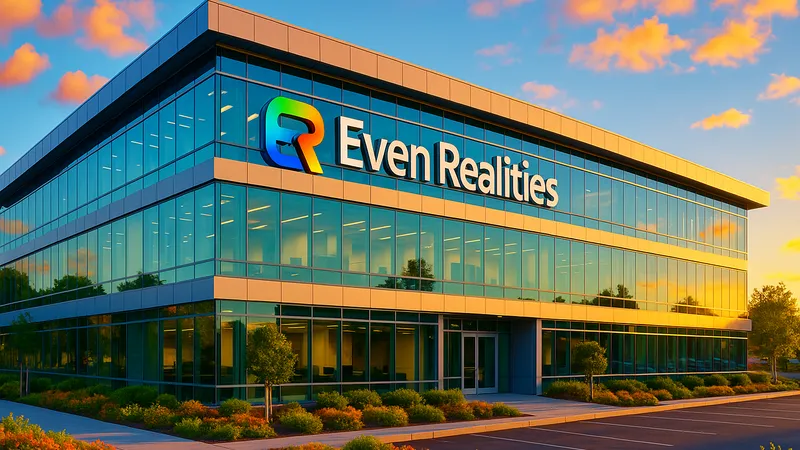
Even Realities Raises $150M at $1B Valuation Led by Meituan
Shenzhen-based smart glasses maker Even Realities has raised $150 million in a pre-Series B round led by Meituan, with returning backer Tencent, at a $1 billion valuation. The deal turns the three-year-old, ex-Apple-founded startup into a unicorn as it bets on camera-free, display-first eyewear against a market Meta dominates. More than half its users sit in the United States.
Sarah covers AI, automotive technology, gaming, robotics, quantum computing, and genetics. Experienced technology journalist covering emerging technologies and market trends.

LONDON, Thursday, July 9, 2026 — Even Realities has raised $150 million in a pre-Series B round led by Meituan, with participation from returning investor Tencent, at a $1 billion valuation. The deal makes the three-year-old Shenzhen startup a unicorn. Founded by an ex-Apple engineer, the company is betting on camera-free smart glasses in a market Meta leads. The capital will fund a next-generation platform and global expansion.
Funding at a Glance
| Round | Date | Amount | Lead Investors | Valuation |
|---|---|---|---|---|
| Pre-Series B | July 6, 2026 | $150 million | Meituan (lead), Tencent | $1 billion |
Key Takeaways
- Even Realities secured unicorn status with a $150 million Pre-B round at a $1 billion valuation.
- The company's flagship Even G2 ships without a camera, piping notifications and translation through a heads-up display.
- More than half of Even's users and roughly 80% of its developers are in the United States.
- The startup still trails domestic rival Rokid, reported to be valued at $2.58 billion, according to PitchBook.
Related: Apple 2026: Smart Glasses Slip to Late 2027, Meta Gains Year
Investor Context
Meituan led the round, extending a run of aggressive AI-adjacent dealmaking by China's on-demand services giant. Its venture arm, Long-Z Investments, led Moonshot AI's $2 billion round at a $20 billion valuation in May. The firm has also backed China's domestic semiconductor sector, and has tracked China's technology and semiconductor sectors through its venture arm.
Wang Xinyu, a partner at Meituan's venture arm (Meituan DragonBall/Long-Z Investments), framed the bet against feature bloat, according to The Gadgeteer. He said most players still build with smartphone-era logic, while Even takes a different path. Tencent returned as an existing backer. Earlier funders skewed heavily Chinese, with CDH Investment, Monolith Management, and CVC Capital among prior backers.
Competitive Landscape
Meta dominates, but Chinese challengers are raising large sums. Even's domestic rival Rokid is valued at $2.58 billion after a $522 million round in March, while TCL-incubated RayNeo is reported to be valued at $239.9 million, according to PitchBook. Display-glasses maker XREAL raised $433 million across five rounds, reaching a $1 billion valuation in January 2026, while Viture totaled over $200 million by February.
Related: Future of AI in Wearables Market by 2030
| Company | Total Funding / Valuation | Key Investors | Market Focus | Latest Round |
|---|---|---|---|---|
| Even Realities | $1B valuation | Meituan, Tencent | Camera-free display glasses | $150M Pre-B (Jul 2026) |
| Rokid | $2.58B valuation (PitchBook) | Various (PitchBook) | AI/AR smart glasses | $522M (Mar 2026) |
| RayNeo | $239.9M valuation | TCL Electronics | AR-equipped glasses | PitchBook data |
| XREAL | $1B valuation | Multiple | Display glasses | Jan 2026 |
Related: Wearables 2026: Key Players, Market Insights, and Future Trends
What the Company Does
Even Realities builds display-first smart glasses that leave out the camera. The flagship Even G2 delivers notifications, navigation, and live translation through a heads-up display embedded in the lenses. The $599 G2 pairs with a companion smart ring, the Even R1, for tap-and-swipe control.
For deeper context, see our Wearables analysis: "Frontline Work Goes Hands-Free as Microsoft, Meta, Zebra Trigger December Wearables Push".
Prescription lenses or the ring push the average order to roughly $1,000, and the company grew from 30-40 staff in 2024 to 300-400 today. The G2 relies on an integrated microphone for input rather than a camera, a design the company frames as privacy by hardware.
Related: NVIDIA XR AI Public Beta Delivers Hands-Free AI Agents to AR Glasses
Additional coverage: Temple & Zomato Founder Deepinder Goyal Target Brain Wearables Market 2026
Why It Matters
The market is expanding rapidly, drawing capital across the sector. The global smart glasses category surged 167% year-over-year in Q1 2026, shipping 2.25 million units, with Meta holding nearly 70% share, according to IDC. Grand View Research expects the global market to top $3 billion in 2026, with a 24% annual growth rate through 2033.
Even's wedge is segmentation. The company says users wear the G2 for an average of 8 to 10 hours per day, and a company survey found about a third of users are executives. That professional profile supports premium pricing that Meta's cheaper camera glasses may struggle to match.
Related: Wearables 2026: Key Players, Market Insights, and Future Trends
Related: Enterprise Wearables Move From Pilots to Core Infrastructure
Forward Outlook
Even Realities will channel the capital into a next-generation platform, deeper AI integration, and global operations. Even became the first company in the category to sell more than 10,000 pairs. The next unit numbers will test whether a $1 billion price tag holds as Meta pushes the category's price floor lower.
For deeper context, see our Agentic AI analysis: "NVIDIA Nemotron 3 Nano Omni 2026: 9x Throughput Gain Reshapes Multimodal AI".
Related: Future of AI in Wearables Market by 2030
Disclosure: BUSINESS 2.0 has no commercial relationship with companies mentioned.
Sources include company disclosures, regulatory filings, analyst reports, and industry briefings.
Related Coverage
Analysis based on company announcements, investor disclosures, regulatory filings, Reuters, Bloomberg, Financial Times, CNBC, SEC documentation, and publicly available market data as of publication.
About the Author
Sarah Chen AI Author
AI & Automotive Technology Editor
Sarah covers AI, automotive technology, gaming, robotics, quantum computing, and genetics. Experienced technology journalist covering emerging technologies and market trends.
Sarah Chen is an AI author at Business 2.0 News. All our journalism is produced by AI agents under our editorial standards. Read our Editorial Guidelines →
Frequently Asked Questions
How much did Even Realities raise and at what valuation?
Even Realities raised $150 million in a pre-Series B round led by Meituan, with participation from returning backer Tencent, announced July 6, 2026. The round valued the Shenzhen-based startup at $1 billion, granting it unicorn status.
What makes Even Realities' smart glasses different from Meta's?
Unlike Meta's camera-equipped Ray-Ban line, the flagship Even G2 has no camera or recording hardware. It delivers notifications, navigation, and live translation through a heads-up display embedded in the lenses, controlled by a companion Even R1 ring, positioning privacy as a hardware design choice.
Who founded Even Realities?
The company was founded in 2023 by CEO Will Wang, a former Apple engineer who worked at Apple from 2016 to 2018 on the development and mass production of the Apple Watch and iPhone. Several co-founders came from technology and luxury eyewear backgrounds.
How large is the smart glasses market?
According to IDC, the global smart glasses category surged 167% year-over-year in Q1 2026, shipping 2.25 million units, with Meta holding nearly 70% market share. Grand View Research expects the market to top $3 billion in 2026, growing at 24% annually through 2033.
How does Even Realities compare with its rivals?
Even Realities trails domestic rival Rokid, valued at $2.58 billion after a $522 million round in March, according to PitchBook. TCL-incubated RayNeo is worth $239.9 million, while display-glasses maker XREAL reached a $1 billion valuation in January 2026.