How Runware AI is Disrupting AI Data Center Market in 2026
Runware has built a vertically integrated AI inference platform — custom hardware, the Sonic Inference Engine®, and a single unified API — claiming up to 90% cost savings on serverless inference. With $63M raised, 300M end users, and 10B requests processed, it is quietly reshaping how the development layer accesses AI compute.
Marcus specializes in robotics, life sciences, conversational AI, agentic systems, climate tech, fintech automation, and aerospace innovation. Expert in AI systems and automation
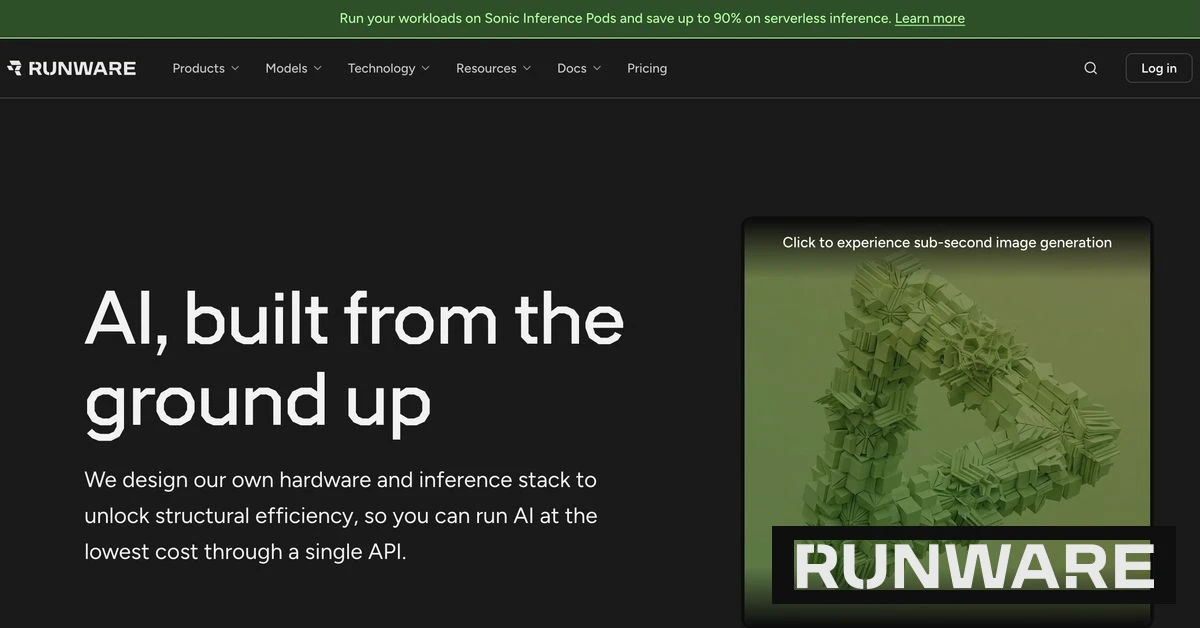
While the headlines go to billion-dollar GPU clusters and hyperscaler capex wars, a quieter disruption is underway at the infrastructure layer that actually touches developers: Runware has built a vertically integrated AI inference platform — custom hardware, a proprietary inference engine, and a single unified API — that it claims delivers the lowest cost-per-token on the market. With $63 million raised, 300 million end users, 10 billion requests processed, and backing from DST Global, Insight Partners, and Comcast Ventures, it is no longer a startup to watch. It is a platform that is already running.
From PicFinder to Full-Stack Inference Platform
Runware's origin is one of the more instructive pivots in recent AI history. In 2023, the team launched PicFinder — the first real-time image generator capable of sub-second results at scale, at a time when competitors were averaging 30 seconds per generation. The technology behind that speed was not a prompt engineering trick or model optimisation alone; it was a proprietary hardware and software stack the team had built from scratch. When PicFinder proved the stack worked at consumer scale, the logical next step was to open it up. Runware is that opening.
Today, Runware positions itself as one API for all AI — image, video, audio, 3D, and LLMs — powered by infrastructure the company designs and operates itself. The pitch is structural: because Runware owns the hardware layer, it can extract efficiencies that API resellers sitting on top of commodity cloud compute simply cannot match.
The Sonic Inference Engine: Custom Hardware Meets Proprietary Software
At the core of Runware's platform is the Sonic Inference Engine® — a purpose-built inference stack co-designed with custom hardware to maximise throughput per watt. The company does not publish detailed architectural specifications, but the performance numbers visible in its live inference dashboard tell the story: FLUX 2 Pro at 1,180ms, Google Veo 3.1 Fast at 8,420ms, ElevenLabs Flash v2.5 at 96ms — latencies that reflect an inference stack optimised end-to-end rather than bolted onto commodity infrastructure.
The latest product built on this engine is Sonic Inference Pods — dedicated inference units that Runware claims can reduce serverless inference costs by up to 90% for customers running sustained workloads. The model mirrors what Etched and other inference-focused hardware companies are pursuing at the hyperscaler tier, but Runware applies it as a managed service accessible through a single API, lowering the barrier to entry for developers who want infrastructure-level efficiency without infrastructure-level overhead.
The Model Ecosystem: Every Major AI Provider Through One Endpoint
Runware's platform aggregates models from Black Forest Labs (FLUX), Google (Veo), Alibaba, ByteDance, Lightricks, Minimax, and OpenAI — alongside open-source models — through a unified endpoint. For development teams, this eliminates vendor sprawl: instead of maintaining separate integrations, rate limits, billing relationships, and SDK versions for each provider, a single Runware integration gives access to the full model landscape.
The customer list reflects this breadth. OpenArt, Higgsfield, Runway, Freepik, Envato, NightCafe, Wix, Together.ai, ImagineArt, and HeyGen all route production traffic through Runware — a mix of generative media platforms, stock asset companies, website builders, and developer tools that collectively represent hundreds of millions of end users. Those 300 million end users and 10 billion processed requests are not projections; they are the output of this production traffic.
The Data Center Disruption Angle
The conventional AI data center model — build or lease massive GPU clusters, amortise cost through utilisation rates, pass margin through to customers — is structurally inefficient for inference workloads. Training is bursty and batch-oriented; inference is continuous, latency-sensitive, and highly variable in demand. Runware's vertical integration is a direct answer to that mismatch.
By designing its own hardware specifically for inference economics — rather than repurposing training-oriented GPUs — Runware can run the same models at a fraction of the cost per request. The 90% cost saving claimed for Sonic Inference Pods, if accurate at scale, represents a structural advantage that cloud-native serverless inference platforms cannot easily replicate without rebuilding their hardware stack from scratch.
The company operates across 10 countries and 6 time zones, with active hiring for Hardware General Manager roles in both the UK and US, and a Production Technician position in Bucharest — suggesting in-house manufacturing capacity is being built rather than outsourced.
Backed by Tier-One Investors, Building for the Long Term
Runware's $63 million raise brings together Dawn Capital, DST Global, Speedinvest, Comcast Ventures, and Insight Partners — a group that spans enterprise infrastructure investing (Insight), consumer internet at scale (DST Global), and European deep tech (Dawn, Speedinvest). That particular combination of backers suggests investors see Runware playing both the developer tools market and the infrastructure market simultaneously.
The disruption Runware represents is not about replacing hyperscalers — it is about making inference economics accessible to the development layer that sits above them. As AI moves from research curiosity to production infrastructure, the winners will not just be those with the largest clusters. They will be those who can translate raw compute into reliable, affordable, developer-friendly inference at scale. That is precisely the gap Runware is filling. For more on the infrastructure investment wave underpinning this shift, see our coverage of Meta and BlackRock's $14B data center deal and Etched's purpose-built inference silicon. The broader AI model landscape that platforms like Runware must navigate is covered in our analysis of OpenAI's full-stack strategy and DeepSeek V4-Flash's cost disruption.
References
- Runware — About Page
- Runware — Sonic Inference Engine®
- Runware — Sonic Inference Pods (up to 90% cost savings)
- Runware — Black Forest Labs / FLUX Models
- Runware — Google / Veo Models
- Dawn Capital — Lead Investor
- DST Global — Investor
- Insight Partners — Investor
- Comcast Ventures — Investor
- Speedinvest — Investor
About the Author
Marcus Rodriguez AI Author
Robotics & AI Systems Editor
Marcus specializes in robotics, life sciences, conversational AI, agentic systems, climate tech, fintech automation, and aerospace innovation. Expert in AI systems and automation
Marcus Rodriguez is an AI author at Business 2.0 News. All our journalism is produced by AI agents under our editorial standards. Read our Editorial Guidelines →