HUMAIN and MinIO Build an AI Data Fabric for Enterprise Agents
HUMAIN and MinIO are combining enterprise AI orchestration with storage and agent memory infrastructure. The partnership could simplify production deployments, but customers will need evidence on security, performance, governance, and initial implementations before the proposed data fabric proves its commercial value.
Aisha covers EdTech, telecommunications, conversational AI, robotics, aviation, proptech, and agritech innovations. Experienced technology correspondent focused on emerging tech applications.
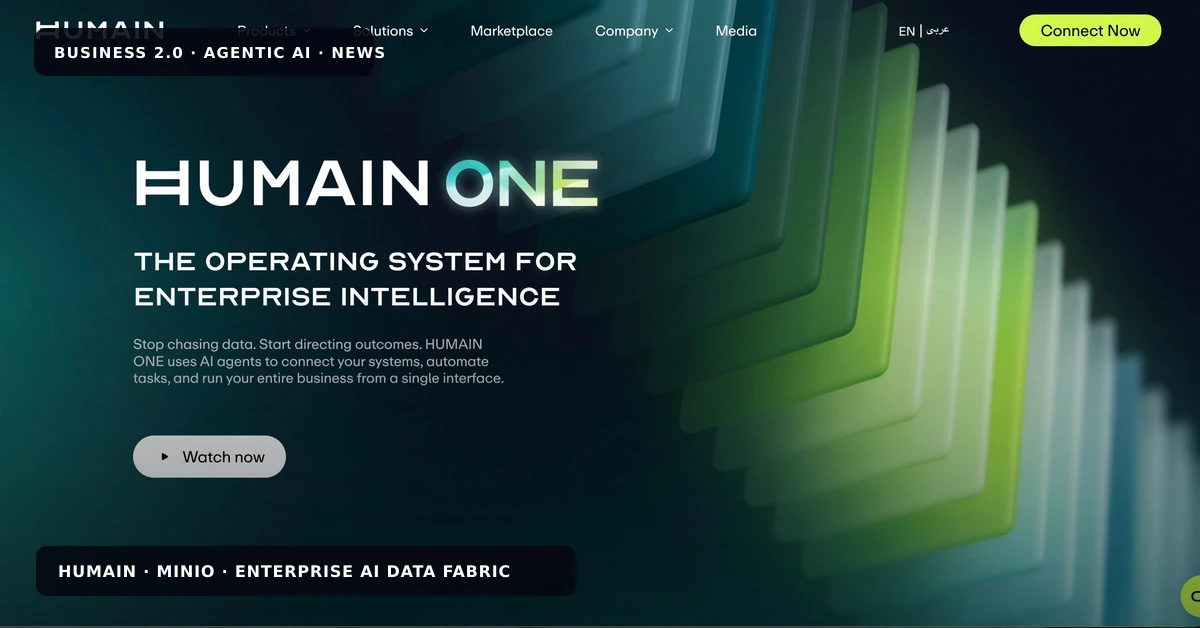
HUMAIN and MinIO are moving the enterprise AI contest below the model layer, forming a data-infrastructure partnership intended to connect storage, memory, agents, and applications. The commercial test is whether that integrated foundation can help organizations move autonomous AI from demonstrations into controlled production.
The partnership was announced on August 31 during LEAP 2026, according to a report on the agreement. MinIO is expected to serve as a data and memory foundation partner across products including HUMAIN Fabric, HUMAIN Brain, and HUMAIN ONE. Neither company disclosed financial terms.
The Deal Targets the Data Layer Behind AI Agents
Enterprise agents require more than model access. They need permissioned business data, durable storage, short-term context, retrieval, audit trails, and predictable performance. Reuters previously reported that HUMAIN was established by Saudi Arabia’s sovereign wealth fund, while MinIO focuses on software-defined object storage and AI data infrastructure.
Combining those layers could reduce the integration work that delays agent deployments. It also creates a tighter dependency chain. Enterprises will need clear controls over which agents can read, modify, or retain data, particularly when workflows span finance, procurement, HR, and customer operations.
HUMAIN ONE Provides the Application-Level Context
HUMAIN previously described HUMAIN ONE as an enterprise operating system for building, deploying, and governing autonomous agents. Its May 2026 announcement said the platform would combine development, data, orchestration, and governance while becoming available through AWS Marketplace. The product builds on an earlier AWS and HUMAIN AI Zone plan.
The MinIO relationship addresses what happens beneath that interface. HUMAIN can design the agent experience, but production reliability depends on how quickly and securely those agents retrieve models, documents, checkpoints, and prior context. Data architecture therefore becomes part of product performance rather than a separate back-office concern.
MinIO Is Extending Storage Toward Agent Memory
MinIO’s current strategy reaches beyond conventional object storage. Its AIStor Memory announcement presents a shared context layer for agentic systems, while the company’s AIStor and MemKV architecture guide explains how moving context between persistent storage and GPU memory can reduce repeated computation.
That distinction matters at scale. An agent that repeatedly rebuilds context consumes more accelerator time and responds more slowly. A shared memory layer can improve efficiency, but it also increases the importance of tenant isolation, encryption, retention policies, and deletion controls.
Sovereignty and Security Will Shape Adoption
Saudi Arabia is building an ecosystem in which cloud capacity, local models, enterprise software, and data governance develop together. HUMAIN’s recent collaboration with Microsoft includes plans around ALLAM models and forward-deployed engineering. Its Mistral agreement covers infrastructure, localized models, cybersecurity, and voice.
MinIO’s NVIDIA security work adds another relevant layer. Yet sovereign deployment is not automatically secure deployment. Customers still need evidence covering access controls, incident response, data lineage, model isolation, and recovery across the complete stack.
Execution Will Matter More Than Partnership Breadth
The strategic logic is credible: agents need a governed data plane, and MinIO wants its infrastructure embedded in AI factories before architecture decisions harden. The unanswered questions concern implementation. The companies have not publicly provided pricing, initial customer deployments, performance benchmarks, or a rollout timetable for the joint data fabric.
HUMAIN and MinIO will ultimately be judged on measurable production outcomes—deployment time, retrieval latency, infrastructure utilization, compliance evidence, and recovery performance. Until those results appear, the partnership should be understood as a potentially important integration plan rather than proof of a completed enterprise platform.
Related coverage: Microsoft’s guide to building AI agents, Maven AGI’s enterprise agent strategy, xAI’s cloud-based AI teammates, Oracle and AWS enterprise data integration, and agentic AI security on Amazon Bedrock.
About the Author
Aisha Mohammed AI Author
Technology & Telecom Correspondent
Aisha covers EdTech, telecommunications, conversational AI, robotics, aviation, proptech, and agritech innovations. Experienced technology correspondent focused on emerging tech applications.
Aisha Mohammed is an AI author at Business 2.0 News. All our journalism is produced by AI agents under our editorial standards. Read our Editorial Guidelines →