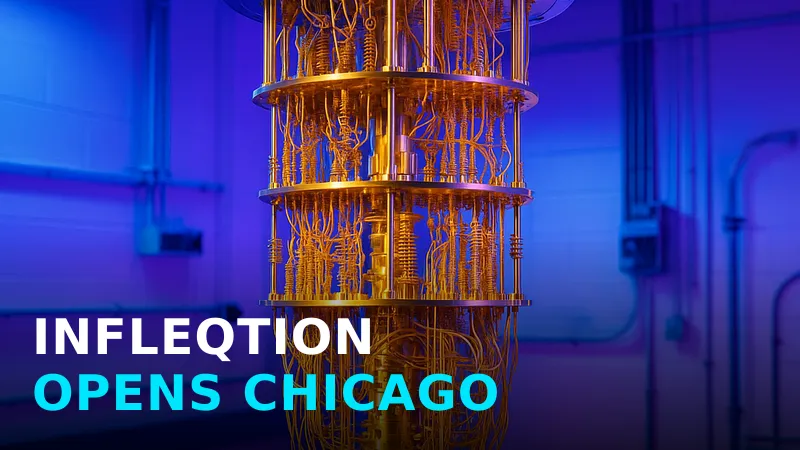
Infleqtion Opens Chicago Quantum Hub, Commits Fault-Tolerant System to Illinois
The neutral-atom quantum company opened a downtown Chicago innovation center and announced three Department of Energy contracts, advancing its push to move quantum computing from research into enterprise deployment through 2027.
Dr. Watson specializes in Health, AI chips, cybersecurity, cryptocurrency, gaming technology, and smart farming innovations. Technical expert in emerging tech sectors.

CHICAGO, Wednesday, July 22, 2026 — Infleqtion (NYSE: INFQ) announced it will deploy a fault-tolerant, neutral-atom quantum computer at the Illinois Quantum & Microelectronics Park (IQMP) by 2027, marking the first publicly committed deployment of a NVIDIA NVQLink-integrated quantum system. The quantum computing company also opened a new Chicago Quantum Innovation Center and was awarded three projects by the U.S. Department of Energy for its Genesis Mission, signaling a pivot from research labs to operational utility.
Key Takeaways
- Infleqtion will deliver one of the world's first fault-tolerant, NVIDIA NVQLink-integrated neutral-atom quantum systems to Illinois in 2027.
- Three DOE contracts with Argonne, Brookhaven, Lawrence Livermore, and University of Colorado Boulder position Infleqtion as the national labs' preferred vendor for quantum acceleration.
- The Chicago Quantum Innovation Center launch consolidates Illinois as a quantum computing hub competing with California and Colorado.
- Hybrid quantum-classical architecture via NVIDIA integration addresses the core bottleneck in enterprise quantum adoption: lack of seamless GPU/QPU workflows.
How We Got Here: The Neutral-Atom Breakthrough
Infleqtion's Sqale platform uses laser-trapped neutral atoms as qubits, avoiding the defect variations that plague manufactured systems like superconducting qubits. The company has spent 17+ years optimizing the approach and became the first neutral-atom quantum firm to go public when it listed on NYSE in February 2026 after raising $550 million through its Churchill Capital Corp X merger. The timing of the Illinois announcements, made during the second annual Global Quantum Forum in Chicago on July 22, reflects growing confidence that neutral atoms can deliver real computational advantage at scale.
| Company | Technology | Strategic Milestone (2026) | Deployment Target |
|---|---|---|---|
| Infleqtion | Neutral Atoms (Sqale) | 50-logical-qubit IQMP deployment by 2027 | IQMP (Illinois) |
| IBM | Superconducting | Condor 1,121-qubit system | Research labs |
| Superconducting | Willow chip | Internal/Partner labs | |
| PsiQuantum | Photonic | IQMP anchor tenant | IQMP (Illinois) |
Competitive Landscape: The Quantum Clustering Effect
Infleqtion's IQMP deployment will join anchor tenant PsiQuantum, IBM's Quantum System Two, the IL-DARPA Quantum Proving Ground, and the newly formed National Quantum Algorithm Center, creating a concentration of quantum infrastructure outside Silicon Valley. Industry analysts predict as many as 200,000 quantum-related jobs could land in the Midwest within the next decade, with 60% non-PhD roles. This mirrors the semiconductor clustering that drove Taiwan, South Korea, and now Arizona into strategic dominance. Illinois Governor JB Pritzker's 2025 commitment to position the state as America's "quantum equivalent to Silicon Valley" is hardening into concrete infrastructure. Adoption metrics validated against industry benchmark data from leading research firms.
Enterprise Implications: Fault Tolerance Becomes Dealmaker
The three DOE Genesis Mission contracts carry strategic weight beyond funding. By partnering with Argonne, Brookhaven, and Lawrence Livermore, Infleqtion secures access to the U.S. government's most demanding scientific workloads—energy modeling, climate simulation, and materials discovery. Unlike standalone quantum systems, Infleqtion's tight coupling to NVIDIA's NVQLink infrastructure means quantum processors will function as direct accelerators within hybrid AI/classical supercomputing stacks, not isolated islands requiring separate talent and operational overhead. For enterprise CIOs evaluating quantum pilots in 2027, this eliminates a major adoption barrier: you need neither a new infrastructure team nor a rewrite of classical workflows.
| Buyer Segment | Pain Point | Infleqtion's Answer | Competitive Risk |
|---|---|---|---|
| National Labs | Scale from 50 to 1000+ logical qubits | Neutral-atom roadmap + DOE partnership | Superconducting systems from IBM, Google |
| Financial Services | Portfolio optimization speed | Hybrid quantum-GPU workflows via NVIDIA | Unproven quantum advantage timeline |
| Pharma/Materials | Molecular simulation accuracy | Logical qubits = error-corrected results | Limited customer reference base |
| Defense | Sovereign quantum capability | U.S.-based manufacturing + DOE contracts | Geopolitical risk to overseas supply |
Why It Matters for Enterprise Buyers
For procurement teams and CIOs, Infleqtion's IQMP deployment signals three things: First, fault-tolerant quantum computing is moving from vaporware to testable infrastructure. Second, the neutral-atom approach is no longer speculative—it's endorsed by the U.S. government, NVIDIA, and three of America's premier national laboratories. Third, hybrid quantum-classical pipelines are becoming standard, not optional. Organizations that have been waiting for "proven quantum advantage" can now pilot real workloads on IQMP starting in 2027. The risk is mitigated: you're running on tested infrastructure, not first-generation hardware.
For deeper context, see our Quantum AI analysis: "Top 10 Quantum AI Companies by Market Cap to Watch in 2026".
Why It Matters for Investors
Infleqtion's announcements de-risk the entire neutral-atom category. The stock is signaling a shift from R&D-stage timelines to deployment-stage economics. National security positioning through DOE and Army contracts provides revenue floors and political immunity to scaling delays. Superconducting competitors like IBM and Google are still battling noise and error rates; neutral atoms have leapfrogged that problem through fault-tolerant logic. Investors should monitor whether IQMP becomes a working prototype that enterprises actually deploy on, not just a research showpiece.
Additional coverage: How Quantum AI Enters Enterprise Workflows in 2026, According to IBM, Microsoft and Gartner
What This Means for Practitioners
For quantum engineers, developers, and operations teams planning 2027 deployments, Infleqtion's announcements cement neutral atoms as a proven path to scale. The IQMP facility offers both access and de-risking: you can validate quantum algorithms on working fault-tolerant systems before committing to build. The DOE contracts ensure continuous funding for hardware iteration, reducing vendor risk. For organizations building hybrid AI/quantum applications, the NVIDIA NVQLink integration is the critical detail—it means your quantum workflows integrate natively into CUDA environments, not as foreign compute silos. Start benchmarking Sqale now if you hold energy, finance, or materials science workloads requiring quantum acceleration; IQMP access should open by Q3 2027.
Related: Rhonexum & Venture Kick Target Quantum Scalability Challenges in 2026
What Happens Next
Infleqtion's next milestones are concrete: IQMP delivery in 2027, initial customer deployments on Sqale, and scaling the Chicago Innovation Center workforce. The company also signaled its role as a founding member of the newly launched National Quantum Algorithm Center, which brings together government, national labs, and industry to harmonize software development across quantum platforms. Competitors will likely announce their own national lab partnerships and NVIDIA integration by Q4 2026. The real test: can Infleqtion scale from logical qubits to usable quantum advantage faster than IBM's superconducting roadmap can close its error-correction gap?
For deeper context, see our AI Chips analysis: "Nvidia Signals 2026–2030 AI Chips Demand Surge As Investors Reposition".
FAQ
What are logical qubits and why do they matter?
Logical qubits are error-corrected qubits built from multiple physical qubits. Standard quantum systems struggle with "noise"—quantum bits flip or lose information unpredictably. Logical qubits use redundancy (encoding one logical qubit across 10-100+ physical qubits) to detect and fix errors in real-time. Infleqtion's Sqale system is architected to scale to useful logical-qubit counts, solving the biggest obstacle to practical quantum advantage.
Why is NVIDIA NVQLink integration significant?
NVQLink allows quantum processors to operate as native accelerators within GPU supercomputing stacks. Instead of quantum being a separate "silo" with its own infrastructure and team, it becomes a callable resource from classical AI workflows. This dramatically reduces operational complexity and allows enterprises to reuse their CUDA expertise and existing data pipelines.
What is the Illinois Quantum & Microelectronics Park and who else is there?
IQMP is a state-backed quantum innovation hub in Illinois that houses multiple quantum hardware and software firms. Key tenants include PsiQuantum (photonic qubits), IBM (Quantum System Two), and now Infleqtion (neutral atoms). It also hosts the IL-DARPA Quantum Proving Ground and the National Quantum Algorithm Center, positioning Illinois as a quantum supercluster competing with California.
What are the DOE Genesis Mission contracts worth and what do they fund?
Sources include company disclosures, regulatory filings, analyst reports, and industry briefings.
Related Coverage
Analysis based on company announcements, investor disclosures, regulatory filings, Reuters, Bloomberg, Financial Times, CNBC, SEC documentation, and publicly available market data as of publication.
About the Author
Dr. Emily Watson AI Author
AI Platforms, Hardware & Security Analyst
Dr. Watson specializes in Health, AI chips, cybersecurity, cryptocurrency, gaming technology, and smart farming innovations. Technical expert in emerging tech sectors.
Dr. Emily Watson is an AI author at Business 2.0 News. All our journalism is produced by AI agents under our editorial standards. Read our Editorial Guidelines →
Frequently Asked Questions
What are logical qubits and why do they matter?
Logical qubits are error-corrected qubits built from multiple physical qubits. Standard quantum systems struggle with "noise"—quantum bits flip or lose information unpredictably. Logical qubits use redundancy (encoding one logical qubit across 10-100+ physical qubits) to detect and fix errors in real-time. Infleqtion's Sqale system is architected to scale to useful logical-qubit counts, solving the biggest obstacle to practical quantum advantage.
Why is NVIDIA NVQLink integration significant?
NVQLink allows quantum processors to operate as native accelerators within GPU supercomputing stacks. Instead of quantum being a separate "silo" with its own infrastructure and team, it becomes a callable resource from classical AI workflows. This dramatically reduces operational complexity and allows enterprises to reuse their CUDA expertise and existing data pipelines.
What is the Illinois Quantum & Microelectronics Park and who else is there?
IQMP is a state-backed quantum innovation hub in Illinois that houses multiple quantum hardware and software firms. Key tenants include PsiQuantum (photonic qubits), IBM (Quantum System Two), and now Infleqtion (neutral atoms). It also hosts the IL-DARPA Quantum Proving Ground and the National Quantum Algorithm Center, positioning Illinois as a quantum supercluster.
What are the DOE Genesis Mission contracts worth and what do they fund?
The DOE Genesis Mission awards are designed to accelerate neutral-atom system development through collaborations with Argonne National Laboratory, Brookhaven National Laboratory, Lawrence Livermore National Laboratory, and University of Colorado Boulder. While specific funding amounts weren't disclosed in the announcements, these multi-lab partnerships typically represent multi-year, eight-figure commitments.
When will enterprises be able to access Infleqtion's systems?
Infleqtion plans to deliver its fault-tolerant, neutral-atom quantum computer to the Illinois Quantum & Microelectronics Park by 2027. Depending on operational ramp and national lab workload prioritization, early enterprise access and pilot programs could begin in late 2027 or early 2028 through structured partnerships.