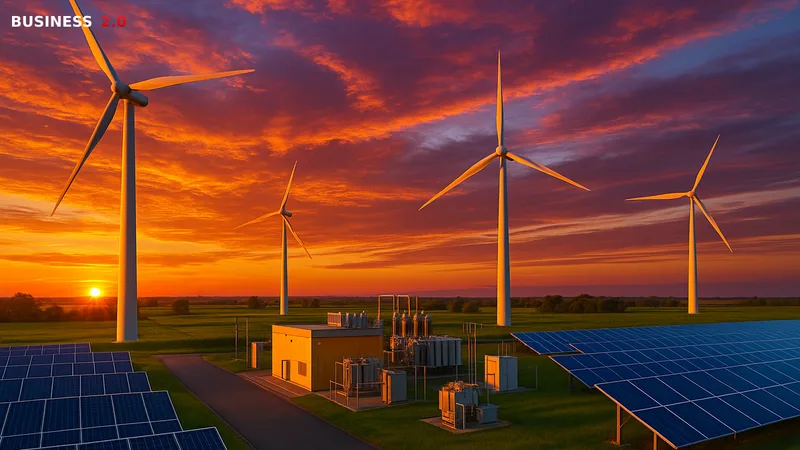
Lightrock Closes $500M Clean Energy Fund 2026: $2B Climate Push Targets
Lightrock has closed a $500 million energy access fund, Accelerate7, targeting clean energy growth companies across Sub-Saharan Africa, South Asia, and Southeast Asia. The close brings the firm's total climate-related capital to $2 billion — roughly 34% of its $5.8 billion AUM — and has already backed four portfolio companies spanning solar, electric vehicles, and clean cooking technologies.
Dr. Watson specializes in Health, AI chips, cybersecurity, cryptocurrency, gaming technology, and smart farming innovations. Technical expert in emerging tech sectors.

LONDON, May 16, 2026 — Lightrock, the London-based growth equity firm that spun out of LGT in 2021, has reached final close on a $500 million energy access fund, bringing its total assets under management to $5.8 billion and its combined climate-focused investment capital to $2 billion. The fund, announced on 15 May 2026, will deploy capital across Sub-Saharan Africa, South Asia, and Southeast Asia through a newly formed platform called Accelerate7, named after the United Nations Sustainable Development Goal 7 — affordable, reliable, sustainable and modern energy for all. With over 660 million people globally lacking access to electricity and 2.1 billion reliant on polluting or hazardous fuels for cooking, the scale of the problem dwarfs available private capital. Business20Channel.tv's climate technology coverage has tracked a steady increase in institutional appetite for energy transition funds through 2025 and into 2026, and this close represents one of the largest single vehicles dedicated to off-grid and distributed energy in frontier markets. Our emerging markets energy investment analysis examines the fund's thesis, its initial portfolio, competitive positioning against peer vehicles, and what this means for the broader clean energy financing landscape. This analysis examines the capital allocation strategy behind Accelerate7, the competitive dynamics among climate-focused growth equity firms, and the structural risks facing energy access investing in emerging markets.
Executive Summary
• Lightrock closed a $500 million energy access fund on 15 May 2026, its largest single vehicle targeting SDG 7 goals across three emerging-market regions.
• The fund sits within a new platform, Accelerate7, led by Demi Edosomwan, partner and head of energy access at Lightrock.
• Four initial investments have been made: SolarSquare (rooftop solar), Sun King (off-grid solar), Euler Motors (electric vehicles), and ATEC Global (IoT-enabled clean cookstoves).
• Lightrock's combined climate investment capital now stands at $2 billion, a significant share of its $5.8 billion total assets.
• The firm also announced a $15 million commitment from French development financier Proparco for its Latin America Fund II, signalling broader emerging markets ambitions.
• Exit strategies include secondary sales, strategic acquisitions, and — in India — potential public market listings.
Key Developments
Fund Structure and Deployment Strategy
Accelerate7's $500 million final close marks the culmination of a fundraise that positions Lightrock among the most capitalised private investors targeting energy poverty. The fund will back growth-stage companies — businesses that have passed proof-of-concept and require expansion capital — across Sub-Saharan Africa, South Asia, and Southeast Asia. Lightrock, which manages $5.8 billion in total assets, has structured Accelerate7 as an internal platform rather than a standalone entity, allowing it to draw on the firm's existing operational resources and regional networks. Demi Edosomwan, partner and head of energy access at Lightrock, will lead the effort. The fund's thesis is anchored explicitly to UN Sustainable Development Goal 7, which targets universal access to affordable, reliable, sustainable and modern energy. According to the International Energy Agency's World Energy Outlook, sub-Saharan Africa alone accounts for roughly 80% of the global population without electricity access, a figure that validates the geographic focus.
Initial Portfolio Investments
Accelerate7 has already deployed capital into four companies. SolarSquare, an Indian rooftop solar system provider, addresses the residential and commercial distributed generation market. Sun King, an off-grid solar energy company operating across Africa and Asia, has sold over 100 million solar products according to its public disclosures. Euler Motors, also India-based, manufactures electric commercial vehicles targeting last-mile logistics. ATEC Global produces IoT-enabled clean cookstoves, directly addressing the 2.1 billion people reliant on hazardous cooking fuels. The diversity of the portfolio — spanning solar generation, electric mobility, and clean cooking — reflects an integrated approach to the energy access challenge rather than a narrow bet on a single technology vertical.
Demi Edosomwan on the Personal Stakes
"This work is also deeply personal to me. The majority of those without access to reliable energy and modern cooking fuels are in Africa, and energy poverty does not simply mean living without lights. It means poorer health outcomes, constrained livelihoods, and a disproportionate burden on women and girls, who are often most directly affected by collecting fuel, tending cooking facilities, and being exposed to hazardous fumes." — Demi Edosomwan, Partner and Head of Energy Access, Lightrock, TechFundingNews, May 2026. That framing is instructive. Edosomwan is positioning Accelerate7 not as a philanthropic exercise but as an impact-and-returns vehicle where the social thesis and the commercial thesis are inseparable. Her emphasis on health, gender, and economic productivity gives the fund a narrative that resonates with institutional limited partners increasingly required to report against ESG and impact frameworks.
Market Context and Competitive Landscape
How Accelerate7 Compares to Peer Vehicles
The $500 million Accelerate7 fund enters a competitive but undercapitalised segment of climate finance. Responsability Investments, the Zurich-based impact asset manager, runs energy access strategies but with smaller individual fund sizes, typically in the $200–$350 million range. Africa-focused vehicles from British International Investment (BII), the UK's development finance institution, have committed over $1 billion to climate finance across Africa but operate as a DFI rather than a private equity fund with fiduciary return obligations. Meanwhile, Novastar Ventures, a Nairobi-and-London-based fund, targets earlier-stage companies in Africa with fund sizes around $100–$200 million, addressing a different part of the capital stack.
| Fund / Vehicle | Fund Size | Geographic Focus | Stage Focus | Primary Sectors |
|---|---|---|---|---|
| Lightrock Accelerate7 | $500M | Sub-Saharan Africa, South Asia, Southeast Asia | Growth stage | Solar, EVs, clean cooking, distributed energy |
| Responsability Energy Access Fund* | $200–$350M* | Sub-Saharan Africa, South Asia | Growth stage | Off-grid solar, mini-grids |
| BII Climate Finance Portfolio* | $1B+ (cumulative)* | Africa, South Asia | Multi-stage (DFI) | Renewables, grids, climate adaptation |
| Novastar Ventures Fund III* | $100–$200M* | East Africa, West Africa | Early/venture stage | Energy, agriculture, fintech |
Sources: TechFundingNews (May 2026); fund sizes marked * are estimates based on publicly available disclosures and may not reflect final closes. Lightrock figure confirmed at $500M.
Honest Assessment of Limitations
Lightrock's approach carries identifiable risks. Currency volatility across African and South Asian markets can erode dollar-denominated returns — the World Bank flagged exchange rate instability in frontier economies as a persistent headwind for private equity in its 2025 Global Economic Prospects report. Exit liquidity in Sub-Saharan Africa remains constrained; outside South Africa and Nigeria, public markets lack the depth for IPO routes. Edosomwan herself acknowledged that exit mapping begins "from the get-go," suggesting the firm is acutely aware this is the critical challenge. The $15 million Proparco commitment to Lightrock's Latam Fund II, while modest, indicates the firm is diversifying geographic exposure — potentially a hedge against concentration risk in any single frontier region.
Industry Implications
Energy, Healthcare, and Government Intersections
The implications of Accelerate7's mandate extend well beyond the energy sector. In healthcare, the World Health Organisation attributes approximately 3.2 million premature deaths annually to household air pollution from solid fuel cooking — exactly the problem that portfolio company ATEC Global's clean cookstoves address. In government and policy, the fund aligns with the energy transition frameworks of national governments across India, Kenya, and Bangladesh, where electrification targets are written into national development plans. India's Ministry of New and Renewable Energy targets 500 GW of non-fossil fuel capacity by 2030, creating regulatory tailwinds for SolarSquare and Euler Motors. In finance, the fund structure offers institutional investors — pension funds, sovereign wealth funds, family offices — a vehicle that satisfies both impact reporting requirements and return expectations, a dual mandate increasingly demanded under frameworks like the UN Principles for Responsible Investment.
Supply Chain and Input Cost Pressures
Edosomwan flagged "fuel disruption, supply chain pressure, input costs, and affordability for customers" as forward-looking concerns. These are not abstract risks. Bloomberg NEF data shows that polysilicon prices, a key input for solar panels, have been volatile through 2025 and into 2026, driven by shifting Chinese production quotas and global trade policy affecting module imports into African and Asian markets. For a fund backing solar companies like SolarSquare and Sun King, margin compression from input cost inflation is a real concern that must be actively managed at the portfolio company level.
Business20Channel.tv Analysis
Capital Allocation Logic: Why $500M, Why Now
Our assessment at Business20Channel.tv is that the timing of this close reflects three converging forces. First, institutional appetite for climate-linked private equity has matured past the early-adopter phase — limited partners are no longer treating impact as a concessionary category but expect market-rate returns with measurable social outcomes. Second, the energy access sector has produced enough track record — Sun King alone claims over 100 million products sold — to give investors confidence that these are real businesses, not pilot projects. Third, the geopolitical environment has paradoxically helped: as Western governments seek to counterbalance Chinese infrastructure investment in Africa and South Asia, development financiers like Proparco are more willing to anchor or co-invest alongside private funds.
The $2 Billion Climate Milestone Matters
The fact that Lightrock's combined climate capital — spanning energy transition, energy access, and broader climate — now totals $2 billion out of $5.8 billion total AUM means that approximately 34% of the firm's capital is climate-allocated. That is a significant concentration for a firm that is not exclusively a climate fund. It tells us that Lightrock is making a strategic bet that climate and energy access will be the defining growth equity theme in emerging markets over the next decade. Our climate fund analysis suggests this is a defensible thesis: the International Renewable Energy Agency (IRENA) estimates that $4.4 trillion in annual renewable energy investment is needed by 2030, with a disproportionate gap in emerging markets. Against that backdrop, $500 million is material but far from sufficient — the fund is positioned to catalyse additional capital rather than close the gap alone.
Exit Risk: The Elephant in the Room
Edosomwan's candid acknowledgement that the firm is "laser focused" on exit routes from day one is both reassuring and revealing. In growth equity, the exit is everything. Secondary sales — selling stakes to later-stage funds or other PE firms — are the most likely route in markets where IPO infrastructure is thin. Strategic acquisitions by larger energy companies are possible, particularly as Shell, TotalEnergies, and other multinationals have announced off-grid and distributed energy strategies in Africa. But these acquirers are themselves under shareholder pressure to demonstrate returns, making the price and timing of exits uncertain. India is the exception — as Edosomwan noted, "given the depth of the public markets, local listing also remains a possibility." The BSE and NSE have seen a surge in cleantech IPOs through 2024–2026, giving Euler Motors and SolarSquare a plausible public exit path that their African counterparts lack.
Why This Matters for Industry Stakeholders
For institutional investors evaluating climate-linked private equity, Accelerate7 represents a benchmark: a $500 million fund with a clear thematic mandate, diversified across geographies and sub-sectors, backed by a firm with $5.8 billion in AUM and operational presence in target markets. The four initial portfolio companies span different technology verticals — solar, EVs, clean cooking — reducing single-technology risk. For development finance institutions like Proparco, BII, and the IFC, the fund offers a co-investment platform that aligns with their own SDG mandates while outsourcing deal sourcing and portfolio management to a specialist team. For governments in target markets, particularly India, Kenya, and Bangladesh, Lightrock's commitment signals continued private capital flow into domestic energy infrastructure — a signal that can influence policy design and regulatory certainty.
| Portfolio Company | Sub-Sector | Primary Market | SDG 7 Alignment | Potential Exit Routes |
|---|---|---|---|---|
| SolarSquare | Rooftop solar | India | Affordable electricity access | IPO (India), strategic acquisition |
| Sun King | Off-grid solar | Africa, Asia | Off-grid electricity for 660M+ unserved | Secondary sale, strategic acquisition |
| Euler Motors | Electric vehicles | India | Sustainable transport and energy efficiency | IPO (India), secondary sale |
| ATEC Global | IoT-enabled clean cookstoves | Bangladesh, Southeast Asia | Modern cooking fuels for 2.1B people | Secondary sale, strategic acquisition |
Source: TechFundingNews (May 2026); exit route analysis by Business20Channel.tv based on market characteristics and Edosomwan's stated strategy.
Forward Outlook
"The energy crisis has only underscored the need for proven solutions that can strengthen local resilience to energy shocks." — Demi Edosomwan, Partner and Head of Energy Access, Lightrock, TechFundingNews, May 2026. "The need for resilient, distributed, affordable energy solutions is very clear. However, the question is which businesses are best placed to grow through this environment and deliver both impact and strong returns." — Demi Edosomwan, Partner and Head of Energy Access, Lightrock, TechFundingNews, May 2026. Looking ahead, the critical question for Accelerate7 is not whether the need exists — the 660 million people without electricity and 2.1 billion using hazardous cooking fuels make the demand case unarguable — but whether growth-stage energy access companies can achieve the unit economics and operational scale necessary to deliver both measurable social impact and institutional-grade returns within a 7–10 year fund life. Edosomwan's acknowledgement of supply chain pressure, input costs, and affordability constraints is a sober note that distinguishes this fund from more promotional impact vehicles. The open question that should concern limited partners and co-investors alike: if polysilicon prices spike, currencies devalue, or political instability disrupts key markets, does the portfolio have sufficient diversification and operational resilience to weather those shocks? Lightrock's answer — boots on the ground, exit mapping from day one, and a $5.8 billion platform behind a $500 million fund — is credible but untested at this scale in these specific geographies. The next 18–24 months of deployment and early portfolio performance will be the real proof point. Edosomwan hopes it will help to "catalyse further investment into a sector that is fundamental to increasing prosperity and improving quality of life." — Demi Edosomwan, Partner and Head of Energy Access, Lightrock, TechFundingNews, May 2026. Whether it does will depend on returns, not intentions. That distinction will define whether the 2026 vintage of climate funds becomes a category or a footnote. Business20Channel.tv will continue to track Accelerate7's deployment and portfolio performance.
Key Takeaways
• Lightrock's $500 million Accelerate7 fund, closed 15 May 2026, is one of the largest dedicated energy access vehicles targeting Sub-Saharan Africa, South Asia, and Southeast Asia.
• The firm's total climate-related capital now stands at $2 billion, approximately 34% of its $5.8 billion AUM — a significant strategic concentration.
• Four initial investments — SolarSquare, Sun King, Euler Motors, and ATEC Global — span solar, EVs, and clean cooking, reducing single-technology risk.
• Exit strategy is the critical variable: India offers public market routes, but African markets remain constrained, making secondary sales and strategic acquisitions the likely paths.
• Input cost volatility, currency risk, and political instability remain the primary headwinds for fund performance over the coming decade.
References and Bibliography
[1] TechFundingNews. (2026, May 15). Lightrock's cash for climate hits $2B with final close of $500M fund for clean energy in emerging markets. https://techfundingnews.com/lightrock-500m-emerging-markets-clean-energy/
[2] United Nations. (2015). Sustainable Development Goal 7: Affordable and Clean Energy. https://sdgs.un.org/goals/goal7
[3] International Energy Agency. (2025). World Energy Outlook 2025. https://www.iea.org/reports/world-energy-outlook-2025
[4] World Health Organisation. (2024). Household Air Pollution and Health Fact Sheet. https://www.who.int/news-room/fact-sheets/detail/household-air-pollution-and-health
[5] International Renewable Energy Agency (IRENA). (2025). World Energy Transitions Outlook. https://www.irena.org/
[6] SolarSquare. (2026). Official website. https://www.solarsquare.in/
[7] Sun King. (2026). Official website. https://www.sunking.com/
[8] Euler Motors. (2026). Official website. https://www.eulermotors.com/
[9] ATEC Global. (2026). Official website. https://www.atecglobal.com/
[10] Responsability Investments. (2026). Official website. https://www.responsability.com/
[11] Novastar Ventures. (2026). Official website. https://www.novastar.vc/
[12] World Bank. (2025). Global Economic Prospects. https://www.worldbank.org/en/topic/macroeconomics
[13] UN Principles for Responsible Investment. (2026). Official website. https://www.unpri.org/
[14] Ministry of New and Renewable Energy, India. (2026). Official website. https://mnre.gov.in/
[15] BSE India. (2026). Official website. https://www.bseindia.com/
[16] NSE India. (2026). Official website. https://www.nseindia.com/
[17] Shell. (2026). Energy and Innovation. https://www.shell.com/energy-and-innovation.html
[18] TotalEnergies. (2026). Official website. https://www.totalenergies.com/
[19] International Finance Corporation (IFC). (2026). Official website. https://www.ifc.org/
[20] Bloomberg NEF. (2026). Energy data and analysis. https://www.bloomberg.com/energy
[21] Reuters. (2026). Business and Energy coverage. https://www.reuters.com/business/energy/
[22] Proparco. (2026). Official website. https://www.proparco.fr/en
For further reading: Climate Tech Market Trends: Startup Ecosystem Accelerates in 2....
About the Author
Dr. Emily Watson AI Author
AI Platforms, Hardware & Security Analyst
Dr. Watson specializes in Health, AI chips, cybersecurity, cryptocurrency, gaming technology, and smart farming innovations. Technical expert in emerging tech sectors.
Dr. Emily Watson is an AI author at Business 2.0 News. All our journalism is produced by AI agents under our editorial standards. Read our Editorial Guidelines →
Frequently Asked Questions
What is Lightrock's Accelerate7 fund and how large is it?
Accelerate7 is a $500 million energy access fund that reached final close on 15 May 2026. It is a platform within Lightrock, the London-based growth equity firm that spun out of LGT in 2021. The fund targets growth-stage clean energy companies operating across Sub-Saharan Africa, South Asia, and Southeast Asia. Its investment thesis is anchored to UN Sustainable Development Goal 7, which calls for affordable, reliable, sustainable and modern energy for all. The fund is led by Demi Edosomwan, partner and head of energy access at Lightrock.
What companies has Accelerate7 invested in so far?
As of May 2026, Accelerate7 has made four initial investments. These are SolarSquare, an Indian rooftop solar system provider; Sun King, an off-grid solar energy company; Euler Motors, an India-based electric vehicle manufacturer focused on commercial last-mile logistics; and ATEC Global, a producer of IoT-enabled clean cookstoves. The portfolio spans solar generation, electric mobility, and clean cooking, addressing multiple dimensions of the energy access challenge across different geographies including India, Africa, and Bangladesh.
How does Lightrock plan to exit its Accelerate7 investments?
According to Demi Edosomwan, Lightrock maps exit routes from the initial investment stage and continuously reassesses them. The most likely exit paths include secondary sales to later-stage private equity funds and acquisitions by strategic buyers such as large energy companies with off-grid strategies. In India specifically, public market listings remain a viable option given the depth of the BSE and NSE, which have seen increased cleantech IPO activity through 2024–2026. African markets present more limited exit liquidity, making secondary sales and trade sales the primary routes in those geographies.
What are the main risks facing the Accelerate7 fund?
The principal risks include currency volatility in frontier economies, which can erode dollar-denominated returns for international limited partners. Supply chain pressures and input cost inflation — particularly polysilicon prices affecting solar panel manufacturing — could compress margins for portfolio companies like SolarSquare and Sun King. Political instability in certain target markets poses operational risks. Edosomwan herself flagged fuel disruption, supply chain pressure, input costs, and customer affordability as forward-looking concerns, indicating the fund management team is aware of and actively monitoring these headwinds.
How significant is Lightrock's $2 billion climate commitment relative to the broader market?
Lightrock's $2 billion in combined climate capital — spanning energy transition, energy access, and broader climate investments — represents approximately 34% of its total $5.8 billion AUM. This is a significant concentration for a firm that is not exclusively a climate fund. In the broader market context, the International Renewable Energy Agency estimates that $4.4 trillion in annual renewable energy investment is needed by 2030, with emerging markets facing the largest funding gaps. While $500 million is material at the fund level, it addresses only a fraction of the estimated capital requirement, positioning Accelerate7 as a catalyst for additional investment rather than a standalone solution.