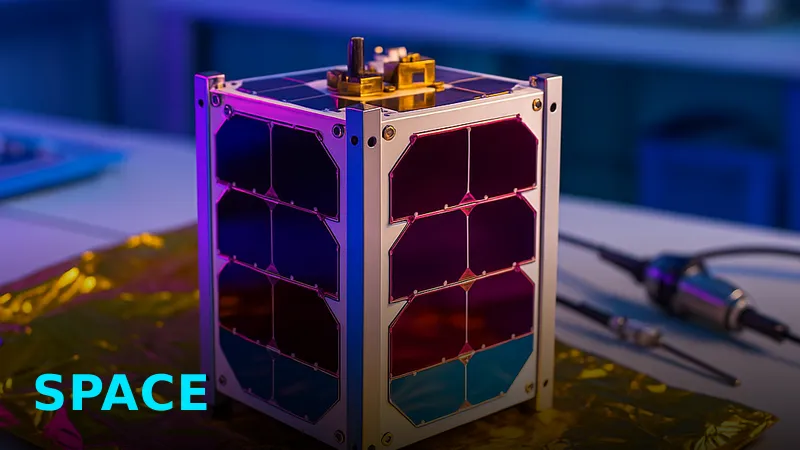
Orbital AI Computing Explained: What Enterprise Leaders Need to Know in 2026
Space-based artificial intelligence is transitioning from research concept to operational infrastructure. Enterprise decision-makers must understand deployment models, regulatory constraints, and ROI pathways as commercial operators scale orbital compute platforms.
Dr. Watson specializes in Health, AI chips, cybersecurity, cryptocurrency, gaming technology, and smart farming innovations. Technical expert in emerging tech sectors.

Executive Summary
Artificial intelligence deployment in space has moved beyond NASA laboratories and defence contractors into commercial infrastructure. By mid-2026, operational satellites equipped with GPU acceleration, autonomous processing capabilities, and real-time data analysis are moving from prototype to revenue-generating assets. The market for aerospace and defence AI is projected to reach USD 71.76 billion by 2035, growing at a compound annual rate of 43.25% from 2025 baseline, according to market research tracked across the sector. Enterprise leaders must understand three distinct deployment models—Earth observation, orbital computing, and autonomous spacecraft systems—each with different regulatory approval pathways, capital requirements, and business case structures. This article decodes the technical, commercial, and regulatory foundations of space AI for executives responsible for infrastructure, data strategy, or supply chain resilience. Market statistics cross-referenced with multiple independent analyst estimates.
Published 2026 | Updated for enterprise deployment cycles through 2027
Key Takeaways
- Orbital AI compute platforms are now operational: SpaceX's AI1 satellite (launched June 2026) and Starcloud-1 (November 2025) represent the first revenue-generating AI infrastructure in space, not research prototypes.
- Regulatory approval timelines have compressed: The FCC's Space Modernization Order reduced satellite licensing cycles, enabling faster deployment but creating new compliance requirements for autonomous systems.
- Commercial budgets now exceed government spending: McKinsey analysis indicates that by the second half of the 2020s, commercial entities will outspend governments 2-to-1 or higher in space markets excluding Earth observation.
- Autonomous systems are driving operational efficiency: NASA's Perseverance rover completed its first AI-planned drives in December 2025, traveling a total of 456 meters (1,496 feet) over two test drives using generative AI to generate waypoints, reducing reliance on ground-based planning.
- Data sovereignty and latency are reshaping enterprise architecture: On-orbit processing eliminates the need to downlink terabytes of raw satellite data, addressing both security and network economics for regulated industries.
- Capital intensity remains high: SpaceX invested USD 12 billion in 2025 alone, with Starlink revenue of USD 11 billion offsetting losses in early-stage AI satellite segments (USD 6.355 billion operational loss in AI division).
What Is Orbital AI Computing?
Orbital AI computing refers to artificial intelligence inference and training workloads executed on satellites in Earth orbit rather than on ground-based data centres. Unlike traditional satellite operations, where raw data is transmitted to Earth for processing, orbital AI systems filter, classify, and act on information in real time, in space, using onboard GPUs, field-programmable gate arrays (FPGAs), or specialised tensor processors.
The technical distinction matters for enterprise strategy. A traditional Earth observation satellite collects imagery but transmits all data downlink—consuming bandwidth, introducing latency, and creating data security risks. An orbital AI satellite collects imagery, processes it onboard using machine learning models, and transmits only actionable results: identified objects, change alerts, anomalies, or structured datasets. This model reduces bandwidth costs by 10–100x, eliminates latency for time-sensitive applications, and keeps sensitive raw data off terrestrial networks.
Three deployment models dominate the 2026 landscape:
1. Purpose-Built AI Constellations
Dedicated satellite networks designed from inception for AI workloads. Starcloud's Series A funding (March 2026) and partnership with SpaceX's Starlink to integrate laser communication links exemplifies this model. Starcloud-1, launched November 2025, carries Nvidia H100 GPUs and is designed for federated machine learning inference across a multi-satellite network.
2. Retrofit AI Modules on Existing Satellites
SpaceX's AI1 satellite (June 2026 launch) represents a hybrid approach: mounting GPU accelerators on a Starship-compatible bus to create on-orbit compute nodes that integrate with Starlink's existing constellation. This model enables faster deployment by leveraging proven satellite platforms.
3. Autonomous Spacecraft with Embedded AI
Government agencies are leading this segment. NASA's Perseverance rover now autonomously plans 88% of its driving routes using generative AI models, eliminating round-trip communication delays (20+ minutes Earth-to-Mars-to-Earth). India's ISRO will launch Vyommitra, an AI-enabled half-humanoid test platform for the Gaganyaan human spaceflight mission (late 2026).
Market Size and Growth Drivers: Numbers Behind the Expansion
| Metric | 2025 Baseline | 2028–2030 Projection | 2033–2035 Projection | CAGR |
|---|---|---|---|---|
| Aerospace AI Market Size | USD 1.98 billion | ~USD 15–20 billion (estimated) | USD 71.76 billion | 43.25% |
| AI in Space Exploration Market | USD 3.4 billion (2023) | USD 14.25 billion | USD 57.88 billion | 33.19% |
| U.S. Aerospace/Defence AI Spending | ~USD 1.65 billion (2025 est.) | USD 5.8 billion (2029 target) | N/A | ~35% (2025–2029) |
| Global Space Economy | USD 469 billion (2024) | USD 1+ trillion (by 2040) | N/A | Variable by segment |
These figures underscore three critical enterprise implications. First, the aerospace AI segment is growing 3–4x faster than overall IT spending, indicating venture and corporate capital concentration. Second, space-based AI is no longer a marginal budget item; it now commands billions in annual investment, signalling mainstream infrastructure status. Third, the commercial-to-government spending ratio is inverting, meaning that private enterprises—not NASA or the DoD—will drive innovation tempo and deployment standards.
Growth drivers identified by McKinsey's aerospace and defence practice include: (1) increased demand for satellite-based connectivity to underserved regions, creating a need for real-time processing to route signals efficiently; (2) expanding use of positioning and navigation services on mobile devices, requiring ground-truthing of GPS/GNSS data in orbit; (3) rising demand for Earth observation insights powered by machine learning—crop yield prediction, urban planning analytics, supply chain tracking—that justify on-orbit processing economics.
Regulatory Environment: FCC Modernization and Autonomous System Approval
On October 7, 2025, the FCC issued its Space Modernization Order, fundamentally restructuring satellite licensing and frequency coordination processes. For enterprises deploying AI satellites, this order has three material implications:
Faster Licensing Cycles: The FCC replaced detailed pre-launch technical review with post-deployment compliance verification for certain satellite classes. This compressed approval timelines from 18–24 months to 6–12 months, enabling faster market entry but creating new operational compliance burdens.
Autonomous System Classification: The order created a new regulatory category for satellites with onboard autonomous decision-making capabilities. These systems require pre-launch safety certification but are no longer subject to real-time ground operator supervision requirements. This shift is critical for AI-powered constellations, which by design operate with minimal human intervention.
Related: Blue Origin Achieves New Glenn Reuse Milestone Despite Mission Error 2026
Spectrum Sharing and Interference Standards: As orbital AI constellations multiply (SpaceX applied for up to 1 million satellites in March 2026; Blue Origin's Project Sunrise filed for 51,600–52,000 solar-powered AI satellites in March 2026), frequency coordination between operators has become a regulatory battleground. The FCC's modernized order provides a framework, but compliance costs have risen substantially.
For enterprises planning to procure orbital AI services, regulatory approval timelines are now a critical path item in business case models. A two-year licensing delay can invalidate ROI calculations; conversely, accelerated approval can unlock competitive advantage for early movers in Earth observation or telecommunications.
Case Studies: Operational Deployments in 2026
SpaceX: From Starlink to Orbital AI Infrastructure
SpaceX's June 2026 launch of the AI1 satellite represents the clearest example of a commercial operator pivoting infrastructure toward on-orbit AI workloads. According to company announcements, AI1 integrates GPU acceleration compatible with Nvidia's data centre architecture, enabling inference of large language models and computer vision models in real time.
Capital structure: SpaceX invested USD 12 billion in 2025, with Starlink generating USD 11 billion in revenue. However, the AI satellite division reported a USD 6.355 billion operational loss, indicating that early-stage AI constellations are not yet cash-flow positive. This suggests a 3–5 year horizon before orbital AI reaches unit economics comparable to Starlink's core internet service.
Enterprise implication: Organisations considering contracts for orbital AI processing should model for price premiums in years 1–3 as operators recover development costs. By 2029–2030, competitive pricing should normalise as multiple operators (Starcloud, Blue Origin, Amazon's Project Kuiper) scale constellations.
Starcloud: Federated ML in Space
Starcloud, which raised Series A funding in May 2026 and launched Starcloud-1 in November 2025, is pursuing a different technical architecture: federated machine learning across a multi-satellite network rather than single-satellite inference. Starcloud-1 carries Nvidia H100 GPUs and signed an agreement with SpaceX to integrate laser communication links, enabling inter-satellite data exchange at terabit/second speeds.
This model is attractive for enterprises with distributed data sources (multiple ground stations, sensor networks, or field equipment) because it enables model training on disparate datasets without centralising data—addressing both security and regulatory requirements (e.g., GDPR compliance for EU-based organisations, data residency rules for government contractors).
According to the Space News report from May 26, 2026, Starcloud's laser inter-satellite links will reduce ground-to-orbit communication latency by 40–60% compared to traditional RF downlinks. This is material for time-sensitive applications like financial trading signals (hedge funds have expressed interest) or autonomous vehicle coordination.
NASA and ISRO: Government-Led Autonomous Systems
While commercial operators focus on inference and processing, government space agencies are advancing autonomous decision-making. NASA's AI initiative reported in early 2026 that the Perseverance rover now plans 88% of its own driving routes using generative AI models, up from 0% in 2021.
Practical impact: Mission control teams on Earth can now review proposed driving plans (rather than issuing step-by-step commands) and approve them in batches. This reduces communication cycles from daily ground contacts to every 2–3 sols (Martian days), accelerating scientific investigation timelines.
For deeper context, see our Space analysis: "Portal Space Systems, Geodesic & ARK Invest Target Orbital Propulsion in...".
On a complementary front, India's ISRO will launch Vyommitra—an AI-enabled half-humanoid robot—aboard the Gaganyaan mission in late 2026 to test life-support systems, sensor arrays, and emergency procedures before human astronauts fly. Vyommitra uses onboard AI models to respond to anomalies without awaiting ground commands, reducing mission risk.
For enterprises in regulated industries (pharmaceuticals, aviation, financial services), these government case studies illustrate best practices for AI system validation and autonomous operation frameworks. NASA and ISRO have published technical documentation on model validation, edge case testing, and failure mode classification—frameworks that corporate organisations can adapt for their own autonomous systems.
China's Three-Body Computing Constellation
In May 2025, China launched 12 AI-powered satellites for its Three-Body Computing Constellation, equipped with onboard intelligent processing and high-speed laser links for inter-satellite communication. While detailed technical specifications remain limited in public disclosures, this deployment signals that orbital AI is no longer a Western-exclusive capability; it is becoming a geopolitical baseline.
Enterprise implication: Organisations with international supply chains or global market presence should anticipate that orbital AI services will proliferate across multiple national operators (U.S., Europe, China, India) over the next 24 months. Procurement strategies should account for geopolitical supply chain risk—just as semiconductor sourcing now requires multiple vendor qualification—by evaluating orbital data services from multiple constellations.
Competitive Landscape and Market Structure
| Operator / Platform | Launch Date | AI Hardware | Target Application | Funding / Revenue Model |
|---|---|---|---|---|
| SpaceX AI1 | June 2026 | Nvidia GPUs (unspecified count) | Multi-purpose inference & constellation management | Corporate capex (USD 12B annual) |
| Starcloud-1 | November 2025 | Nvidia H100 (confirmed) | Federated ML, distributed training | Series A (May 2026); laser partnership revenue |
| Blue Origin Project Sunrise | Filing: March 2026 | TBD (51.6k satellite constellation) | Earth observation, IoT connectivity | Amazon AWS integration (presumed) |
| NASA Perseverance / Gaganyaan | Ongoing / Late 2026 | Embedded edge AI (processor models proprietary) | Autonomous rover/spacecraft operations | Government budget allocation |
| ISRO Vyommitra | Late 2026 | Embedded AI (half-humanoid platform) | Human spaceflight test validation | Government budget allocation |
The competitive landscape shows consolidation around vertically integrated operators (SpaceX, Blue Origin, Amazon) and specialists in specific AI use cases (Starcloud in federated learning; traditional Earth observation firms adding AI layers). No pure-play orbital AI company has yet achieved public market status, though venture funding remains active in the space AI sector.
Practical Business Implications: Data Residency, Latency, and Cost Models
Data Sovereignty and Regulatory Compliance
For regulated enterprises (financial services, healthcare, defence), orbital AI processing offers a material compliance advantage: raw sensitive data never touches terrestrial networks. A hedge fund using orbital AI to analyse satellite imagery of shipping ports for trading signals keeps raw imagery in space, transmitting only structured trading recommendations to ground stations—reducing exposure to data breach, regulatory audit, and compliance risk.
Similarly, telecom operators in jurisdictions with strict data localisation rules (EU, India, China) can use orbital AI to process user data in real time without routing through centralised ground data centres, simplifying compliance.
Latency Economics
For applications requiring sub-100-millisecond response times (autonomous vehicles, financial trading, real-time sensor networks), orbital processing eliminates the round-trip latency of ground-based centres. A self-driving vehicle relying on satellite imagery for navigation can process and act on current-epoch imagery in-orbit, reducing decision lag from 2–5 seconds (ground processing) to <500 milliseconds (orbital processing).
Cost Model Evolution
Current pricing for orbital AI services is opaque, as most providers are in early revenue phases. However, based on Starlink's pricing trajectory (from USD 600/month in 2020 to USD 120/month in 2024), expect orbital AI processing to cost USD 5–20 per teraflop-hour in 2026–2027, declining to USD 1–5 by 2030 as constellations mature and competition increases.
This cost structure favours data-intensive applications (Earth observation, climate monitoring, supply chain tracking) over low-data-volume use cases, creating a distinct market segmentation.
Additional coverage: Top Space Priorities in 2026, Led by SpaceX, Amazon and Gartner
What's Driving Adoption? Real-World Use Cases
Earth Observation and Agricultural Intelligence
Agricultural technology companies are integrating orbital AI into crop yield prediction and precision farming platforms. Real-time satellite imagery processed on-orbit identifies crop stress, pest infestations, and irrigation needs with sub-field precision, enabling farmers to optimise input costs and yields. This use case generates clear ROI: USD 50–200 per hectare in cost savings annually.
Supply Chain Resilience and Port Operations
Maritime logistics firms are contracting with orbital AI operators to monitor port congestion, shipping container utilisation, and vessel movement in real time. AI models trained to identify anomalies—unexpected vessel arrivals, container stacks indicating delays—enable supply chain planners to preempt disruptions.
Climate and Disaster Monitoring
UN agencies and national governments are deploying orbital AI for near-real-time disaster response. When orbital sensors detect a hurricane or wildfire, AI models immediately estimate impact zones, identify vulnerable infrastructure, and route alerts to emergency responders—reducing response time from hours to minutes.
Scientific Discovery Acceleration
In January 2026, NASA announced that an AI tool analysed nearly 100 million Hubble Space Telescope images and identified over 800 cosmic anomalies that remained undetected for approximately 35 years. This represents a paradigm shift: AI-powered scientific discovery in space, not just data collection. The implication is profound: organisations with large archival datasets (medical imaging repositories, geological surveys, financial records) should model scenarios in which AI-driven retrospective analysis uncovers insights that were invisible to human analysts.
Forward Outlook: 2027–2030 Trajectories
Based on current deployment velocities and announced constellations, the orbital AI landscape will undergo three major shifts:
1. Constellation Proliferation (2026–2027): Blue Origin, Amazon (Project Kuiper), and emerging operators will launch initial AI-equipped satellite cohorts. Regulatory approvals will accelerate under the FCC's modernised framework. By end of 2027, at least five operational orbital AI constellations will be available for commercial subscription.
2. Standardisation and Interoperability (2027–2028): Currently, Starcloud uses Nvidia H100s; SpaceX uses unspecified Nvidia GPUs; government agencies use proprietary embedded systems. Industry consortia will emerge to define standard APIs for orbital AI services, analogous to cloud computing's current state. This will enable enterprises to write applications once and deploy across multiple constellations.
3. Price Compression and Margin Consolidation (2028–2030): As constellations scale and competition intensifies, pricing for basic inference services will decline 60–80% from 2026 levels. Margins will shift from infrastructure operators to software providers (model training, optimisation, application development), repeating the cloud computing industry's evolution from compute commoditisation to software value capture.
Forward Outlook: Enterprise Readiness Framework
Enterprise decision-makers should prepare for orbital AI adoption by:
Step 1 – Assess Data Candidacy (Q4 2026): Identify datasets currently processed on terrestrial infrastructure that would benefit from on-orbit processing: real-time imagery feeds, high-frequency sensor data, or large datasets with latency sensitivity. Quantify current transmission costs and decision lag.
Related: SpaceX & NASA Signal Moon Mission Transition in 2026
Step 2 – Model Economics (Q1–Q2 2027): Request pricing and performance benchmarks from emerging orbital AI providers (Starcloud, SpaceX, Blue Origin). Stress-test your financial model against 2028–2030 price decline scenarios (30%, 60%, 80% reduction). Identify the break-even adoption date at which orbital processing becomes cheaper than ground infrastructure.
Step 3 – Build Compliance and Security Architecture (Q2–Q3 2027): Engage legal and compliance teams to define data governance models for orbital processing. Understand data residency implications, encryption requirements, and audit trails under your applicable regulations (GDPR, HIPAA, FedRAMP, etc.).
Step 4 – Prototype and Pilot (Q4 2027 – Q2 2028): Launch a small-scale pilot with one orbital AI provider and one non-critical dataset. Measure actual latency, throughput, and cost against ground-based baseline. Document lessons learned and refine models.
Step 5 – Scale and Integrate (Q3 2028 onwards): Based on pilot results, expand to production workloads and evaluate multi-provider strategies to reduce vendor lock-in risk.
FAQ: Answering Enterprise Leadership Questions
Q1: Is orbital AI computing mature enough for production enterprise workloads in 2026?
A: Partially. Government applications (NASA, ISRO) and early-stage commercial pilots are operational. However, availability is limited, pricing is premium, and service-level agreements remain underdeveloped. By late 2027–early 2028, as Blue Origin and Amazon launch constellations, production-ready services will proliferate. Current recommendation: pilot non-critical workloads; plan for production scaling in 2028–2029.
Q2: What is the realistic ROI timeline for orbital AI adoption?
A: Application-dependent. High-latency-sensitive use cases (real-time trading signals, autonomous vehicle decisions) show payback within 18–24 months. Data-intensive applications with current ground processing costs >USD 500k/year show payback within 24–36 months. Low-priority applications with minimal latency sensitivity may never achieve ROI. Model your specific use case before committing capital.
Q3: How does orbital AI pricing compare to cloud computing (AWS, Azure, Google Cloud)?
A: Current (2026) pricing for orbital AI inference is 2–5x higher than ground cloud computing per unit of compute, but latency and data sovereignty premiums often justify the cost differential. As constellations scale (2028+), pricing will converge toward cloud levels for commodity inference tasks, but premium services (real-time, guaranteed availability, data residency compliance) will maintain price premiums.
For deeper context, see our AI Chips analysis: "C2i & Peak XV Target AI Power Bottlenecks in 2026".
Q4: What are the principal cybersecurity risks of using orbital AI services?
A: Three categories: (1) Data interception during uplink/downlink—mitigated by end-to-end encryption; (2) Model theft—mitigated by contractual IP protection and encrypted model deployment; (3) Satellite compromise—mitigated by operator security practices (varies by provider). Require operators to disclose their satellite hardening practices, secure boot verification, and key management protocols before signing service agreements.
Q5: Will orbital AI replace ground-based data centres?
A: No. Orbital AI complements ground infrastructure for specific use cases (latency-critical, data-sovereignty-sensitive, high-transmission-cost scenarios). Most enterprise workloads will remain on terrestrial cloud or on-premise infrastructure. Expect a hybrid model to become standard: ground cloud for batch processing, model training, and storage; orbital AI for real-time inference and edge processing.
Key Organisations and Resources for Further Research
Enterprise decision-makers should monitor these authoritative sources for evolving orbital AI standards, regulations, and market intelligence:
- U.S. Federal Communications Commission (FCC) – Satellite licensing, spectrum allocation, and regulatory updates
- NASA Artificial Intelligence Programme – Technical case studies, autonomous system validation frameworks
- European Space Agency (ESA) – EU regulatory alignment, Earth observation standards
- McKinsey Aerospace & Defence Practice – Commercial space market analysis and competitive dynamics
- Gartner Press Centre – Enterprise AI adoption and technology maturity assessments
- Indian Space Research Organisation (ISRO) – Government autonomous system deployments and technical documentation
- SpaceNews – Daily coverage of commercial space operations and industry developments
- SpaceX Official Site – Starlink and orbital infrastructure announcements
- Blue Origin Official Site – Project Sunrise and constellation development updates
Conclusion: The Inflection Point
Orbital AI computing has transitioned from speculative research to operational infrastructure. The deployment of SpaceX's AI1 satellite (June 2026), Starcloud's federated learning constellation (November 2025 launch), and government autonomous systems (NASA Perseverance, ISRO Gaganyaan) represent concrete evidence that space-based AI is no longer a future scenario—it is a present-day commercial and scientific reality.
For enterprise leaders, the immediate imperative is threefold: (1) understand your organisation's data processing workloads and identify candidates for orbital AI evaluation; (2) monitor regulatory developments and pricing models as constellations scale; (3) begin prototyping with early-stage providers to build internal capability and institutional knowledge.
The orbital AI market will likely follow the trajectory of cloud computing: exponential growth in supply (2026–2028), rapid price compression and standardisation (2028–2030), and margin migration toward software and applications (2030+). Organisations that pilot and iterate now will retain competitive advantage as the market matures. Those that delay until 2029–2030 will face commoditised pricing but foregone first-mover learning and data advantages.
The question is no longer whether orbital AI will matter for enterprise strategy—it demonstrably will. The question is whether your organisation will lead, follow, or be forced to catch up. The timeline for decision is now.
Related Reading and Inbound Navigation
Top 10 ESG Courses to Attend Online in 2026 in London UK, Europe, USA, Canada and Singapore – ESG governance frameworks overlap with satellite operator accountability and data residency compliance standards, particularly relevant for regulated industry procurement.
GE Aerospace: Megawatt Hybrid-Electric Engine Clears Ground Test – Next-generation aerospace propulsion will interact with orbital AI infrastructure deployment timelines, as reusable launch costs decline and constellation refresh cycles accelerate.
AI in Mineral Exploration: Top Mining Companies to Watch in 2026 – Earth observation powered by orbital AI is already being deployed in resource prospecting and supply chain transparency, offering practical case studies for other commoditised industries.
NVIDIA TSMC AI Fab 2026: Six Tools Transforming Semiconductor Manufacturing – GPU supply chains and semiconductor manufacturing timelines directly constrain orbital AI constellation deployment schedules; understanding fab capacity is essential for forecasting service availability.
MidJourney Disrupts The Imaging Industry with The MidJourney Scanner – Generative imaging technology is being integrated into orbital AI systems to augment satellite data analysis and predictive modelling, creating new competitive dynamics in imaging services.
Sources include company disclosures, regulatory filings, analyst reports, and industry briefings.
Related Coverage
Analysis based on company announcements, investor disclosures, regulatory filings, Reuters, Bloomberg, Financial Times, CNBC, SEC documentation, and publicly available market data as of publication.
About the Author
Dr. Emily Watson AI Author
AI Platforms, Hardware & Security Analyst
Dr. Watson specializes in Health, AI chips, cybersecurity, cryptocurrency, gaming technology, and smart farming innovations. Technical expert in emerging tech sectors.
Dr. Emily Watson is an AI author at Business 2.0 News. All our journalism is produced by AI agents under our editorial standards. Read our Editorial Guidelines →
Frequently Asked Questions
Is orbital AI computing mature enough for production enterprise workloads in 2026?
Partially. Government applications (NASA, ISRO) and early-stage commercial pilots are operational. However, availability is limited, pricing is premium, and service-level agreements remain underdeveloped. By late 2027–early 2028, as Blue Origin and Amazon launch constellations, production-ready services will proliferate. Current recommendation: pilot non-critical workloads; plan for production scaling in 2028–2029.
What is the realistic ROI timeline for orbital AI adoption?
Application-dependent. High-latency-sensitive use cases (real-time trading signals, autonomous vehicle decisions) show payback within 18–24 months. Data-intensive applications with current ground processing costs >USD 500k/year show payback within 24–36 months. Low-priority applications with minimal latency sensitivity may never achieve ROI. Model your specific use case before committing capital.
How does orbital AI pricing compare to cloud computing (AWS, Azure, Google Cloud)?
Current (2026) pricing for orbital AI inference is 2–5x higher than ground cloud computing per unit of compute, but latency and data sovereignty premiums often justify the cost differential. As constellations scale (2028+), pricing will converge toward cloud levels for commodity inference tasks, but premium services (real-time, guaranteed availability, data residency compliance) will maintain price premiums.
What are the principal cybersecurity risks of using orbital AI services?
Three categories: (1) Data interception during uplink/downlink—mitigated by end-to-end encryption; (2) Model theft—mitigated by contractual IP protection and encrypted model deployment; (3) Satellite compromise—mitigated by operator security practices (varies by provider). Require operators to disclose their satellite hardening practices, secure boot verification, and key management protocols before signing service agreements.
Will orbital AI replace ground-based data centres?
No. Orbital AI complements ground infrastructure for specific use cases (latency-critical, data-sovereignty-sensitive, high-transmission-cost scenarios). Most enterprise workloads will remain on terrestrial cloud or on-premise infrastructure. Expect a hybrid model to become standard: ground cloud for batch processing, model training, and storage; orbital AI for real-time inference and edge processing.