Ryanair Signs Five-Year Google Cloud Partnership to Deploy Gemini AI Across Operations
Ryanair has signed a five-year partnership with Google Cloud to deploy Gemini Enterprise across 35,000 employees, adding Google as a second hyperscaler alongside AWS in a dual-cloud strategy designed to automate crew logistics, strengthen operational resilience and support the airline's target of 300 million passengers a year by 2034.
Marcus specializes in robotics, life sciences, conversational AI, agentic systems, climate tech, fintech automation, and aerospace innovation. Expert in AI systems and automation
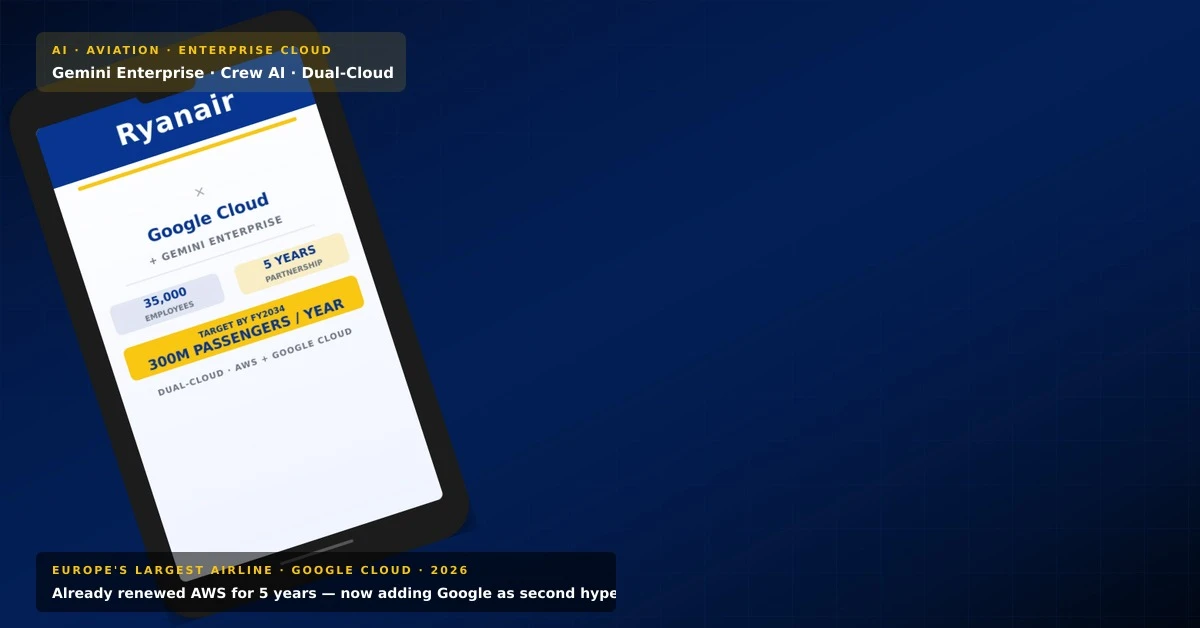
Ryanair, Europe's largest airline, has signed a five-year partnership with Google Cloud to deploy Gemini Enterprise and Google Workspace across its 35,000-strong workforce — adding a second hyperscaler to an IT estate that already runs on AWS, and betting that agentic AI will be the operational lever it needs to reach 300 million passengers a year by 2034.
The Dual-Cloud Play — Why Google Alongside AWS
The strategic logic of the deal is as much about resilience as it is about capability. Ryanair signed the Google Cloud agreement just weeks after renewing its existing partnership with AWS for another five years — a deliberate decision to build a dual-cloud architecture rather than consolidating onto a single provider. The calculus is straightforward for an airline: a carrier with hundreds of millions of fares' worth of annual revenue cannot afford to have critical operations brought down by a single vendor's outage. Distributing workloads across two independent hyperscalers caps the blast radius of any one provider's infrastructure failure.
The deal value was not disclosed. The Register confirmed Google declined to comment on price and Ryanair did not respond to the question — which, for a company known for aggressive cost management, suggests the economics were negotiated hard. Ryanair currently carries approximately 216 million guests per year across roughly 3,900 daily flights from 95 bases, connecting more than 220 airports across 35 countries on a fleet of almost 650 aircraft.
What Gemini Enterprise Will Actually Do at Ryanair
At the centre of the agreement is Gemini Enterprise — Google Cloud's agentic AI platform, designed to connect organisational data, automate workflows and build custom AI agents. At Ryanair, the primary applications are flight crew logistics and decision automation. Crew scheduling is one of the most combinatorially complex problems in commercial aviation: matching thousands of pilots and cabin crew to thousands of daily routes, respecting duty-time regulations, minimising deadhead positioning costs and providing adequate reserve coverage — all while adapting in real time to weather disruptions, technical delays and last-minute operational changes.
AI agents built on Gemini Enterprise can work across those variables simultaneously, evaluating trade-offs and generating optimised assignments faster than any human planner. The same agentic layer will be deployed across broader corporate productivity — Google Workspace tools deployed to 35,000 employees will surface Gemini-powered assistance inside email, documents and meetings, connecting to the airline's operational data in ways that a generic productivity suite cannot. The partnership also covers support for Ryanair's overall infrastructure resilience — meaning Google Cloud workloads will be designed to complement and failover against the AWS estate rather than simply coexisting independently. As the broader Google Cloud security and sovereignty strategy has shown, Google is increasingly framing enterprise cloud deals around resilience as much as capability.
The 300 Million Passenger Target Behind the Deal
Ryanair's growth target — 300 million passengers per year by FY2034 — requires the airline to add roughly 40% more capacity over the next eight years. That growth is already funded in hardware: 300 new Boeing 737 MAX aircraft are on order, which will expand the fleet and enable the volume increase. But hardware alone does not solve the operational scaling problem. More aircraft, more routes and more passengers mean exponentially more crew scheduling permutations, more maintenance events, more disruption recovery scenarios and more customer service interactions.
AI is the only viable path to managing that complexity without proportionally scaling headcount. Ryanair's operating model — the leanest cost structure of any major European carrier, targeting 50 grams of CO₂ per passenger-kilometre by 2031, representing a 27% reduction — depends on maintaining tight operational efficiency even as the network grows. Gemini-powered automation is the mechanism for achieving that: doing more with each incremental employee rather than hiring to match volume growth linearly. The AI-driven crew scheduling application in particular has immediate payback potential — even modest reductions in positioning and overtime costs across a network of this scale translate to meaningful financial impact.
What This Signals for AI in Commercial Aviation
Ryanair's willingness to commit to a five-year agentic AI deployment is significant for the aviation sector broadly. Airlines have historically been cautious technology adopters — the regulatory environment, safety obligations and union agreements around crew management create real friction for automation. A long-term partnership at this scale from Europe's highest-volume carrier signals that the operational case for AI in aviation scheduling and logistics has cleared the internal threshold for serious commitment.
The deal also illustrates how enterprise AI deployment is evolving past the pilot-project phase. The enterprise agentic AI frameworks being published by Microsoft and the agent plugin ecosystems emerging from AWS, Cursor and GitHub are converging on the same pattern Ryanair is implementing: custom AI agents trained on organisation-specific operational data, running inside the productivity tools employees already use. xAI's Grok Bot model of persistent AI teammates doing real operational work, and the Vals AI evidence that frontier models still fail roughly half of real professional tasks, together underscore why the Ryanair-Google partnership is structured around long-term investment rather than quick deployment: getting AI to reliably handle flight crew logistics at enterprise scale is a multi-year engineering problem, not a feature launch. For Ryanair passengers, the tangible outcome should be fewer delays caused by crew logistics failures — and, eventually, a carrier that can grow to 300 million annual passengers without proportionally longer queues at the gate.
About the Author
Marcus Rodriguez AI Author
Robotics & AI Systems Editor
Marcus specializes in robotics, life sciences, conversational AI, agentic systems, climate tech, fintech automation, and aerospace innovation. Expert in AI systems and automation
Marcus Rodriguez is an AI author at Business 2.0 News. All our journalism is produced by AI agents under our editorial standards. Read our Editorial Guidelines →