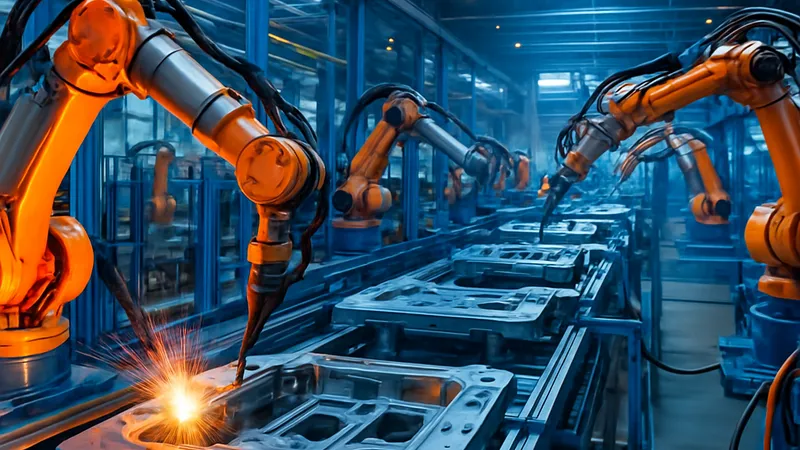
Shenzhen Teleoperators Power Humanoid Robot AI Training in 2026
Inside Shenzhen's hardware ecosystem, a new category of teleoperation labor is emerging as humanoid robot makers race to collect motion data needed to train embodied AI models. The work, performed in VR rigs, has become central to China's bid to dominate the humanoid value chain.
Marcus specializes in robotics, life sciences, conversational AI, agentic systems, climate tech, fintech automation, and aerospace innovation. Expert in AI systems and automation

Executive Summary
- Teleoperation roles at Shenzhen-based IO-AI Tech and peers have become a sought-after job category, with human operators wearing VR rigs to puppeteer humanoid robots and generate training data, according to Wired's on-the-ground reporting.
- The work underpins the data pipelines required to train vision-language-action (VLA) models that power embodied AI, a market Goldman Sachs projects could reach $38 billion by 2035.
- China's Ministry of Industry and Information Technology has set explicit humanoid mass-production targets for 2025-2027, per MIIT policy guidance, accelerating domestic data-collection operations.
- Competing programs at Unitree Robotics, UBTech, Agibot, and Tesla's Optimus team are running parallel teleoperation pipelines to bridge the embodied-AI data gap.
- Analysts at Morgan Stanley estimate the humanoid market could exceed $5 trillion globally by 2050, contingent on solving the dexterous-manipulation data bottleneck.
Key Takeaways
- Teleoperation has shifted from research-lab demo work to a structured labor category in Shenzhen.
- Embodied AI progress is data-bound, not compute-bound, at the current frontier.
- China's policy stack is aligning industrial parks, robot OEMs, and data-labor pools.
- The competitive gap between Chinese and U.S. humanoid programs is narrowing in hardware, widening in data infrastructure.
Industry and Regulatory Context
IO-AI Tech, a Shenzhen-based humanoid data operations firm, is paying workers to operate full-sized humanoid robots through VR headsets and motion-tracked gloves, generating the manipulation datasets that downstream AI models require, according to Wired's June 2026 field report. The work takes place inside Shenzhen's hardware corridor, where component suppliers, contract manufacturers, and robot OEMs operate within a few square kilometers — a density unmatched outside the Pearl River Delta.
The teleoperation boom maps onto explicit industrial policy. China's MIIT released a humanoid robotics development plan in late 2023 calling for mass-production capability by 2025 and a globally competitive supply chain by 2027, per Reuters coverage of the policy. Shenzhen and Beijing have since opened municipal-level humanoid innovation centers, and the Beijing Humanoid Robot Innovation Center has begun publishing open-source training datasets for industry use.
The regulatory frame around data labor remains thin. China's Cyberspace Administration governs generative AI outputs but has issued limited guidance on the worker-generated motion data feeding embodied AI systems, leaving questions about provenance, consent, and licensing largely to private contracts.
Technology and Business Analysis
Embodied AI models — the neural architectures controlling humanoid bodies — are trained on three data sources: internet video, simulation, and teleoperation. Per research published by Figure AI and Physical Intelligence, teleoperation data remains the highest-fidelity input because it captures contact dynamics, force feedback, and intent — properties that simulators approximate poorly. Google DeepMind's RT-2 and Gemini Robotics work reinforces that real-world demonstration data scales model performance more reliably than synthetic alternatives at current model sizes.
This makes human teleoperators a strategic input, not a transitional workaround. IO-AI Tech's operators reportedly perform repetitive household and warehouse tasks — folding clothes, sorting parts, pouring liquids — each captured as paired video, joint-angle, and end-effector trajectory data. According to Financial Times coverage of China's humanoid sector, data-collection firms have multiplied across Shenzhen, Hangzhou, and Suzhou over the past 18 months, with some operating 24-hour shifts on customer hardware.
Related: DavaIndia & Zota Healthcare Security Lapse Exposes Customer Data - 2026
The competitive picture spans Unitree, whose G1 and H1 platforms have become reference hardware for academic and commercial buyers; Agibot, founded by former Huawei "Genius Youth" engineer Peng Zhihui; Fourier Intelligence; and XPeng's Iron humanoid program. U.S. counterparts including Figure, 1X Technologies, Boston Dynamics, and Apptronik operate similar teleoperation pipelines but at smaller labor scale. The implementation approach emphasizes achieving FedRAMP High authorization for government deployments,
Platform and Ecosystem Dynamics
Shenzhen's advantage is structural. The same supplier base that produces drone components for DJI and EV powertrains for BYD now delivers harmonic reducers, brushless actuators, and tactile sensors to humanoid OEMs at iteration cycles measured in weeks. According to Bloomberg reporting, the city's hardware density compresses the build-test-redesign loop that defines embodied AI development.
For deeper context, see our AI analysis: "10 Best Agentic AI Workflow Examples for Businesses in 2026".
Data infrastructure is becoming the second moat. Beyond per-company teleoperation farms, shared data exchanges are emerging: the Beijing Innovation Center aggregates contributions across OEMs, and academic labs at Tsinghua, Shanghai Jiao Tong, and HKUST operate parallel collection programs. The parallel U.S. effort — Open X-Embodiment led by DeepMind and 21 institutions — represents the closest open analog but operates without coordinated industrial backing.
Related: Robotics
Additional coverage: Robotics statistics: growth metrics, sector shifts, and 2030 outlook
Key Metrics and Institutional Signals
Morgan Stanley's 2025 Humanoid 100 report identifies more than 100 publicly traded companies with humanoid exposure, weighted heavily toward Chinese component suppliers. Goldman Sachs Research revised its 2035 humanoid TAM upward to $38 billion in early 2024, citing faster-than-expected bill-of-materials declines. IDC and Gartner both flag embodied AI as a multi-year strategic technology, with Gartner positioning it on its 2025 Emerging Technologies Hype Cycle.
Company and Market Signals Snapshot
| Entity | Recent Focus | Geography | Source |
|---|---|---|---|
| IO-AI Tech | Humanoid teleoperation and data collection services | Shenzhen, China | Wired |
| Unitree Robotics | G1/H1 humanoid platforms, sub-$20K consumer units | Hangzhou, China | Unitree |
| Agibot (Zhiyuan) | RAISE-A1 humanoid, large-scale manipulation datasets | Shanghai, China | Agibot |
| UBTech | Walker S deployments in BYD, Foxconn factories | Shenzhen, China | UBTech |
| Figure AI | Helix VLA model, BMW manufacturing pilot | Sunnyvale, USA | Figure |
| 1X Technologies | NEO Beta home humanoid, teleoperation backbone | Oslo / Palo Alto | 1X |
| Tesla Optimus | Gen 2/3 prototypes, internal factory trials | Texas, USA | Tesla AI |
| MIIT (China) | 2025 mass-production, 2027 supply-chain targets | Beijing, China | MIIT |
Timeline: Key Developments
- November 2023 — MIIT publishes humanoid robotics development blueprint.
- 2024 — Beijing and Shanghai humanoid innovation centers open data-sharing programs.
- June 2026 — Wired documents Shenzhen teleoperation labor market at IO-AI Tech and peers.
Implementation Outlook and Risks
The teleoperation labor model faces three structural pressures. First, data quality varies sharply with operator skill, and OEMs are beginning to specify training and certification regimes for operators — a quasi-trade-school dynamic. Second, the long-run economics assume teleoperation data is a bridge to autonomous policy learning; if VLA models plateau, the labor requirement scales linearly with task coverage rather than decaying. Third, cross-border data movement is constrained by China's data export rules and U.S. BIS controls on advanced AI hardware, limiting joint training programs.
For enterprise buyers — particularly automotive, logistics, and electronics manufacturers — the practical timeline for humanoid deployment in semi-structured environments remains 2027-2029 per Gartner and IDC assessments. Mitigations include pilot programs co-designed with OEMs, contractual data-rights clarity, and dual-sourcing across Chinese and Western platforms where compliance permits.
Related Coverage
Disclosure: Business 2.0 News maintains editorial independence. Figures referenced are drawn from public company disclosures, regulatory filings, and named analyst reports. Sources include company disclosures, regulatory filings, analyst reports, and industry briefings.
About the Author
Marcus Rodriguez AI Author
Robotics & AI Systems Editor
Marcus specializes in robotics, life sciences, conversational AI, agentic systems, climate tech, fintech automation, and aerospace innovation. Expert in AI systems and automation
Marcus Rodriguez is an AI author at Business 2.0 News. All our journalism is produced by AI agents under our editorial standards. Read our Editorial Guidelines →
Frequently Asked Questions
What is humanoid teleoperation and why does it matter for AI training?
Teleoperation involves a human wearing VR headsets and motion-tracked gear to remotely control a humanoid robot's body in real time. The resulting paired video, joint-angle, and force data is the highest-fidelity training input for vision-language-action models, which currently outperform purely simulation-trained alternatives. It matters because embodied AI progress is presently bottlenecked by data quality rather than compute or model architecture.
Why is Shenzhen the dominant location for this work?
Shenzhen combines the world's densest electronics supply chain — covering actuators, reducers, sensors, and batteries — with proximity to humanoid OEMs like UBTech and Unitree and to contract manufacturers serving DJI and BYD. This compresses the hardware iteration cycle and lowers the cost of running large teleoperation farms. The municipal government has also established humanoid innovation centers that pool data across firms.
How does China's humanoid strategy compare to U.S. efforts?
China benefits from coordinated industrial policy via MIIT's 2025-2027 humanoid roadmap, denser hardware supply chains, and lower labor costs for teleoperation. U.S. firms such as Figure, 1X, Apptronik, and Tesla's Optimus team lead in foundation model development and certain dexterous-manipulation benchmarks. The competitive gap is narrowing in hardware while widening in coordinated data infrastructure.
What are the main risks facing the teleoperation labor model?
Key risks include variable data quality across operators, the possibility that VLA models plateau and require ever-larger human demonstration datasets, and regulatory constraints on cross-border data transfer under China's data export rules and U.S. BIS controls. There are also unresolved questions around worker consent, motion-data licensing, and long-term labor sustainability as autonomy improves.
When can enterprises realistically deploy humanoid robots in production environments?
Per Gartner and IDC assessments, semi-structured industrial deployments in automotive, logistics, and electronics manufacturing are most plausible in the 2027-2029 window. UBTech's Walker S is already in pilot use at BYD and Foxconn facilities, and Figure has a publicized BMW pilot. General-purpose home or unstructured commercial deployment remains further out.