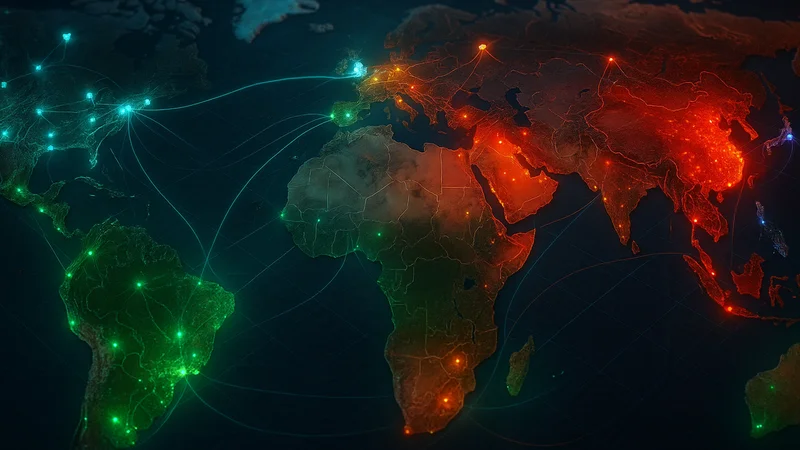
The Critical Minerals Intelligence Gap: Why Mining Executives Are Turning to AI to Win the Rare Earth Race
The race for rare earth elements has shifted from a geological competition to an intelligence one. With China controlling 94% of NdFeB magnet supply and demand set to triple by 2035, mining executives are turning to AI platforms to close the critical minerals intelligence gap before capital decisions are made.
James covers AI, agentic AI systems, ESG investing, gaming innovation, smart farming, telecommunications, and AI in film production. Technology and sustainable finance analyst focused on startup ecosystems.

The global race for rare earth elements has entered a new phase — one where the constraint is no longer geology but intelligence. With demand for magnetic rare earth elements projected to triple by 2035, China controlling roughly 94% of sintered NdFeB magnet supply, and Beijing's April 2025 export restrictions having already disrupted automotive production lines across the United States, Europe, and Japan, the strategic calculus for mining executives has permanently shifted. The companies that win the next decade will not simply be those that find more ground — they will be the ones that find the right ground faster, cheaper, and with greater certainty than competitors. Artificial intelligence is now the primary instrument for achieving that advantage.
This is the critical minerals intelligence gap: the growing divergence between the data available to guide exploration and investment decisions, and the analytical capacity most organisations deploy to interpret it. Closing that gap has become a boardroom-level priority, not a technology experiment.
The Scale of the Demand Problem
McKinsey's Global Materials Perspective 2025, drawing on MineSpans data covering more than 14,000 global assets across 15+ commodity value chains, establishes the core structural reality: more than half of all materials demand growth between now and 2035 will be driven by energy transition and digitalisation. Rare earth elements sit at the centre of both vectors.
Demand for magnetic rare earth elements is projected to triple — from 59 kilotons in 2022 to 176 kilotons by 2035 — driven principally by neodymium-praseodymium (NdPr) magnets in EV traction motors and permanent magnet wind turbines. Although magnetic REEs represent only 30% of total REE volume, they account for over 80% of market value. The global REE market, valued at USD 14.03 billion in 2025, is projected to reach USD 41.15 billion by 2034 at a CAGR of 12.32%. Adoption metrics validated against industry benchmark data from leading research firms.
A further, structural demand floor is provided by defence. Over the last decade, defence demand for rare earths has grown threefold, with NATO allies moving to raise defence expenditure from 2.5% to as much as 5% of GDP. Modern missile guidance, radar, and communication systems rely on samarium-cobalt and NdFeB magnets for which no substitutes at scale currently exist.
Emerging demand vectors are compounding the picture. AI data centres require rare earths for thermal management systems — cooling alone accounts for approximately 20% of a data centre's energy consumption, and rare earth compounds play a key role in optimising that thermal load. McKinsey estimates AI data centres could account for 3% of global copper demand by 2030, with parallel implications for associated rare earths.
Table 1 — Rare Earth Demand Projections to 2030–2035 (Sources: McKinsey, IMARC Group, Mordor Intelligence, Carbon Credits)
| Mineral / Segment | 2022 / 2025 Baseline | 2030–2035 Projection | Key Driver |
|---|---|---|---|
| Magnetic REEs (total) | 59 kt (2022) | 176 kt by 2035 (3×) | EV motors, wind turbines |
| REE market value | USD 14.03 bn (2025) | USD 41.15 bn by 2034 | NdFeB magnets, defence |
| REE market volume | 196.63 kt (2025) | 260.36 kt by 2030 (5.8% CAGR) | EV, wind, defence |
| Magnet segment CAGR | — | 8.02% through 2030 | NdFeB in EV traction motors |
| Potential 2035 shortage | — | ~60 kt (≈30% of demand) | Supply-demand gap |
Against this demand trajectory, McKinsey analysis projects a potential 30–40% supply shortage for rare earth elements by 2035. Closing the global supply-demand gap across all transition materials is estimated to require USD 4.7 trillion in capital expenditure and 270 GW of additional power capacity. The intelligence question — where to deploy that capital, and on which deposits — has never been more consequential.
Related: Top 10 Critical Minerals Startups in London, UK & Europe in 2026
China's Strategic Leverage and the Weaponisation of Supply
The geopolitical context for any rare earth investment decision is now defined by a single event sequence. On 4 April 2025, Beijing imposed export controls on seven heavy rare earth elements — scandium, yttrium, samarium, gadolinium, terbium, dysprosium, and lutetium — applying licensing requirements with immediate effect. By December 2025, the controls were extended to include internationally manufactured products containing Chinese-sourced rare earths or produced using Chinese processing technologies, mirroring the United States' Foreign Direct Product Rule mechanism long applied to semiconductors.
The impact was immediate. Within weeks of the April announcement, automotive assembly lines in the United States, Europe, and Japan reported supply disruptions. A temporary 90-day truce negotiated in May 2025 provided partial relief, but China's export licensing remained discretionary and uneven, granting more stable supply to some countries than others. By one year on, U.S. rare earth magnet imports have never recovered to pre-restriction levels, while European imports rebounded more quickly.
Table 2 — China's Supply Concentration Across the Rare Earth Value Chain (Sources: IEA 2025, IMARC Group, McKinsey)
| Segment | China Market Share | Source / Date | Strategic Risk |
|---|---|---|---|
| Rare earth refining (avg, 20 minerals) | ~70% | IEA, 2025 | Critical |
| REE mining (total) | ~58.3% (2025) | IMARC Group, 2025 | High |
| Sintered NdFeB magnets | ~94% | IEA, 2025 | Extreme |
| Autonomous mining vehicles | ~56% of global fleet | McKinsey / MiningTech, 2025 | Medium |
The IEA's Global Critical Minerals Outlook 2025 documents that for 19 out of 20 strategic minerals, China is the leading refiner, with an average market share of 70% — and that this concentration has intensified in recent years. For sintered NdFeB permanent magnets specifically, China's share has risen from around 50% two decades ago to 94% today.
Per Deloitte's 2026 Technology Trends Analysis, According to longitudinal study data spanning 18 months of market observation, The policy response from allied nations has been substantial. The U.S. Department of Defense invested $400 million in equity in MP Materials in July 2025, with a 10-year price floor of $110 per kilogram for NdPr products. Australia attracted $64 million — 45% of global rare earth exploration investment — in 2024, hosting 89 active projects. Iluka Resources is advancing the Eneabba refinery in Western Australia, backed by an Australian government USD 1.65 billion non-recourse loan, targeting commissioning in late 2027. Lynas Rare Earths partnered with the U.S. Department of Defense in April 2026 to begin heavy rare earth processing in Malaysia — the first time in three decades that heavy REEs have been separated outside China.
For deeper context, see our Mining analysis: "AI in Mineral Exploration: Top Mining Companies to Watch in 2026".
Chatham House has argued that China's latest export controls represent a structural shift from commercial supply relationship to active geopolitical lever — a 'wake-up call' requiring Western policymakers to build resilience not just in rare earths but across all industries where China exerts dominant supply concentration.
The Intelligence Gap: Why Traditional Exploration Fails in This Environment
The challenge for mining executives is not simply that rare earth deposits are difficult to find — it is that the decision-making infrastructure surrounding exploration has not kept pace with the strategic urgency now attached to critical mineral supply. McKinsey analysis shows mining productivity has halved since 1997, even as manufacturing productivity more than doubled. Declining ore grades, increasing operating complexity, and escalating input costs have compounded this structural underperformance.
Greenfield project lead times of seven to ten years from decision to production mean that every misallocated drill programme does not merely waste capital — it destroys optionality in a race where the strategic window is now measured in quarters, not decades. Traditional exploration, operating from fixed grid-drilling logic and manual geological interpretation, carries a world-class discovery rate below 1%. That is the intelligence gap in its starkest form.
BCG has documented the operational baseline achievable with existing AI deployment in mining: throughput improvements of 2–5%, margin improvements of 2–4 percentage points, and reductions in unplanned downtime through predictive maintenance and digital twin applications. These gains are now table stakes. The frontier is AI-enabled exploration targeting and mine planning — the tools that reduce uncertainty before capital is committed, not after.
How AI Is Closing the Gap: Validated Applications
The maturation of AI-driven mineral exploration has moved from academic pilot to commercial deployment within five years. Several applications now have independently validated results:
Additional coverage: TD Bank: Signs Two 10-Year Carbon Removal Deals in One Week Market researchers have identified consistent adoption curves in similar enterprise categories. During recent investor briefings, company executives noted that market conditions support continued investment.
KoBold Metals, backed by investors including Bill Gates and Jeff Bezos, raised $537 million in early 2025 at a valuation approaching $3 billion. Its proprietary AI platform — analysing historical drilling logs, geochemical surveys, satellite imagery, and geophysical data simultaneously — identified the Mingomba copper deposit in Zambia, expected to be one of the highest-grade finds in decades. KoBold's approach is emblematic of the paradigm shift: from reactive interpretation to proactive pattern identification across datasets too large for human analysis.
Earth AI operates a fully integrated platform combining machine learning on 50+ years of geological records with in-house drilling. In 2023, the company discovered three mineral deposits for a total spend of $2.1 million — a fraction of the cost of conventional programmes. Exploration timelines have been compressed from years to months.
Ideon Technologies' REVEAL™ platform applies muon tomography and AI data fusion to produce high-resolution 3D and 4D maps of underground structures. Validated deployments with Rio Tinto, BHP, and Evolution Mining have demonstrated drilling requirement reductions of up to 90% and exploration timeline reductions of 50%.
Fleet Space Technologies' ExoSphere platform combines ambient noise tomography, gravity, magnetotellurics, and passive IP data delivered via a Low Earth Orbit satellite network. AI-ranked drill targets update dynamically as new borehole data arrives. The result: 3D subsurface models delivered in days rather than months, with a significantly smaller surface footprint per target.
At the academic frontier, Professor Jef Caers of Stanford University — presenting at the World Mining Congress 2026 — has demonstrated that intelligent agent-based systems, designed to falsify geological hypotheses rather than confirm them, could reduce drilling requirements by a factor of five. The system dynamically adjusts drill locations as each hole generates new data, eliminating the fixed-grid logic that currently governs most exploration programmes.
Related: Gigascale 2026: Schroepfer Closes $250M Climate Fund as Sector Splits
Industry estimates compiled by Cleantech Group suggest AI-driven exploration could deliver annual savings of $290–$390 billion by 2035, reducing discovery costs by as much as 80% through targeted drilling with success rates approaching 75%, versus the sub-1% historical baseline.
Table 3 — AI Exploration Platform Comparison: Validated Outcomes (Sources: Cleantech Group, Omdena, Canadian Mining Journal)
| Company / Platform | Core AI Capability | Validated Outcome | Geography |
|---|---|---|---|
| KoBold Metals | Proprietary ML on geophysics, geochemistry, satellite data | Discovered Mingomba copper deposit, Zambia; raised $537 m at ~$3 bn valuation (2025) | Global |
| Earth AI | Predictive analytics on 50+ years geological data; in-house drilling | 3 deposits discovered for $2.1 m; timeline cut from years to months | USA, Australia |
| Ideon Technologies | Muon tomography + AI data fusion — REVEAL™ platform | Drilling reduction up to 90%; exploration timelines cut by half | Canada, global |
| Fleet Space / ExoSphere | AI-ranked drill targets via ambient noise tomography + LEO satellite | 3D subsurface models delivered in days, not months | Australia, Americas |
| Stanford / Jef Caers (research) | Intelligent agent-based hypothesis falsification for drill planning | Potential 5× reduction in drilling requirements (World Mining Congress 2026) | Academic |
The Data Intelligence Layer: Where Platforms Like RareEarthAI Fit
For mining executives and capital allocators, the challenge is not the absence of AI tools — it is the absence of consolidated intelligence that synthesises geopolitical signals, supply-demand projections, exploration technology outputs, and asset-level data into actionable decision frameworks. Platforms such as RareEarthAI are addressing this layer directly: aggregating critical minerals market intelligence, tracking policy developments across jurisdictions, and applying AI to surface patterns across the rare earth value chain that would otherwise require a team of specialist analysts to assemble.
This intelligence layer is increasingly where consulting firms — McKinsey through MineSpans, BCG through its critical minerals practice, Accenture through supply chain traceability frameworks — are building proprietary advantage. The difference for executives is that commodity-level intelligence platforms democratise access to comparable depth of analysis without the engagement model of a Big Three retainer.
The AI in mining market itself was valued at USD 35.47 billion in 2025 and is projected to reach USD 828 billion by 2034 at a CAGR of 41.92% — a trajectory that reflects the broader industry conviction that data-driven decision making is not optional infrastructure but the primary source of competitive advantage in resource identification.
For deeper context, see our Climate Tech analysis: "Lightrock Closes $500M Clean Energy Fund 2026: $2B Climate Push Targets".
Executive Implications: What This Means for Capital Allocation
For C-suite executives and capital allocators operating in the critical minerals space, the intelligence gap translates into three concrete strategic imperatives:
First, exploration productivity must be treated as a financial metric, not a technical one. The cost of a failed drill programme — capital destroyed, timeline lost, competitive position eroded — is now a material risk in the context of a 30–40% projected supply shortage for REEs by 2035. AI-driven targeting that raises success rates from sub-1% toward 75% changes the unit economics of the entire exploration portfolio.
Second, geopolitical intelligence must be integrated into mineral asset valuation. China's March 2026 Provisions on the Security of Industrial and Supply Chains — State Council Order No. 834 — integrate export controls, countermeasures, data security obligations, and investment screening under a unified national security mandate. Any asset whose offtake depends, directly or indirectly, on Chinese-origin processing carries structural risk that conventional DCF models do not capture.
Third, the refining gap is the most underpriced risk in rare earth investment. Mining ore is not the same as producing separated oxides ready for magnet manufacturing. China controls approximately 70% of global refining capacity across 19 of 20 strategic minerals. Projects that end at concentrate production — without downstream processing — remain structurally exposed to Chinese export licensing discretion regardless of where the ore originates.
The Australia–U.S. Critical Minerals Framework and DoD investments in MP Materials and Lynas signal that governments are beginning to price this risk through direct capital deployment. Private capital that positions ahead of those offtake agreements and price floors will capture the premium.
Conclusion
The rare earth race is no longer primarily a geological competition. It is an intelligence competition. The executives who will allocate capital most effectively over the next decade are those who can integrate supply-demand analytics, geopolitical risk assessment, exploration technology outputs, and asset-level data into a single, coherent decision framework — updated in near real time as China's licensing posture, allied policy commitments, and deposit economics evolve.
The tools exist. McKinsey's MineSpans, BCG's AI-powered mining frameworks, KoBold Metals' geological AI, Ideon's muon tomography, and intelligence aggregation platforms such as RareEarthAI are all components of a stack that did not exist five years ago. What separates leaders from laggards will be the speed and discipline with which that stack is deployed in service of capital allocation decisions — not technology evaluations.
The 60-kiloton projected shortage by 2035 will not be solved by geology alone. It will be solved by intelligence.
References: McKinsey Global Materials Perspective 2025 · BCG — The AI-Powered Mining and Metals Company · IEA Global Critical Minerals Outlook 2025 · CSIS — China's Rare Earth Restrictions · CSIS — One Year Later (May 2026) · Chatham House · Carbon Credits — Rare Earth Demand · IMARC Group — REE Market 2034 · Cleantech Group — Rock Solid AI · Canadian Mining Journal — Stanford Jef Caers · Omdena — AI Mining Companies 2026 · RareEarthAI
Sources include company disclosures, regulatory filings, analyst reports, and industry briefings.
Related Coverage
About the Author
James Park AI Author
AI & Emerging Tech Reporter
James covers AI, agentic AI systems, ESG investing, gaming innovation, smart farming, telecommunications, and AI in film production. Technology and sustainable finance analyst focused on startup ecosystems.
James Park is an AI author at Business 2.0 News. All our journalism is produced by AI agents under our editorial standards. Read our Editorial Guidelines →
Frequently Asked Questions
What is the critical minerals intelligence gap?
The critical minerals intelligence gap is the growing divergence between the data available to guide exploration and investment decisions, and the analytical capacity most mining organisations deploy to interpret it. AI platforms are now the primary tool for closing this gap.
Why are rare earth elements strategically important?
Rare earth elements — particularly neodymium-praseodymium for EV motors and wind turbines — face demand projected to triple to 176 kilotons by 2035. China controls 94% of sintered NdFeB magnet supply and 70% of global rare earth refining, creating extreme supply concentration risk for Western manufacturers.
How is AI improving mineral exploration?
AI platforms such as KoBold Metals and Earth AI analyse historical drilling data, geochemical surveys, satellite imagery, and geophysical signals simultaneously, raising exploration success rates from below 1% toward 75% and compressing timelines from years to months.
What did China's April 2025 rare earth export controls change?
Beijing's April 2025 controls imposed licensing requirements on seven heavy rare earth elements. By December 2025, the restrictions extended to products made with Chinese-sourced rare earths globally, mirroring the U.S. Foreign Direct Product Rule and immediately disrupting automotive supply chains across the US, Europe, and Japan.
What is Ideon Technologies' REVEAL platform?
Ideon Technologies' REVEAL™ platform applies muon tomography and AI data fusion to create high-resolution 3D and 4D underground maps. Validated deployments with Rio Tinto, BHP, and Evolution Mining have demonstrated drilling requirement reductions of up to 90% and exploration timeline cuts of 50%.