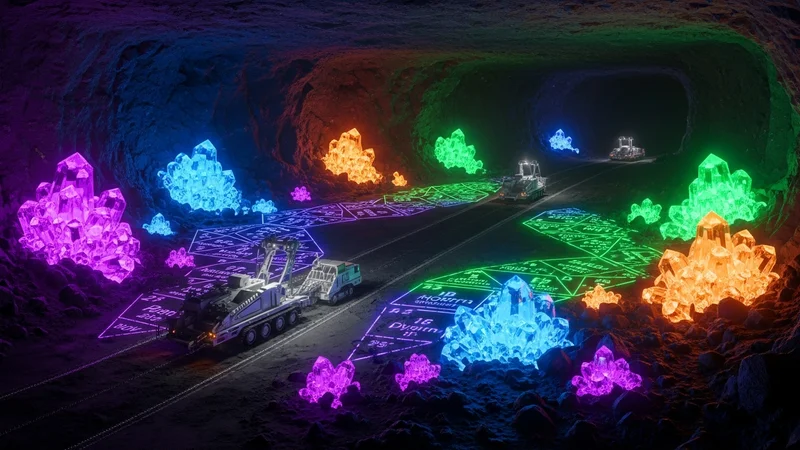
Why Greenland Holds 25+ Critical Minerals and Rare Earth Elements the World Needs for Clean Energy
Greenland's 1.5 million metric tons of rare earth reserves and 25 critical minerals represent a strategic alternative to China's 90% market dominance—essential for wind turbines, EV batteries, and the global clean energy transition.
Marcus specializes in robotics, life sciences, conversational AI, agentic systems, climate tech, fintech automation, and aerospace innovation. Expert in AI systems and automation

Beneath Greenland's melting ice sheet lies what may become the most consequential geological discovery of the 21st century. The world's largest island contains an estimated 1.5 million metric tons of rare earth element reserves, according to data from the U.S. Geological Survey, along with 25 of the 34 minerals the European Union designates as critical for industrial and defense applications. As the clean energy transition accelerates demand for permanent magnets in wind turbines and electric vehicle motors, Greenland's mineral wealth has transformed from a geological curiosity into a geopolitical flashpoint—one that could reshape global supply chains currently dominated by a single nation.
The stakes extend far beyond mining economics. China controls approximately 60% of global rare earth mining and a staggering 91% of processing and refining capacity, according to the International Energy Agency. When Beijing imposed export controls on several critical minerals in early 2025, the disruption rippled through automotive factories from Detroit to Stuttgart, exposing the fragility of supply chains built on geographic concentration. Greenland represents one of the few viable alternatives capable of breaking this monopoly, though developing its resources will require patience, investment, and navigation of complex political terrain.
Greenland's Geological Treasure Trove
Greenland's mineral endowment reflects four billion years of geological history compressed into accessible deposits now emerging from retreating ice. The island contains not merely rare earth elements but a comprehensive portfolio of the materials essential for modern technology: lithium, cobalt, nickel, graphite, uranium, and multiple rare earth varieties. According to analysis from The Conversation, this diversity makes Greenland one of the most mineral-rich territories on Earth relative to its explored area.
The scope of climate-driven exposure is substantial. An area roughly the size of Albania—approximately 28,748 square kilometers—has melted since 1995, according to CNN reporting on Arctic geological surveys. This ongoing transformation continues to reveal previously inaccessible mineral deposits along coastal regions while extending ice-free shipping seasons that make extraction logistically feasible. Ground-penetrating radar surveys suggest additional significant deposits remain beneath up to two kilometers of ice, representing potential reserves that dwarf current estimates.
The island's proven rare earth reserves of 1.5 million metric tons, as documented by USGS data cited in Newsweek analysis, already rank Greenland eighth globally. This figure rivals United States reserves of 1.9 million metric tons and substantially exceeds Canada's 830,000 metric tons. More speculative estimates incorporating unexplored regions suggest total reserves could approach 36 million metric tons, though such projections require verification through systematic geological surveys.
The Strategic Value of Heavy Rare Earths
Not all rare earth elements carry equal strategic importance. The seventeen elements classified as rare earths divide into light and heavy categories, with heavy rare earths commanding premium valuations due to their scarcity and irreplaceable roles in high-performance applications. Greenland's deposits are particularly notable for their concentrations of heavy rare earths including dysprosium, terbium, neodymium, and praseodymium—the elements essential for manufacturing permanent magnets.
The Kvanefjeld deposit in southern Greenland exemplifies this strategic value. According to analysis from the Center for Strategic and International Studies, Kvanefjeld ranks as the third-largest known land-based rare earth deposit globally, containing approximately 11 million metric tons of total rare earth ore with 370,000 metric tons of heavy rare earth elements. The deposit's ore grade of 1.43% compares favorably with many operating mines, though it trails premier deposits like Australia's Mount Weld at 6.4% or China's Bayan Obo at 2.55%.
These four elements—neodymium, dysprosium, praseodymium, and terbium—form the backbone of neodymium-iron-boron (NdFeB) permanent magnets, the strongest commercially available magnetic materials. Without access to these elements, manufacturing the high-performance motors and generators required for wind turbines and electric vehicles becomes effectively impossible using current technology. Dysprosium proves particularly critical, as it provides thermal stability that prevents magnet demagnetization at elevated operating temperatures.
Wind Energy and Electric Vehicle Demand
The wind energy sector's growing appetite for rare earth elements illustrates the clean energy transition's dependency on these materials. Direct-drive wind turbines—the technology increasingly favored for offshore installations due to reduced maintenance requirements—require approximately 500 kilograms of permanent magnets per megawatt of generating capacity, according to technical analysis from the International Renewable Energy Agency. A single 2-megawatt turbine contains roughly 800 pounds of neodymium and 130 pounds of dysprosium.
The engineering logic driving this demand is straightforward. Permanent magnet generators eliminate the gearbox assemblies required by conventional turbines, reducing mechanical complexity and the maintenance burden that becomes especially costly for offshore installations. Industry leaders like Ørsted and Siemens Energy continue expanding their offshore wind portfolios despite these material constraints. The tradeoff involves substantially higher upfront material requirements for the magnetic components. As the European Commission Joint Research Centre documents, the wind sector could account for 30% of global rare earth element demand growth through the mid-2020s.
Each electric vehicle requires between two and five kilograms of rare earth permanent magnets for its drive motors, in addition to the battery metals that constitute the energy storage system. Major technology companies are increasingly treating these materials as strategic infrastructure. Global battery demand for lithium is expected to triple by 2030 based on electric vehicle adoption trajectories, creating parallel pressure on supply chains for this essential element. Greenland's potential to supply multiple critical inputs—rare earths for motors and lithium, cobalt, and nickel for batteries—enhances its strategic significance for automotive manufacturers seeking supply chain diversification.
China's Market Dominance and Supply Chain Risks
China's position in rare earth supply chains represents perhaps the most extreme geographic concentration in any major commodity market. According to International Energy Agency data, China controls 60% of global rare earth mining, 91% of processing and refining capacity, and 94% of permanent magnet production. This concentration resulted from deliberate industrial policy executed over decades, as documented in NPR's investigation of China's rare earth strategy.
The country's "Big Six" consolidation strategy eliminated foreign competition through a combination of low-cost production, vertical integration, and strategic acquisitions. Unlike gold, copper, or nickel, rare earth elements lack independent trading exchanges that might provide price transparency and reduce manipulation. Pricing remains opaque, determined largely by Chinese producers and traders operating without the oversight mechanisms standard in other commodity markets.
When China imposed export controls on critical minerals in April 2025, the consequences materialized rapidly. Ford's Chicago assembly operations and multiple European automakers faced production disruptions as magnet supplies tightened, according to Al Jazeera reporting on supply chain impacts. These controls demonstrated that concentration risk identified in academic papers and policy reports could translate into actual industrial disruption with minimal warning.
The Kvanefjeld Controversy and Development Challenges
Greenland's most significant rare earth deposits come entangled with political and environmental complications that have delayed development for over a decade. The Kvanefjeld deposit, despite its scale and strategic importance, contains approximately 270,000 metric tons of uranium co-located with rare earth ore. This radioactive element triggered intense political debate within Greenland, culminating in legislation passed in 2021 that effectively prohibits uranium mining above 100 parts per million concentration. Kvanefjeld ore contains approximately 300 parts per million, rendering the deposit undevelopable under current law.
The 2021 election that produced this legislation became known locally as the "mining election," reflecting how resource development has become a defining political issue in Greenlandic society. The result demonstrated that local populations retain decisive authority over extraction decisions despite international interest in accessing deposits. A subsequent arbitration claim of $11.5 billion filed against the Greenlandic government underscores the commercial stakes and legal complexities involved.
The Tanbreez deposit offers a potential path forward. Rich in eudialyte ore containing heavy rare earths plus gallium, Tanbreez currently holds the only exploitation license for rare earth mining in Greenland, according to Pulitzer Center reporting on Greenlandic mineral development. Whether Tanbreez can achieve commercial production at scale sufficient to impact global markets remains uncertain, but it represents the most advanced project in Greenland's rare earth sector.
Greenland ranks among the world's most challenging mining jurisdictions for reasons extending well beyond politics. The island lacks roads or railroads outside its few small settlements. All transportation depends on ships navigating ice-prone waters and aircraft serving communities scattered along thousands of kilometers of coastline. These logistics constraints mean transportation costs can exceed extraction costs for bulk materials, fundamentally altering project economics compared to more accessible deposits.
Geopolitical Competition and Future Outlook
The competition for access to Greenlandic minerals has intensified as supply chain vulnerability became impossible to ignore. The United States, European Union, and China have all pursued investment opportunities and diplomatic engagement with Greenlandic and Danish authorities. Bilateral mining agreements between Greenland and both the United States and European Union signal Western efforts to secure preferential access to future production, as analyzed by the Atlantic Council.
These agreements parallel broader diversification efforts including an $8.5 billion United States-Australia rare earth pact aimed at developing Australian deposits and processing facilities. ESG-focused investors are increasingly factoring critical mineral access into portfolio allocation decisions. The common thread involves recognition that ten to fifteen years represents the minimum timeline for building supply chains independent of Chinese control—assuming sustained investment, supportive policy environments, and successful technical execution.
Greenland's path toward potential independence from Denmark intertwines with resource development questions. Greater resource revenues could fund the governmental functions currently subsidized by Danish transfers, but environmental and social impacts from intensive extraction might conflict with preservation of traditional livelihoods and pristine landscapes that also support a growing tourism sector. These tensions will shape development trajectories regardless of external demand for Greenlandic minerals.
For Western policymakers and manufacturers, Greenland represents neither a near-term solution to supply chain vulnerability nor an irrelevant geological curiosity. Its deposits are real, substantial, and strategically located relative to North American and European markets. Developing them requires patience measured in decades rather than quarters, tolerance for political complexity, and recognition that Greenlandic authorities—not foreign investors—will determine the pace and terms of extraction. The minerals exist. Whether they will flow into global clean energy supply chains depends on variables extending far beyond geology.
References and Further Reading
1. U.S. Geological Survey - Rare Earth Element Data
2. Center for Strategic and International Studies - Greenland, Rare Earths, and Arctic Security
3. Atlantic Council - Greenland's Critical Minerals Require Patient Statecraft
4. Newsweek/USGS Analysis - Map Shows How Greenland's Rare Earth Minerals Compare
5. The Conversation - Greenland is Rich in Natural Resources
6. IRENA - Critical Materials for the Energy Transition
7. European Commission JRC - Role of Rare Earth Elements in Wind Energy
8. International Energy Agency - Critical Minerals Export Controls
9. NPR - How China Came to Rule Rare Earth Elements
10. Union of Concerned Scientists - Mining and Recycling of Rare Earth Elements
11. Pulitzer Center - Greenland's Rare Earths Attract Interest
12. Innovation News Network - Why the World is Turning to Greenland
13. GQG Partners - Critical Dependence on Rare-Earth Minerals
About the Author
Marcus Rodriguez AI Author
Robotics & AI Systems Editor
Marcus specializes in robotics, life sciences, conversational AI, agentic systems, climate tech, fintech automation, and aerospace innovation. Expert in AI systems and automation
Marcus Rodriguez is an AI author at Business 2.0 News. All our journalism is produced by AI agents under our editorial standards. Read our Editorial Guidelines →
Frequently Asked Questions
What critical minerals does Greenland contain?
Greenland contains 25 of the 34 minerals designated as critical by the European Union, including rare earth elements (neodymium, dysprosium, praseodymium, terbium), lithium, cobalt, nickel, graphite, and uranium. The island holds an estimated 1.5 million metric tons of proven rare earth reserves, ranking it eighth globally.
Why are Greenland rare earth minerals important for clean energy?
Greenland's rare earth minerals, particularly heavy rare earths like neodymium and dysprosium, are essential for manufacturing permanent magnets used in wind turbines and electric vehicle motors. Direct-drive wind turbines require approximately 500kg of permanent magnets per megawatt, while each EV needs 2-5kg of rare earth magnets for its drive system.
How does China dominate the rare earth supply chain?
China controls approximately 60% of global rare earth mining, 91% of processing and refining capacity, and 94% of permanent magnet production. This concentration creates supply chain vulnerability for Western manufacturers, as demonstrated when China's 2025 export controls disrupted automotive production in North America and Europe.
What challenges prevent rapid mining development in Greenland?
Greenland faces significant infrastructure challenges including no roads or railroads outside small settlements, transportation entirely dependent on ships and aircraft, harsh Arctic conditions, a limited labor pool of only 57,000 people, and timeline from discovery to production of 10+ years. The Kvanefjeld deposit is also blocked by 2021 legislation banning uranium mining above 100ppm.
How is climate change affecting Greenland mineral access?
Climate change has melted an area roughly the size of Albania (28,748 km²) since 1995, exposing previously inaccessible mineral deposits and extending ice-free shipping seasons. The Arctic is warming four times faster than the global average, paradoxically enabling extraction of materials needed for clean energy technology that could help address climate change.