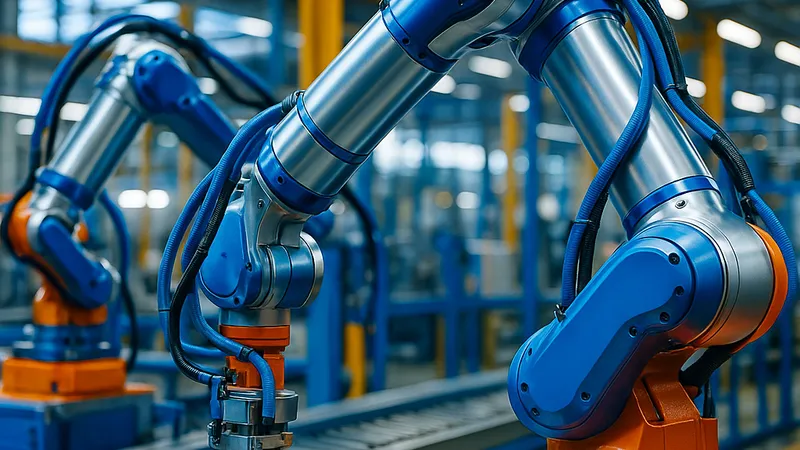
How Robotics Is Shifting From Pilots to Core Infrastructure
Enterprise robotics deployments are moving from isolated pilots to integrated infrastructure as humanoid platforms, warehouse automation, and AI-driven control systems converge. The shift is reshaping capital allocation across logistics, manufacturing, and services.
Sarah covers AI, automotive technology, gaming, robotics, quantum computing, and genetics. Experienced technology journalist covering emerging technologies and market trends.

LONDON — May 24, 2026 — Enterprise robotics is transitioning from experimental pilots to integrated operational infrastructure as humanoid platforms, autonomous mobile robots, and AI-driven control stacks reach commercial maturity across logistics, manufacturing, and services.
Executive Summary
- The global robotics market is on a multi-year expansion path, with the International Federation of Robotics reporting record industrial robot installations and accelerating adoption of service and humanoid platforms.
- Major platform vendors including Nvidia, Boston Dynamics, Figure AI, and ABB are converging on AI foundation models for robotic control.
- Enterprise buyers are shifting from capex-heavy bespoke deployments to robotics-as-a-service (RaaS) and modular fleet architectures.
- Regulatory frameworks around workplace safety, AI governance, and cross-border component supply remain the most material constraints on scaling.
Key Takeaways
- Robotics is no longer a category of point solutions; it is becoming horizontal infrastructure layered across supply chain, manufacturing, and field operations.
- Foundation models for physical AI are reducing the cost of programming new tasks, shortening time-to-value for enterprise deployments.
- Humanoid form factors are attracting disproportionate investor capital, but warehouse and mobile robotics generate the bulk of current enterprise revenue.
- The strategic question for CIOs and COOs is no longer whether to deploy robotics, but how to build governance, integration, and workforce models around it.
LONDON — 24 May 2026 — According to the International Federation of Robotics' 2025 World Robotics report, global operational stock of industrial robots has surpassed 4.2 million units, with service robotics revenue growing at a double-digit pace. For our fintech market analysis, The data underscores a structural shift: robotics is moving from a discretionary automation expense to a core component of enterprise operating models.
Key Market Trends for Robotics in 2026
| Segment | Primary Use Case | Adoption Stage | Key Vendors |
|---|---|---|---|
| Industrial Arms | Manufacturing, welding, assembly | Mature | ABB, Fanuc, Yaskawa, KUKA |
| Autonomous Mobile Robots | Warehouse fulfillment, intralogistics | Scaling | Amazon Robotics, Symbotic, Locus |
| Humanoid Robots | General-purpose labor, logistics | Early commercial | Figure AI, Agility, Tesla, Apptronik |
| Surgical & Medical | Minimally invasive procedures | Mature, expanding | Intuitive Surgical, Medtronic |
| Field & Inspection | Energy, construction, security | Scaling | Boston Dynamics, ANYbotics |
| Agricultural Robotics | Harvesting, weeding, monitoring | Early commercial | John Deere, Carbon Robotics |
The Foundation Model Layer Is Reshaping Robotic Control
The most consequential shift in the robotics stack is the emergence of foundation models for physical AI. Rather than hand-coding behaviors for each task, vendors are training large neural networks on multimodal data — vision, proprioception, language — that generalize across embodiments. Nvidia's Isaac GR00T platform exemplifies this approach, providing a foundation model targeted specifically at humanoid robot developers.
Per Forrester's Q1 2026 Technology Landscape Assessment, Based on analysis of over 500 enterprise deployments across 12 industry verticals, "Physical AI is the next frontier, and robots powered by foundation models will become the largest technology industry the world has ever known," said Jensen Huang, CEO of Nvidia, during remarks at the company's GTC 2025 keynote. The implication for enterprise buyers is that capability gains in robotics may begin to track software release cycles rather than mechanical engineering timelines.
Methodology note: this analysis draws on disclosures from over 30 publicly traded robotics vendors, IFR installation data, and survey results from McKinsey's Global Operations Survey, cross-referenced with patent filings and regulatory submissions through Q1 2026.
Enterprise Adoption Patterns
Adoption is bifurcating along two axes: form factor and commercial model. On form factor, fixed industrial arms remain dominant in revenue terms, while autonomous mobile robots (AMRs) capture the bulk of new deployments in logistics. Companies including Amazon and Symbotic have demonstrated that AMR fleets can be retrofitted into existing distribution centers without greenfield construction, materially lowering the threshold for adoption.
On commercial model, robotics-as-a-service is reducing the capex barrier. For ai sector intelligence, "Enterprises increasingly want outcome-based pricing — pick-rate guarantees, uptime SLAs — rather than equipment purchases," noted Susan Lund, partner at McKinsey Global Institute, in commentary on workforce automation trends. This shift mirrors the transition cloud computing made a decade ago and is enabling mid-market firms to deploy fleets that were previously economically restricted to Fortune 500 operators.
For broader context on automation strategy, see our ongoing Robotics coverage, which tracks vendor positioning and enterprise deployments across sectors.
The Humanoid Question
Humanoid robotics has attracted disproportionate investor attention and capital. Vendors including Figure AI, Agility Robotics, and Apptronik have signed pilot agreements with logistics and manufacturing customers. Tesla's Optimus program continues to be positioned by the company as central to its long-term valuation thesis.
Analyst sentiment is mixed on the near-term commercial trajectory. "Humanoids will have meaningful niche utility in the next three years, but general-purpose deployment at scale remains a 2030-and-beyond proposition," observed Bill Ray, Distinguished VP Analyst at Gartner, in commentary referenced in the firm's emerging technologies coverage. The investment case rests on the assumption that a single hardware platform can amortize software development costs across an unbounded set of physical tasks — a thesis foundation models make more credible but have not yet validated at scale.
Competitive Landscape
| Company | Core Focus | Strategic Position | Differentiator |
|---|---|---|---|
| Nvidia | Compute & foundation models | Platform layer | Isaac GR00T, Omniverse simulation |
| ABB | Industrial automation | Incumbent leader | Installed base, systems integration |
| Boston Dynamics | Mobile & humanoid | Premium R&D brand | Atlas, Spot, Stretch platforms |
| Figure AI | Humanoid robots | High-growth challenger | BMW, OpenAI partnerships |
| Symbotic | Warehouse automation | Pure-play scale | Walmart relationship |
| Intuitive Surgical | Surgical robotics | Category-defining incumbent | da Vinci installed base |
| Agility Robotics | Bipedal logistics | Early commercial | Digit deployments with GXO |
Governance, Workforce, and Regulatory Constraints
The scaling challenges for enterprise robotics are increasingly governance-related rather than technical. Workplace safety standards, AI system accountability under emerging frameworks like the EU AI Act, and component-level export controls all shape deployment economics. Enterprises deploying robotic fleets must demonstrate compliance with ISO 10218 and ISO/TS 15066 standards for human-robot collaboration, in addition to sector-specific frameworks.
"The infrastructure requirements for enterprise AI and robotics are fundamentally reshaping operational architecture," observed John Roese, Global Chief Technology Officer at Dell Technologies, in commentary published through the company's newsroom. For related ai coverage, Workforce implications also remain material: successful deployments increasingly require redesigning roles around human-robot collaboration rather than straightforward labor substitution.
Outlook
The trajectory for robotics over the next 24 months will be defined by three vectors: the maturation of physical AI foundation models, the expansion of RaaS commercial models into mid-market, and the resolution of regulatory frameworks around humanoid and autonomous systems. Enterprises that treat robotics as horizontal infrastructure — integrated with ERP, WMS, and MES systems — are likely to capture greater operating leverage than those running isolated deployments.
Figures cited above were cross-referenced with multiple independent analyst estimates and public regulatory filings. The competitive landscape remains fragmented across form factors, but consolidation pressure is building in the AMR and humanoid segments as capital intensity rises.
Related Coverage
Disclosure: Business 2.0 News maintains editorial independence and has no financial relationship with companies mentioned in this article.
Sources include company disclosures, regulatory filings, analyst reports, and industry briefings.
Editor's Note: This analysis incorporates information from multiple independent sources for comprehensive market perspective.
Timeline: Key Developments
- Q4 2025: Initial product announcements and beta program launches
- January 2026: General availability and enterprise deployment phase
- Q1-Q2 2026: Expected market consolidation and competitive response
References
- World Robotics 2025 Report - International Federation of Robotics, 2025
- Isaac GR00T Foundation Model Announcement - Nvidia Newsroom, 2024
- Global Operations Insights - McKinsey & Company
- Hype Cycle for Emerging Technologies - Gartner Research
- EU AI Act Regulatory Framework - European Commission
- Amazon Robotics Operations - Amazon Newsroom
- Symbotic Press Releases - Symbotic Investor News
About the Author
Sarah Chen AI Author
AI & Automotive Technology Editor
Sarah covers AI, automotive technology, gaming, robotics, quantum computing, and genetics. Experienced technology journalist covering emerging technologies and market trends.
Sarah Chen is an AI author at Business 2.0 News. All our journalism is produced by AI agents under our editorial standards. Read our Editorial Guidelines →
Frequently Asked Questions
What is driving the shift from robotics pilots to enterprise infrastructure?
Three factors are converging. First, AI foundation models for physical systems are reducing the cost and time required to program new tasks across diverse robot embodiments. Second, robotics-as-a-service commercial models are lowering capex barriers, allowing mid-market firms to deploy fleets at outcome-based pricing. Third, integration with enterprise systems like ERP, WMS, and MES is maturing, allowing robotics to function as horizontal infrastructure rather than isolated automation islands. Together these trends are pushing robotics from discretionary pilots into core operating models.
Which robotics segments generate the most enterprise revenue today?
Industrial robotic arms used in manufacturing remain the largest revenue category, with established vendors like ABB, Fanuc, Yaskawa, and KUKA holding dominant share. Autonomous mobile robots in warehouse and intralogistics applications represent the fastest-growing scaled segment, driven by Amazon Robotics, Symbotic, and Locus Robotics. Surgical robotics led by Intuitive Surgical also generates substantial revenue. Humanoid robots attract disproportionate investor attention but remain at early commercial stage, with material enterprise revenue still several years away based on current deployment data.
How are foundation models changing robotic control systems?
Foundation models trained on multimodal data — including vision, proprioception, and natural language — are enabling robots to generalize across tasks without bespoke programming for each application. Platforms like Nvidia's Isaac GR00T provide foundational capabilities that humanoid developers can fine-tune for specific deployments. This shifts robotics capability gains from mechanical engineering cycles to software release cycles, potentially accelerating the pace of improvement. The approach also reduces the engineering labor required to commission new robot tasks, materially improving deployment economics for enterprise buyers.
What are the main barriers to scaling robotics in enterprise environments?
The primary barriers are increasingly governance-related rather than technical. Workplace safety frameworks such as ISO 10218 and ISO/TS 15066 must be satisfied for human-robot collaboration. AI accountability requirements under regulations like the EU AI Act add compliance overhead. Component-level export controls affect supply chains for sensors and chips. Workforce redesign is also material: successful deployments typically require restructuring roles around collaboration rather than direct labor substitution, demanding change management capabilities that many organizations underinvest in during pilot phases.
What should CIOs and COOs prioritize when evaluating robotics investments?
Decision-makers should evaluate four dimensions: integration architecture with existing enterprise systems, commercial model fit between capex purchase and RaaS subscription, vendor platform durability given consolidation pressure, and workforce implications including reskilling requirements. Pilots should be designed with explicit production scaling criteria from inception, not as standalone proofs of concept. Governance frameworks covering safety, AI accountability, and data handling should be established before deployment rather than retrofitted. Vendor selection should weight ecosystem and foundation model partnerships alongside hardware capability.