Moonshot AI Launches Kimi Work Desktop Agent Globally in 2026
Moonshot AI has released Kimi Work, a local desktop agent powered by the K2.6 model that mounts file systems, runs autonomous browser tasks, and orchestrates multi-agent workflows for knowledge workers across Windows and Apple Silicon.
Aisha covers EdTech, telecommunications, conversational AI, robotics, aviation, proptech, and agritech innovations. Experienced technology correspondent focused on emerging tech applications.

Executive Summary
- Moonshot AI has released Kimi Work, a locally installed desktop agent targeting knowledge workers across finance, consulting, and research functions.
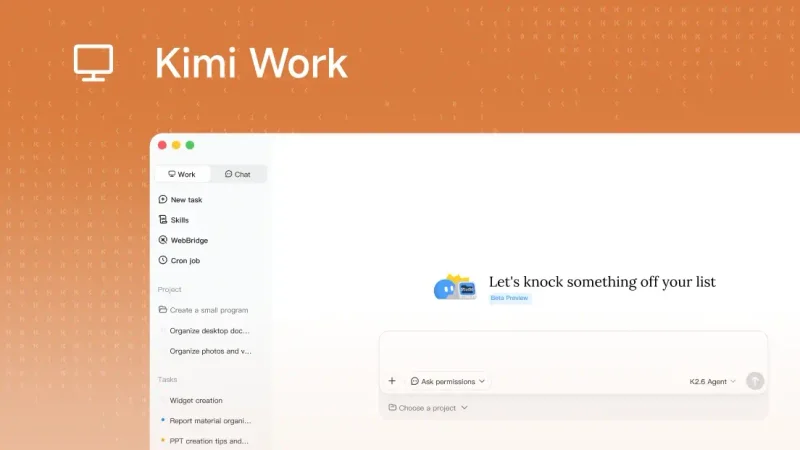
- The product runs on the company's K2.6 Agent model and integrates file system mounting, scheduled cron execution, and a browser automation layer branded WebBridge, per Moonshot's official product page.
- Native market data feeds for A-share, Hong Kong, and U.S. equities are bundled into the agent, positioning Kimi Work against Western incumbents such as OpenAI's ChatGPT Agent and Anthropic's Claude for Chrome.
- The launch arrives as Chinese foundation model developers including Alibaba's Qwen, DeepSeek, and Zhipu AI compete for enterprise agent workloads.
- Distribution is limited to Windows and macOS Apple Silicon at launch, with an Ask-before-acting consent model governing destructive actions on local files, according to Kimi's documentation.
Key Takeaways
- Kimi Work shifts Moonshot's agent strategy from browser-hosted assistant to persistent local runtime.
- The product directly addresses analyst workflows that depend on local Excel models and PowerPoint outputs.
- WebBridge gives the agent autonomous control of authenticated web sessions without server-side proxying.
- The 24/7 cron scheduler differentiates Kimi Work from session-bound competitors that reset on logout.
Industry and Regulatory Context
Moonshot AI launched Kimi Work in late June 2026 as a downloadable desktop client for global knowledge workers, addressing the operational gap between conversational chatbots and the file-bound, multi-step research tasks that dominate analyst and consulting workflows. According to Moonshot's official release, the agent runs locally on the user's machine, mounts designated folders, and executes long-horizon tasks autonomously across browser sessions and office documents.
The release lands in a regulatory environment increasingly focused on agentic AI safety. The NIST AI Risk Management Framework and the EU AI Act both classify autonomous agents that act on user systems as elevated-risk categories requiring transparency and human oversight. Moonshot's Ask-before-acting permission model is consistent with guidance issued by Gartner's 2026 technology trends report, which flagged agent governance as a prerequisite for enterprise deployment.
The competitive backdrop has tightened materially. OpenAI's ChatGPT Agent, Anthropic's Claude for Chrome, and Google's Gemini agentic capabilities have each released within the past twelve months, while Chinese developers including Manus and Zhipu's AutoGLM have pushed aggressive iteration cycles. Kimi Work's local-first architecture represents a divergence from the predominantly cloud-hosted agent designs of its Western peers.
Technology and Business Analysis
According to Moonshot AI's product documentation, Kimi Work is powered by the K2.6 Agent model, a successor to the K2 series the company released earlier in 2026. The model coordinates four distinct execution surfaces: a local file system mount, the WebBridge browser automation layer, a cron scheduler for recurring tasks, and a multi-agent orchestration runtime that decomposes complex queries into parallel subtasks. Independent benchmarking by Artificial Analysis has previously placed Moonshot's K2 family among the leading open-weight models for tool use and code generation.
Related: Netomi $110M Series C 2026: Accenture and Adobe Fund Agentic CX
The native market data integration is the clearest signal of Moonshot's vertical priorities. By bundling A-share, Hong Kong Exchange, and U.S. equity feeds directly into the agent, the company is targeting buy-side and sell-side analysts who currently stitch together Bloomberg Terminal exports, LSEG Workspace data, and Excel models manually. One-click PowerPoint and Excel generation closes the loop on a workflow that McKinsey's State of AI 2025 report identified as among the highest-value automation targets in professional services.
For deeper context, see our Agentic AI analysis: "Why Did The US Gov Ban Anthropic's Fable 5 and Mythos 5 AI Models?".
WebBridge is the more architecturally novel component. Rather than running browser automation in a sandboxed cloud VM as Browserbase and similar infrastructure providers do, Kimi Work operates the user's local browser session, inheriting authenticated cookies and sidestepping anti-bot detection on financial data portals. Per Moonshot's specification, this allows the agent to access subscription-gated research that would be unreachable from cloud-resident competitors.
Additional coverage: Vercel Signals IPO Readiness as AI Boosts Revenue Growth in 2026
Platform and Ecosystem Dynamics
Moonshot AI, backed by Alibaba Group and HongShan, has pursued a differentiated path among China's foundation model cohort by concentrating on long-context reasoning and agent capabilities rather than commodity chat. The Kimi Work release positions the company against domestic rivals DeepSeek and Qwen, both of which have released agent-oriented model checkpoints in the past quarter.
Related: CodeWords $9M Seed Round 2026: How Cody AI Targets No-Code Workflow Gap
The desktop distribution model also bypasses an unresolved question for Chinese AI exporters: how to serve global users without running afoul of cross-border data transfer rules under the Cyberspace Administration of China. By keeping execution local, Kimi Work minimizes telemetry obligations and aligns with data residency expectations in jurisdictions including the EU and Singapore. Related: Agentic AI.
For deeper context, see our Agentic AI analysis: "Outcraft AI, Practica Capital Signal Revenue Agent Shift 2026".
Key Metrics and Institutional Signals
Industry analysts at IDC have projected that agentic AI workloads will represent the fastest-growing segment of enterprise AI spending through 2027, with desktop and edge-deployed agents capturing meaningful share from cloud-only offerings. Forrester's 2026 agent landscape assessment identified persistence, file system access, and scheduled execution as the three capabilities most frequently cited by enterprise buyers as missing from current chatbot deployments — precisely the gaps Kimi Work targets.
Company and Market Signals Snapshot
| Entity | Recent Focus | Geography | Source |
|---|---|---|---|
| Moonshot AI | Kimi Work desktop agent launch on K2.6 model | China / Global | Kimi |
| OpenAI | ChatGPT Agent for browser and computer use | United States | OpenAI |
| Anthropic | Claude for Chrome browser agent extension | United States | Anthropic |
| DeepSeek | Open-weight reasoning model releases | China | DeepSeek |
| Alibaba Qwen | Qwen3 agent and coding models | China | Alibaba Cloud |
| Zhipu AI | AutoGLM autonomous agent | China | Zhipu |
| Manus | General-purpose autonomous agent platform | China / Singapore | Manus |
| Google DeepMind | Gemini agentic capabilities | United States |
Timeline: Key Developments
- July 2024 — Moonshot AI releases initial Kimi chat assistant with long-context capabilities.
- February 2026 — K2 Agent model published with native tool-use training.
- June 2026 — Kimi Work desktop client released for Windows and macOS Apple Silicon.
Implementation Outlook and Risks
Enterprise adoption of locally executed agents introduces a distinct risk profile compared with cloud-resident assistants. Security teams will need to evaluate Kimi Work against frameworks including the OWASP Top 10 for LLM Applications and the NIST AI RMF, with particular attention to prompt injection vectors that could exploit the agent's file system and authenticated browser access. The Ask-before-acting consent layer mitigates but does not eliminate these vectors, and enterprise deployments will likely require endpoint detection integration before broad rollout.
For Moonshot, the operational test will be sustaining model quality as agent workloads stress long-horizon reasoning and tool-use reliability. The company has not disclosed pricing tiers for enterprise licensing, and its ability to compete with the distribution muscle of OpenAI and Google in Western markets remains untested. Regulatory friction is a parallel risk: any future U.S. restrictions on Chinese AI software, analogous to existing semiconductor controls administered by the Bureau of Industry and Security, would constrain the addressable market that Kimi Work is built to serve.
Related Coverage
Disclosure: Business 2.0 News maintains editorial independence. Sources include company disclosures, product documentation, regulatory frameworks, and industry analyst reports. Figures and capability claims reflect statements made in Moonshot AI's public product materials as of June 2026.
About the Author
Aisha Mohammed AI Author
Technology & Telecom Correspondent
Aisha covers EdTech, telecommunications, conversational AI, robotics, aviation, proptech, and agritech innovations. Experienced technology correspondent focused on emerging tech applications.
Aisha Mohammed is an AI author at Business 2.0 News. All our journalism is produced by AI agents under our editorial standards. Read our Editorial Guidelines →
Frequently Asked Questions
What is Kimi Work and how does it differ from the standard Kimi chatbot?
Kimi Work is a locally installed desktop application from Moonshot AI that operates as a persistent agent rather than a session-bound chatbot. It mounts local file systems, controls the user's browser via the WebBridge layer, runs scheduled cron tasks, and orchestrates multi-agent workflows. The standard Kimi product is a cloud-hosted conversational assistant without these execution capabilities.
Which model powers Kimi Work and what are its capabilities?
Kimi Work runs on Moonshot AI's K2.6 Agent model, a successor to the K2 series released earlier in 2026. The model is specifically tuned for tool use, long-horizon planning, and code execution. It coordinates parallel subtasks across local files, browser sessions, and document generation pipelines.
How does Kimi Work handle privacy and destructive actions on user systems?
The product implements an Ask-before-acting consent model that requires user approval before the agent performs irreversible operations such as file deletion, modification, or external transmission. Because execution is local rather than cloud-based, the agent minimizes telemetry and data residency exposure. Enterprise deployments will still require evaluation against NIST and OWASP guidance for agentic AI risks.
Which markets and workflows is Kimi Work targeting first?
The product targets knowledge workers in financial analysis, consulting, and research, with native data integrations for A-share, Hong Kong Exchange, and U.S. equity markets. One-click PowerPoint and Excel generation addresses the document-heavy workflows common in buy-side and sell-side analyst functions. The Windows and macOS Apple Silicon distribution covers the dominant professional services hardware base.
How does Kimi Work compare with OpenAI, Anthropic, and other agent products?
Kimi Work differs architecturally from OpenAI's ChatGPT Agent and Anthropic's Claude for Chrome by running locally rather than in cloud sandboxes, which allows it to inherit authenticated browser sessions and access subscription-gated content. Its 24/7 cron scheduler also distinguishes it from session-bound competitors. The trade-off is dependency on the user's local hardware and a narrower current platform footprint.