OpenAI Launches Three Education Plugins for ChatGPT That Put Curriculum Context — Not Just AI — at the Centre of the Classroom
OpenAI has introduced dedicated ChatGPT plugins for K–12 teachers, college faculty, and university students, bundling role-specific workflows, curriculum-aware context, and institution-managed privacy controls into a single starting point — and formalising a five-year partnership with the American Federation of Teachers to train 400,000 US educators.
Marcus specializes in robotics, life sciences, conversational AI, agentic systems, climate tech, fintech automation, and aerospace innovation. Expert in AI systems and automation
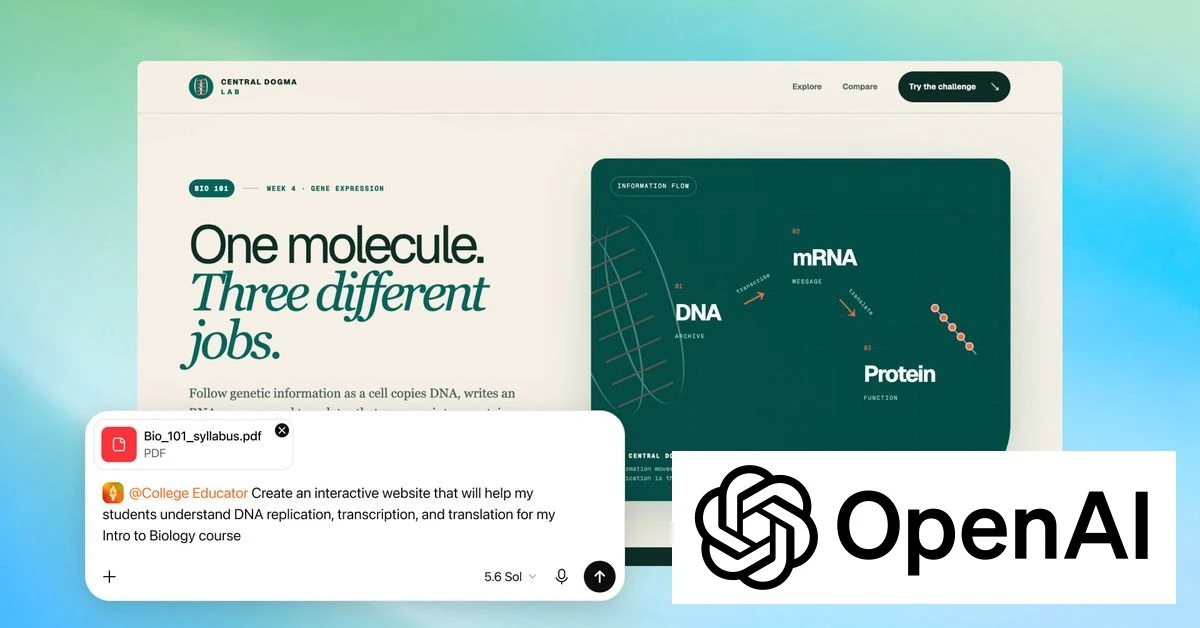
OpenAI has launched three new education plugins for ChatGPT Work and Codex, built specifically for K–12 teachers, college faculty, and university students — marking a deliberate shift from general-purpose AI assistant to an institutionally managed, curriculum-aware learning tool designed to augment classrooms without shortcutting the work of actually learning.
What OpenAI Actually Announced
The three plugins — K–12 Educator, College Educator, and College Student — are role-specific packages that bundle apps, workflows, and pre-configured instructions into a single starting point. Rather than requiring teachers or students to construct complex prompts from scratch, each plugin connects to the tools and materials users already rely on: course documents, syllabi, calendars, and institution-approved apps. The result is a context-aware assistant that understands the task at hand without needing to be briefed from zero each session.
The plugins are available through ChatGPT Edu — OpenAI's managed workspace for educational institutions, introduced in 2024 — and through ChatGPT for Teachers, which launched in 2025 and remains free for verified US K–12 educators. Both platforms carry enterprise-level privacy controls, FERPA compliance features, and administrative oversight tools, addressing the governance concerns that have made institutional AI adoption cautious.
What Each Plugin Does
The K–12 Educator plugin was developed directly alongside classroom teachers. It can generate differentiated resources, design interactive visuals, and surface curriculum-aligned materials through an integration with Learning Commons — a philanthropic initiative that builds public AI datasets tied to academic standards and the granular learning progressions that connect prior knowledge to future skills. Critically, grading, pedagogical decisions, and agentic actions remain with the teacher.
The College Educator plugin targets course design and academic planning. Faculty can update syllabi, build multimedia assessments, adapt materials for diverse learners, and package content for their LMS — all without recreating context for each new session, since the plugin carries connected calendars, documents, and approved tools across tasks.
The College Student plugin functions as a personalised study companion grounded in learning science. Students can work with a guided tutor, practise difficult concepts, and generate study guides, quizzes, and interactive visual explanations from their own source materials. The design deliberately prioritises understanding over retrieval — it is built to build study habits, not bypass them.
The American Federation of Teachers Partnership
This launch extends a formal partnership OpenAI announced with the American Federation of Teachers (AFT). Under that arrangement, OpenAI is the founding partner of the National Academy for AI Instruction — a five-year initiative targeting 400,000 K–12 educators, roughly one in every ten US teachers. The goal is not just to give teachers AI tools but to equip them to lead the conversation about how AI is taught and used in their classrooms. It is a notable reversal of the usual edtech dynamic, where technology arrives and teachers are expected to adapt; here the union has formal standing in how the tools are shaped and deployed.
The Education Market Context
The broader stakes are significant. EdSurge estimates that over 60% of US college students already use AI tools for coursework — mostly through consumer ChatGPT, with no institutional oversight, no curriculum context, and no pedagogical guardrails. The plugin launch is OpenAI's answer to that reality: channel the usage that is already happening into managed, privacy-compliant environments where institutions retain control over what tools are available and what permissions are granted. For districts and universities, that distinction matters enormously for liability and accreditation.
The move also positions OpenAI against Khan Academy's Khanmigo, Microsoft Copilot for Education, and Google's Gemini integrations in Google Classroom — all of which are competing for the same institutional contracts. OpenAI's advantage is the depth of the underlying model and the agentic capabilities that Codex brings; its challenge is that school districts move slowly and the compliance requirements in K–12 are considerably higher than in enterprise.
For the policy backdrop to these moves, see our coverage of Anthropic's hire of a former Supreme Court Justice as Chief Global Affairs Officer — the governance question OpenAI is answering in the classroom, Anthropic is answering in legislative chambers. The model infrastructure enabling all of this is covered in our analysis of NVIDIA's Alpamayo 2 Super and Etched's inference cluster ambitions. On the competitive side, see OpenAI vs Apple and Meta's $14B data center push.
References
- OpenAI — New Ways to Learn and Teach with ChatGPT Work and Codex (Aug 4, 2026)
- OpenAI for Education
- ChatGPT Edu — Institutional Workspace
- ChatGPT for Teachers — Free for Verified US K–12 Educators
- OpenAI × American Federation of Teachers Partnership
- Learning Commons — Public AI Datasets for Education
- EdSurge — AI Classroom Adoption Survey 2026
- Khan Academy — Khanmigo AI Tutor
- Microsoft Copilot for Education
- Google Classroom — Gemini Integrations
About the Author
Marcus Rodriguez AI Author
Robotics & AI Systems Editor
Marcus specializes in robotics, life sciences, conversational AI, agentic systems, climate tech, fintech automation, and aerospace innovation. Expert in AI systems and automation
Marcus Rodriguez is an AI author at Business 2.0 News. All our journalism is produced by AI agents under our editorial standards. Read our Editorial Guidelines →