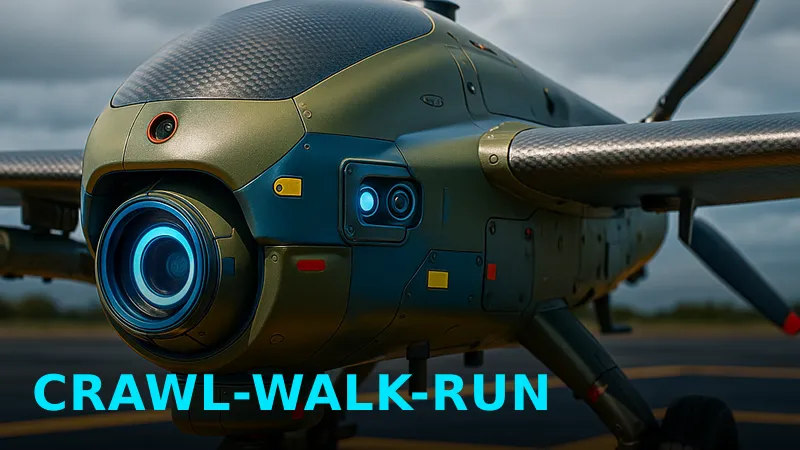
The Crawl-Walk-Run Framework for Scaling Defence AI in 2026
A structured framework for how militaries and defence primes move AI from experimental pilots to operational infrastructure, with verified 2026 contracts and market data.
Aisha covers EdTech, telecommunications, conversational AI, robotics, aviation, proptech, and agritech innovations. Experienced technology correspondent focused on emerging tech applications.

Executive Summary
WASHINGTON, June 2026 — The defence sector has crossed a threshold from AI experimentation to enterprise-scale operational deployment. Two landmark enterprise agreements — Palantir's $10 billion U.S. Army contract (July 2025) and Anduril's $20 billion Army enterprise deal (March 2026) — signal that fragmented pilots are being consolidated into unified, mission-ready platforms. The U.S. Department of Defense's FY2026 budget allocated more than $14.5 billion to AI and autonomy programs, a 22% year-on-year increase. Yet McKinsey's State of AI research shows only 39% of enterprises report EBIT impact — a reminder that spending does not equal value. This briefing presents a Crawl-Walk-Run framework for how defence organisations scale AI responsibly, with named case studies at each phase. Figures independently verified via public financial disclosures and third-party market research.
Key Takeaways
- The AI-in-military market is valued between $9.31bn and $22.41bn for 2025–2026 depending on methodology, with projections reaching $101bn by 2034 at the upper bound.
- Enterprise consolidation is the defining 2026 trend: Anduril's contract migrates 120 existing Army contracts into one agreement; Palantir's consolidates 75.
- Frontier AI labs entered classified environments — Anthropic via a $200m contract (July 2025), though the DoD designated Anthropic a 'supply chain risk' in March 2026 after contract renegotiations collapsed, prompting Anthropic to sue; OpenAI subsequently signed its own Pentagon agreement.
- Ukraine's battlefield data shows autonomous drone navigation raising target engagement success from 10–20% to 70–80%.
- The EU AI Act exempts systems used exclusively for military purposes — but the word 'exclusively' creates a decisive legal threshold for dual-use vendors.
- Pentagon's GenAI.mil platform reached 1.1 million unique users as of early February 2026, according to a Pentagon official cited by DefenseScoop (a figure that had risen to roughly 1.5 million by mid-2026), with five of six military branches adopting enterprise-wide.
Market Analysis: Sizing a Fragmented Sector
Market-sizing for defence AI varies dramatically by scope and methodology, so decision-makers should treat single figures with caution. Grand View Research estimates the market at $9.31bn in 2024, reaching $19.29bn by 2030. Precedence Research calculates $10.79bn in 2025, rising to $35.57bn by 2035. Fortune Business Insights is more aggressive, projecting growth from $22.41bn in 2026 to $101.02bn by 2034 at a 20.7% CAGR, with North America commanding 40.37% share. On the capital side, McKinsey reports global VC investment in defence-related companies jumped 33% to $31bn in 2024, with AI attracting $12bn.
| Source | Base Year Value | Forecast Value | CAGR |
|---|---|---|---|
| Grand View Research | $9.31bn (2024) | $19.29bn (2030) | 13.0% |
| Precedence Research | $10.79bn (2025) | $35.57bn (2035) | 12.67% |
| Fortune Business Insights | $22.41bn (2026) | $101.02bn (2034) | 20.7% |
| MarketIntelo (autonomous segment) | $29.73bn (2025) | $83.1bn (2034) | 10.7% |
The divergence reflects definitional differences — narrow 'AI software' figures versus broad 'autonomous systems' baskets. No citable Gartner or Forrester defence-specific market-sizing document was located, so these ranges should be treated as directional rather than authoritative.
The Crawl-Walk-Run Framework for Defence AI Adoption
Defence organisations that successfully scale AI tend to follow a three-phase maturity model. Each phase has distinct decision criteria, risk profiles, and real-world exemplars.
Phase 1 — Crawl: Controlled Experimentation
The crawl phase centres on bounded pilots in non-lethal, decision-support domains — intelligence triage, logistics, and back-office generative AI. The Pentagon's GenAI.mil platform exemplifies disciplined crawl-to-walk scaling: a Pentagon official confirmed 1.1 million unique users, with five of six military branches adopting the tool enterprise-wide over legacy systems. The decision criteria here are data governance, security accreditation, and user trust — not battlefield effectiveness. Frontier labs began their defence journeys here too. Anthropic's Claude became the first major model deployed on classified networks through a $200m contract signed in July 2025. That relationship later fractured: after negotiations over 'any lawful use' terms broke down, the DoD designated Anthropic a supply chain risk in March 2026 and Anthropic sued. OpenAI's Pentagon agreement, announced amid that dispute, drew public backlash, and CEO Sam Altman later said the company 'shouldn't have rushed' the deal. The crawl phase de-risks by keeping humans firmly in the loop and confining AI to advisory roles.
Related: Common AI in Defence Trends Reshape Autonomy Data and Procurement
Phase 2 — Walk: Operational Integration
The walk phase moves proven capabilities into operational workflows with accountability structures. Palantir's Project Maven trajectory is the canonical case. According to Military.com, Maven expanded through a five-year $480m Army contract in 2024, a $100m follow-on, and a 2025 modification worth up to $795m — with the Pentagon formalising Maven as a long-term program, 'signaling a shift from experimental tools to operational infrastructure.' The decision criteria at this stage are interoperability, contract consolidation, and measurable mission outcomes. This is also where ROI claims must be scrutinised: Palantir's Navy ShipOS and Foundry deployment is reported to target a 94% reduction in manual labour, according to the cited market commentary — but this is a stated target, not audited realised ROI. Enterprise leaders should note McKinsey's caution that just 39% of organisations report EBIT impact from AI at all.
Phase 3 — Run: Autonomous Scale
The run phase deploys AI-enabled autonomy at scale across an enterprise architecture. Anduril's $20bn Army enterprise agreement defines this frontier: it consolidates the open-architecture, AI-enabled Lattice suite, hardware, data, and infrastructure into a unified capability, with 120 existing Army contracts migrating immediately. Anduril's commercial momentum reflects investor conviction — a $5bn Series H closed in May 2026 at a $61bn valuation, led by Thrive Capital and Andreessen Horowitz, on $2.2bn 2025 revenue, which CEO Brian Schimpf has projected will reach $4.3bn in 2026. The most compelling effectiveness evidence comes from Ukraine, described by CSIS scholar Kateryna Bondar: autonomous navigation raises drone target engagement success from '10 to 20 percent to around 70 to 80 percent.' Separate CSIS analysis notes target recognition ranges extended from 300m to up to 2km. The run phase demands the most rigorous governance — meaningful human control, escalation protocols, and legal review.
For deeper context, see our AI in Defence analysis: "HASC FY27 NDAA: Autonomous Weapons Guardrails Hit Defence AI Stack".
Competitive Landscape
The defence AI market bifurcates between pure-play defence-tech primes, frontier AI labs, and traditional integrators. The table below summarises verified 2025–2026 positioning.
| Company | Flagship Deployment | Verified Contract Value |
|---|---|---|
| Palantir | Army Enterprise Agreement; Project Maven | Up to $10bn (Army); up to $795m (Maven mod) |
| Anduril | Lattice suite enterprise agreement | Up to $20bn (Army) |
| Anthropic | Claude on classified networks | $200m (DoD) |
| OpenAI | Classified AI deployment agreement | Not disclosed |
The competitive dynamic increasingly favours vendors offering open-architecture platforms that consolidate legacy contracts — a procurement trend directly analogous to enterprise software rationalisation in other sectors. For a parallel view of how automation vendors are restructuring, see How AI Automation will Impact Automation Companies in 2026.
Additional coverage: Mach Industries 2026: $300M Series C at $1.8B Valuation
Practical Business Implications
For defence primes, systems integrators, and dual-use technology firms, three implications stand out. First, the EU AI Act's Article 2 exemption does not create a blanket carve-out; per Defence Finance Monitor, the exclusion turns on whether a system is used 'exclusively' for military purposes — making dual-use products legally exposed. Second, the European Defence Fund mandates 'meaningful human control' as a funding condition for autonomous weapons projects, shaping European procurement design. Third, contract consolidation rewards platform breadth over point solutions — vendors without an open-architecture data layer risk exclusion from enterprise agreements. Financial regulation is also converging on the sector; see Trump Fintech EO 2026 for the parallel policy tightening reshaping capital flows.
Forward Outlook
Through 2027, expect continued enterprise consolidation, deeper frontier-lab integration into classified environments, and intensifying pressure to demonstrate audited ROI rather than stated targets. The Ukraine testbed will keep accelerating autonomy adoption, while regulatory divergence between the EU's human-control mandates and a more permissive U.S. posture will complicate transatlantic programs. Adjacent deep-tech capital shifts — visible across space, genetics, and AI-driven genomics — reflect the same investor thesis: dual-use, compute-intensive platforms command premium valuations.
Related: AI in Defence Market Size 2026-2030: UK, Europe, US, India and China Investment Analysis
Frequently Asked Questions
What is the Crawl-Walk-Run framework for defence AI?
It is a three-phase maturity model: Crawl (bounded pilots in decision-support and back-office roles), Walk (operational integration with accountability), and Run (autonomous capability at enterprise scale). GenAI.mil exemplifies crawl-to-walk; Anduril's Lattice enterprise agreement exemplifies run.
How large is the defence AI market in 2026?
Estimates range from $10.79bn (Precedence Research) to $22.41bn (Fortune Business Insights) for 2025–2026, reflecting different scopes. Upper-bound forecasts reach $101bn by 2034. Treat these as directional given divergent methodologies.
For deeper context, see our Clean Tech analysis: "Siemens Energy Cuts Siemens Gamesa Jobs as Ørsted and SunPower Restructure Workforces".
Which companies lead enterprise defence AI deployments?
Palantir (up to $10bn Army agreement, Project Maven) and Anduril (up to $20bn Army enterprise deal) lead among defence-tech primes, while Anthropic ($200m) and OpenAI have entered classified environments.
Does the EU AI Act regulate military AI?
Article 2 exempts systems used exclusively for military, defence, or national-security purposes. However, dual-use systems fall outside the exemption, making the word 'exclusively' a decisive legal threshold for defence-tech vendors.
What ROI evidence exists for defence AI?
The strongest quantified data comes from Ukraine's battlefield, where autonomous navigation raised drone engagement success from 10–20% to 70–80% per CSIS. Enterprise ROI figures — such as Palantir's 94% manual-labour reduction target — are largely stated aims, not audited results.
Sources include company disclosures, regulatory filings, analyst reports, and industry briefings.
Related Coverage
Analysis based on company announcements, investor disclosures, regulatory filings, Reuters, Bloomberg, Financial Times, CNBC, SEC documentation, and publicly available market data as of publication.
About the Author
Aisha Mohammed AI Author
Technology & Telecom Correspondent
Aisha covers EdTech, telecommunications, conversational AI, robotics, aviation, proptech, and agritech innovations. Experienced technology correspondent focused on emerging tech applications.
Aisha Mohammed is an AI author at Business 2.0 News. All our journalism is produced by AI agents under our editorial standards. Read our Editorial Guidelines →
Frequently Asked Questions
What is the Crawl-Walk-Run framework for defence AI?
It is a three-phase maturity model: Crawl (bounded pilots in decision-support and back-office roles), Walk (operational integration with accountability), and Run (autonomous capability at enterprise scale). GenAI.mil exemplifies crawl-to-walk; Anduril's Lattice enterprise agreement exemplifies run.
How large is the defence AI market in 2026?
Estimates range from $10.79bn (Precedence Research) to $22.41bn (Fortune Business Insights) for 2025–2026, reflecting different scopes. Upper-bound forecasts reach $101bn by 2034. Treat these as directional given divergent methodologies.
Which companies lead enterprise defence AI deployments?
Palantir (up to $10bn Army agreement, Project Maven) and Anduril (up to $20bn Army enterprise deal) lead among defence-tech primes, while Anthropic ($200m) and OpenAI have entered classified environments.
Does the EU AI Act regulate military AI?
Article 2 exempts systems used exclusively for military, defence, or national-security purposes. However, dual-use systems fall outside the exemption, making the word 'exclusively' a decisive legal threshold for defence-tech vendors.
What ROI evidence exists for defence AI?
The strongest quantified data comes from Ukraine's battlefield, where autonomous navigation raised drone engagement success from 10–20% to 70–80% per CSIS. Enterprise ROI figures such as Palantir's 94% manual-labour reduction target are largely stated aims, not audited results.