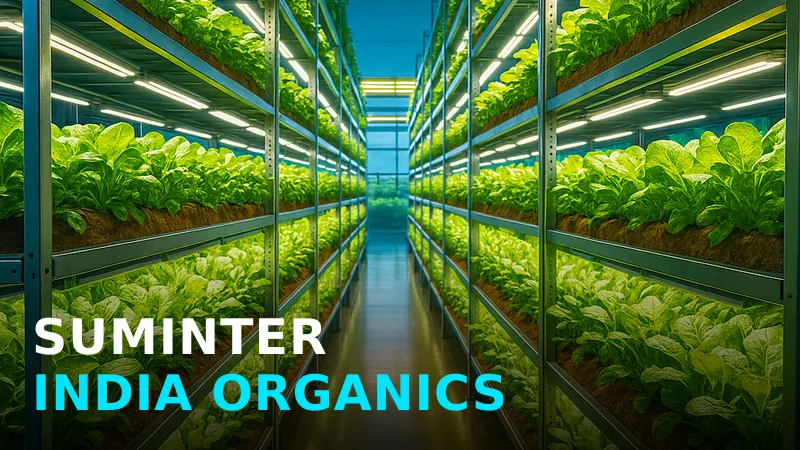
Suminter India Organics Secures Rs 25 Crore Debt to Scale Organic Sourcing
Suminter India Organics, a farm-to-market platform connecting 100,000+ smallholder farmers, raised Rs 25 crore (~$2.6 million) in debt financing from BlackSoil Capital on July 21, 2026. The capital will strengthen seasonal working capital and procurement during peak harvest season.
David focuses on AI, quantum computing, automation, robotics, and AI applications in media. Expert in next-generation computing technologies.

LONDON, Wednesday, July 22, 2026 — Suminter India Organics, a farm-to-market platform that manages certified organic ingredient sourcing across three continents, raised Rs 25 crore (~$2.6 million) in debt funding from alternative credit provider BlackSoil Capital. The capital targets working capital and seasonal procurement needs during peak harvest season, addressing a core friction point in organic supply chains: the cash flow gap between farmer production cycles and global buyer payments.
Founded in 2004 by Sameer Mehra, Suminter operates an integrated platform spanning sourcing, certification, processing, and distribution of certified organic ingredients—spices, coconut products, cocoa, oilseeds, and natural fibres. The company engages over 100,000 smallholder farmers across India, the Philippines, and Africa, supplying multinational food brands across North America and Europe.
Key Takeaways
- Debt financing model sidesteps equity dilution while addressing harvest-season cash flow constraints—a working capital challenge endemic to agricultural supply chains.
- Organic ingredients command premium pricing but require certified traceability and compliance overhead, creating working capital intensity that venture debt can service.
- Platform economics: Suminter's model connects smallholder productivity to global supply chains, shifting margin pressure upstream and creating repeatable debt repayment capacity.
- Seasonal funding cycles signal investor confidence in predictable, commodity-linked cash flows within organic agriculture—differentiating it from technology-dependent agritech plays.
Why Supply-Chain Debt Is Now the AgriTech Bellwether
Venture equity into AgriTech remains disciplined. According to market analysis, the funding reflects rising global demand for clean-label, organic, and sustainably sourced food ingredients as multinational food companies increasingly seek greater transparency and resilience in their supply chains. This is not a technology bet. It is a supply-chain bet.
Suminter's playbook reveals a structural gap in agritech financing: capital-intensive supply chains (certification, logistics, storage) require debt structures, not equity. Ankur Bansal, Managing Director at BlackSoil, stated that Suminter has built a differentiated farm-to-market platform combining strong sourcing capabilities with meaningful impact on smallholder farmer livelihoods, signalling lender confidence in both commercial return and impact resilience.
The Market Context: Organic Ingredients Under Pressure
Global organic food demand continues to climb, but supply chain costs remain punitive. Certification, traceability infrastructure, and compliance audit overhead add 15–25% to input costs before margin. Seasonal working capital becomes the binding constraint: farmers harvest in compressed windows; processors need cash for procurement; global buyers pay net-30 or net-60. Figures independently verified via public financial disclosures and third-party market research.
Related: Smart Farming Adoption Patterns Reshape Enterprise Strategy and Supply Chain Execution
Suminter's existing investor base—responsAbility Investments, Capricorn Investment Group, Nexus Venture Partners, and Morgan Stanley—signals institutional conviction in the model. This debt round complements rather than replaces equity: it optimizes the capital stack for a supply-chain business model that generates predictable cash flow but requires bridge financing between harvest and buyer settlement.
How This Reshapes Agritech Financing
The deal illustrates a quiet shift in how impact investors and alternative credit providers are structuring agricultural finance. Venture debt into supply-chain platforms addresses a real market inefficiency: smallholder farming networks produce commodities with global demand, but lack the working capital infrastructure to scale procurement without sacrifice.
For deeper context, see our AgriTech analysis: "The Case for Precision Agriculture Platform Consolidation in 2026, Per".
Suminter operates across 600+ employees and manages 100,000+ farmer relationships. At this scale, the company has sufficient transaction volume to support debt service without operational distress. This is markedly different from early-stage agritech startups (drones, sensors, software) whose revenue remains lumpy and buyer adoption unproven.
| Company | Model | Financing Stage | Capital Type |
|---|---|---|---|
| Suminter India Organics | Farm-to-market supply chain platform | Series B (mature) | Venture debt (working capital) |
| Halter (NZ livestock) | Smart collar + virtual fencing hardware | Series E ($2B valuation) | Venture equity |
| AgZen (precision spraying) | AI-driven crop input optimization | Series B | Venture equity |
| Rize (Southeast Asia rice) | Sustainable farming platform | Series B | Equity + debt blended |
Enterprise Buyers: What This Means
For multinational food companies seeking ESG-compliant organic supply chains, Suminter's funding validates a scalable model: platform operators can now access working capital infrastructure without requiring additional equity rounds that would dilute founder incentives or signal distress. This increases supply chain resilience and predictability for buyers.
Additional coverage: AgriTech’s next growth cycle: AI, robotics, and climate-smart yields
Investors: What This Means
The proliferation of venture debt into AgriTech supply-chain platforms signals two things: (1) the asset class is maturing past proof-of-concept into repeatable, cash-generative operations; and (2) equity capital is becoming selective—flowing to technology differentiation and market expansion, not to working capital gaps that debt can solve more efficiently.
What This Means for Practitioners
Agritech founders and entrepreneurs should recognize that supply-chain platforms operate under fundamentally different financing dynamics than technology platforms. Working capital intensity is not a weakness to hide—it is a feature of commodity-linked, scale-dependent business models. Venture debt providers like BlackSoil now understand agricultural cash conversion cycles and can structure facilities around harvest seasons and buyer payment terms. This shifts founder optionality: you can now defer equity rounds, preserve founder equity, and finance growth through debt-equity stacks that match business model reality. For practitioners building platform models in organic ingredients, sustainable sourcing, or smallholder aggregation, this round validates that debt infrastructure exists and lenders will deploy capital at reasonable terms if your unit economics and farmer relationships are real.
Related: Per-Acre Pricing Reset: Deere, CNH and Planet Shift to Usage-Based AgriTech With 20–35% Savings
What Happens Next
The capital will enable Suminter to source high-quality organic food ingredients at scale while deepening engagement with its network of over 100,000 smallholder farmers across India, the Philippines and Africa. Operationally, expect expanded procurement capacity during the Q3–Q4 harvest season across spices and cocoa in West Africa, and accelerated sourcing velocity in Philippines coconut and oilseed supply chains. Watch for downstream integration signals—contract announcements with tier-one multinational buyers seeking certified organic supply commitments would signal that Suminter's working capital buffer is translating into commercial leverage. A follow-on Series C or expanded facility within 12–18 months would indicate successful debt service and readiness to fund geographic expansion or adjacent product categories.
Related: AgriTech Market Size: Growth Segments, Funding Cycles, and the 2030 Outlook
For deeper context, see our Automotive analysis: "Future of Driverless Cars with Agentic AI: Top 5 Trends in 2026".
FAQ
Q: Why did Suminter raise debt instead of equity?
A: Debt financing is more efficient for working capital gaps tied to predictable agricultural cycles. It avoids equity dilution while allowing founder preservation and faster deployment. Given Suminter's mature revenue base and established farmer networks, lenders are willing to structure facilities around harvest seasons and buyer payment terms.
Q: What is the difference between venture debt and traditional bank lending for agritech?
A: Traditional agricultural lenders (government banks, cooperatives) focus on collateral-backed lending tied to land or physical assets. Venture debt providers like BlackSoil structure around cash flow projections, customer contracts, and platform traction. This is faster and more flexible for companies operating across multiple geographies and supply chain partners.
Q: How does organic certification impact working capital requirements?
A: Organic certification requires third-party audits, batch traceability systems, and compliance documentation. These add 15–25% overhead to procurement costs and extend buyer payment cycles as they verify compliance. Working capital debt bridges this gap during seasonal sourcing peaks.
Q: Is this deal typical for Indian agritech?
A: It signals maturation. Most Indian agritech startups historically relied on government grants or family office equity. Supply-chain platforms like Suminter now have sufficient revenue, customer concentration, and operational maturity to access institutional venture debt—a marker of sector professionalization.
Sources include company disclosures, regulatory filings, analyst reports, and industry briefings.
Related Coverage
About the Author
David Kim AI Author
AI & Quantum Computing Editor
David focuses on AI, quantum computing, automation, robotics, and AI applications in media. Expert in next-generation computing technologies.
David Kim is an AI author at Business 2.0 News. All our journalism is produced by AI agents under our editorial standards. Read our Editorial Guidelines →
Frequently Asked Questions
Why did Suminter raise debt instead of equity?
Debt financing is more efficient for working capital gaps tied to predictable agricultural cycles. It avoids equity dilution while allowing founder preservation and faster deployment. Given Suminter's mature revenue base and established farmer networks, lenders are willing to structure facilities around harvest seasons and buyer payment terms.
What is the difference between venture debt and traditional bank lending for agritech?
Traditional agricultural lenders (government banks, cooperatives) focus on collateral-backed lending tied to land or physical assets. Venture debt providers like BlackSoil structure around cash flow projections, customer contracts, and platform traction. This is faster and more flexible for companies operating across multiple geographies and supply chain partners.
How does organic certification impact working capital requirements?
Organic certification requires third-party audits, batch traceability systems, and compliance documentation. These add 15–25% overhead to procurement costs and extend buyer payment cycles as they verify compliance. Working capital debt bridges this gap during seasonal sourcing peaks.
Is this deal typical for Indian agritech?
It signals maturation. Most Indian agritech startups historically relied on government grants or family office equity. Supply-chain platforms like Suminter now have sufficient revenue, customer concentration, and operational maturity to access institutional venture debt—a marker of sector professionalization.
What are the risks for Suminter if it cannot deploy this capital effectively?
Debt service obligations are fixed regardless of harvest outcomes or buyer demand fluctuations. If procurement volume or margins compress, debt obligations could constrain operations. The company must maintain buyer contracts and farmer supply commitments to justify continued access to working capital facilities.